de Almeida Júlio Menta, Nunes Felipe Oliveira, Ceole Lígia Fernanda, Klimeck Tabata D'Maiella Freitas, da Cruz Letícia Alves, Tófoli Danilo, Borges Beatriz Santana, Garcez Walmir Silva, Tozetti Inês Aparecida, Medeiros Lia Carolina Soares, Garcez Fernanda Rodrigues, Ferreira Alda Maria Teixeira
Laboratório de Imunologia, Biologia Molecular e Bioensaios do Instituto de Biociências, Universidade Federal de Mato Grosso do Sul, Campo Grande, MS, Brazil.
Laboratório de Pesquisa de Produtos Naturais Bioativos do Instituto de Química, Universidade Federal de Mato Grosso do Sul, Campo Grande, MS, Brazil.
PLoS One. 2021 Jan 28;16(1):e0245882. doi: 10.1371/journal.pone.0245882. eCollection 2021.
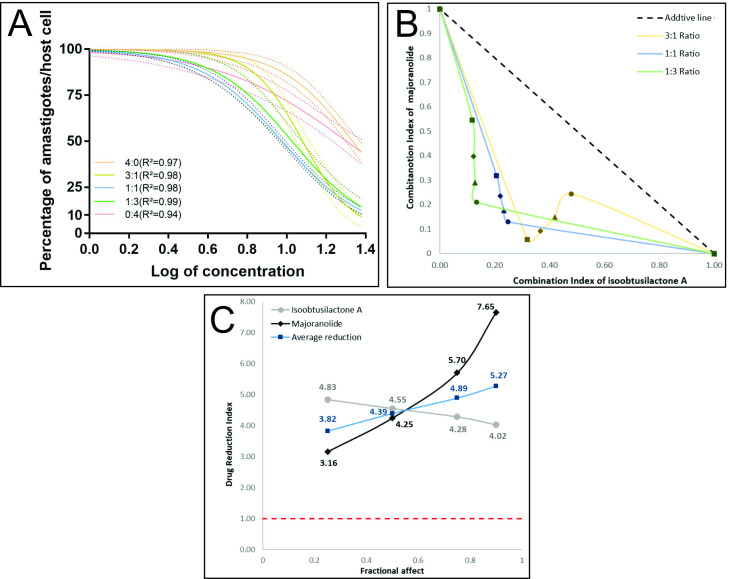
Butanolides have shown a variety of biological effects including anti-inflammatory, antibacterial, and antiprotozoal effects against certain strains of Trypanosoma cruzi. Considering the lack of an effective drug to treat T. cruzi infections and the prominent results obtained in literature with this class of lactones, we investigated the anti-T. cruzi activity of five butanolides isolated from two species of Lauraceae, Aiouea trinervis and Mezilaurus crassiramea. Initially, the activity of these compounds was evaluated on epimastigote forms of the parasite, after a treatment period of 4 h, followed by testing on amastigotes, trypomastigotes, and mammalian cells. Next, the synergistic effect of active butanolides against amastigotes was evaluated. Further, metacyclogenesis inhibition and infectivity assays were performed for the most active compound, followed by ultrastructural analysis of the treated amastigotes and trypomastigotes. Among the five butanolides studied, majoranolide and isoobtusilactone A were active against all forms of the parasite, with good selectivity indexes in Vero cells. Both butanolides were more active than the control drug against trypomastigote and epimastigote forms and also had a synergic effect on amastigotes. The most active compound, isoobtusilactone A, which showed activity against all tested strains inhibited metacyclogenesis and infection of new host cells. In addition, ultrastructural analysis revealed that this butanolide caused extensive damage to the mitochondria of both amastigotes and trypomastigotes, resulting in severe morphological changes in the infective forms of the parasite. Altogether, our results highlight the potential of butanolides against the etiologic agent of Chagas disease and the relevance of isoobtusilactone A as a strong anti-T. cruzi drug, affecting different events of the life cycle and all evolutionary forms of parasite after a short period of exposure.
丁内酯已显示出多种生物学效应,包括抗炎、抗菌以及对某些克氏锥虫菌株的抗原虫作用。鉴于缺乏治疗克氏锥虫感染的有效药物,且文献中这类内酯取得了显著成果,我们研究了从樟科的两种植物三叶艾奥乌木和粗枝密樟中分离出的五种丁内酯的抗克氏锥虫活性。最初,在处理4小时后,对这些化合物在寄生虫的无鞭毛体形式上的活性进行评估,随后对无鞭毛体、上鞭毛体和哺乳动物细胞进行测试。接下来,评估活性丁内酯对无鞭毛体的协同作用。此外,对活性最强的化合物进行了后循环抑制和感染性测定,随后对处理后的无鞭毛体和上鞭毛体进行了超微结构分析。在所研究的五种丁内酯中,大叶木兰内酯和异钝叶内酯A对寄生虫的所有形式均有活性,在Vero细胞中具有良好的选择性指数。这两种丁内酯对锥鞭毛体和无鞭毛体形式均比对照药物更具活性,并且对无鞭毛体也有协同作用。活性最强的化合物异钝叶内酯A对所有测试菌株均有活性,可抑制后循环和新宿主细胞的感染。此外,超微结构分析表明,这种丁内酯对无鞭毛体和锥鞭毛体的线粒体均造成了广泛损伤,导致寄生虫感染形式出现严重形态变化。总之,我们的结果突出了丁内酯对恰加斯病病原体的潜力以及异钝叶内酯A作为一种强效抗克氏锥虫药物的相关性,该药物在短时间暴露后会影响寄生虫生命周期的不同事件和所有进化形式。