Peking University Institute of Mental Health (Sixth Hospital) (QL, HZ, MZ, TL, XY, HW), NHC Key Laboratory of Mental Health, National Clinical Research Center for Mental Disorders, Beijing, China; Beijing Dementia Key Laboratory (QL, HZ, MZ, TL, XY, HW), Beijing, China.
Peking University Institute of Mental Health (Sixth Hospital) (QL, HZ, MZ, TL, XY, HW), NHC Key Laboratory of Mental Health, National Clinical Research Center for Mental Disorders, Beijing, China; Beijing Dementia Key Laboratory (QL, HZ, MZ, TL, XY, HW), Beijing, China; The Third Affiliated Hospital (MZ), Sun Yat-Sen University, Guangzhou, China.
Am J Geriatr Psychiatry. 2021 Jul;29(7):687-697. doi: 10.1016/j.jagp.2021.01.006. Epub 2021 Jan 19.
To investigate mental health status and associated factors among caregivers of older adults during the COVID-19 epidemic in China.
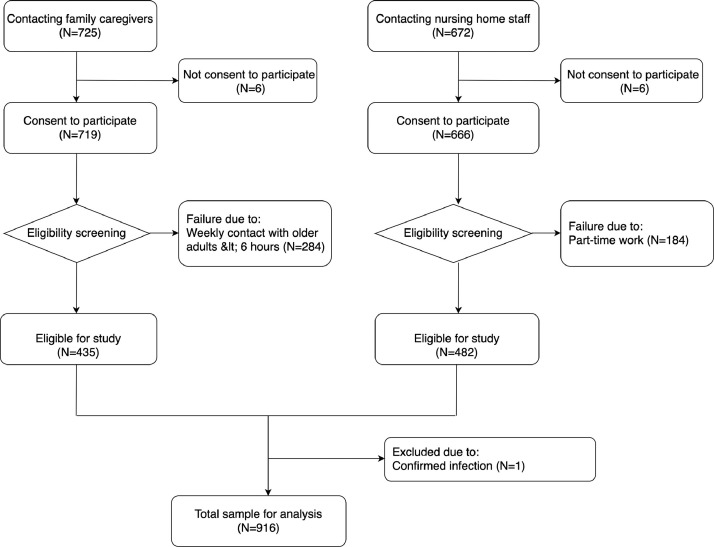
From March 1 to 31, 2020, 916 caregivers of older adults participated in an online cross-sectional survey on the prevalence of anxiety, depression, and sleep problems. The seven-item Generalized Anxiety Disorder Scale (GAD-7) was administered to measure anxiety symptoms, the two-item Patient Health Questionnaire (PHQ-2) was used to assess depressive symptoms, and a self-developed questionnaire was used to assess sleep quality and duration. Six questions about COVID-19-related experiences were used to assess community-level infection contact and the level of exposure to media information. The prevalence rates of anxiety, depression and sleep problems were computed. The Wald χ were applied to compare the differences between subgroups. Multiple logistic regression analyses were performed to investigate factors associated with anxiety, depression, sleep problems, and multimorbidity.
The prevalence rates of anxiety, depression, and sleep problems were 46.8%, 29.8%, and 10.8%, respectively. Approximately 263 participants (28.7%) presented with two or more mental health problems. Being female (OR, 2.254; 95% CI, 1.510-3.363), having community-level COVID-19 contact (OR, 1.856; 95% CI, 1.189-2.898), and having a mental disorder (OR, 3.610; 95% CI, 1.644-7.930) were associated with increased risk of multimorbidity among caregivers. Caregivers who preferred positive information (OR, 0.652; 95% CI, 0.472-0.899) had reduced risk of multimorbidity.
Anxiety and depression were common among caregivers of older adults during the COVID-19 epidemic. Being female and having community-level COVID-19 contact were independent risk factors for experiencing multiple mental health problems. Preexisting mental disorders increased the risk of multimorbidity among caregivers, while enhanced access to positive media information decreased the risk of multimorbidity.
调查 COVID-19 疫情期间中国老年照护者的心理健康状况及其相关因素。
2020 年 3 月 1 日至 31 日,916 名老年照护者参与了一项关于焦虑、抑郁和睡眠问题流行率的在线横断面调查。采用 7 项广泛性焦虑障碍量表(GAD-7)评估焦虑症状,采用 2 项患者健康问卷(PHQ-2)评估抑郁症状,采用自设问卷评估睡眠质量和时长。6 个与 COVID-19 相关的问题用于评估社区级感染接触和媒体信息的接触程度。计算焦虑、抑郁和睡眠问题的患病率。采用 Wald χ²检验比较亚组间的差异。采用多因素逻辑回归分析调查与焦虑、抑郁、睡眠问题和多种合并症相关的因素。
焦虑、抑郁和睡眠问题的患病率分别为 46.8%、29.8%和 10.8%。约 263 名参与者(28.7%)存在两种或多种心理健康问题。女性(OR=2.254;95%CI=1.510-3.363)、社区级 COVID-19 接触(OR=1.856;95%CI=1.189-2.898)和精神障碍(OR=3.610;95%CI=1.644-7.930)与照护者的多种合并症风险增加相关。偏好积极信息的照护者(OR=0.652;95%CI=0.472-0.899)多种合并症的风险降低。
COVID-19 疫情期间,老年照护者中焦虑和抑郁较为常见。女性和社区级 COVID-19 接触是经历多种心理健康问题的独立危险因素。既往精神障碍增加了照护者多种合并症的风险,而更多接触积极媒体信息降低了多种合并症的风险。