Adamcik Jozef, Ruggeri Francesco Simone, Berryman Joshua T, Zhang Afang, Knowles Tuomas P J, Mezzenga Raffaele
Department of Health Sciences and Technology ETH Zürich Zürich 8092 Switzerland.
Department of Chemistry University of Cambridge Lensfield Road Cambridge CB2 1EW UK.
Adv Sci (Weinh). 2020 Dec 11;8(2):2002182. doi: 10.1002/advs.202002182. eCollection 2021 Jan.
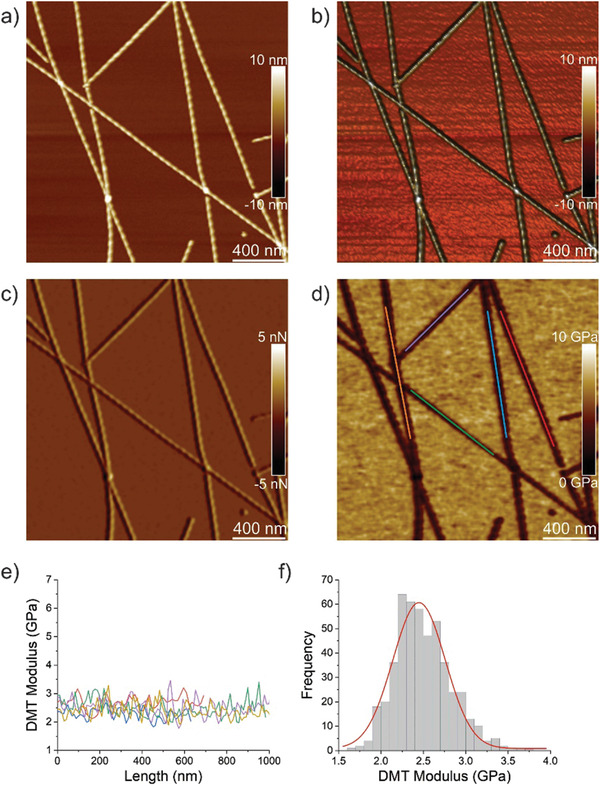
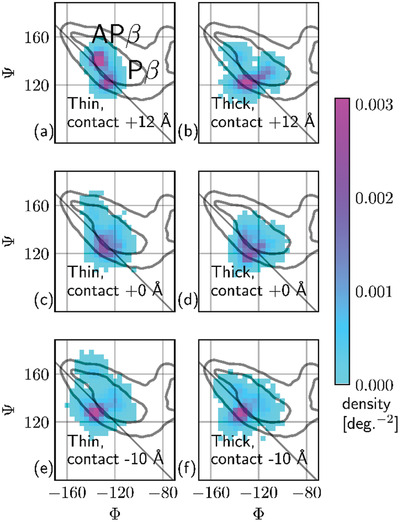
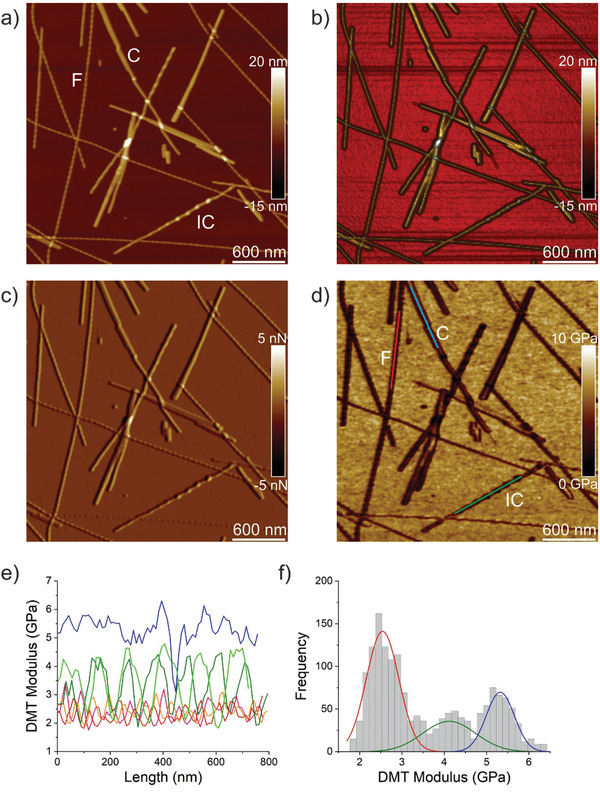
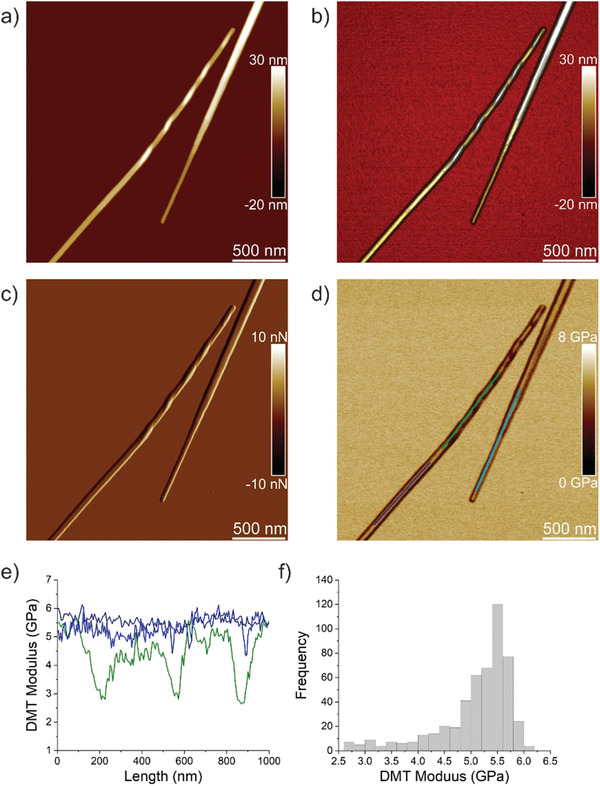
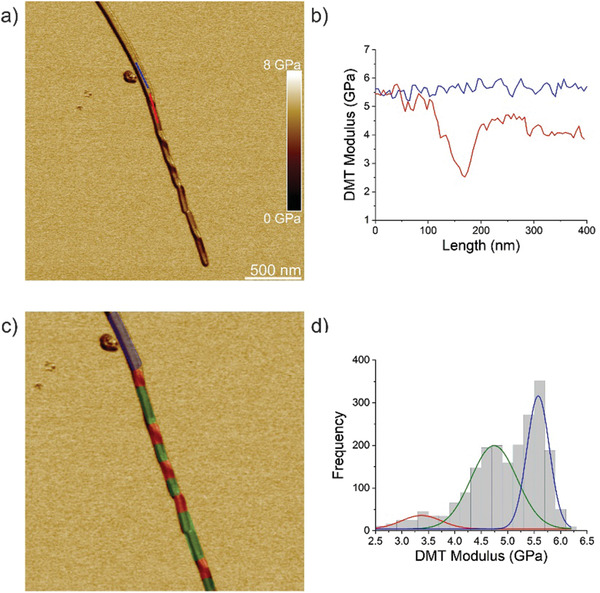
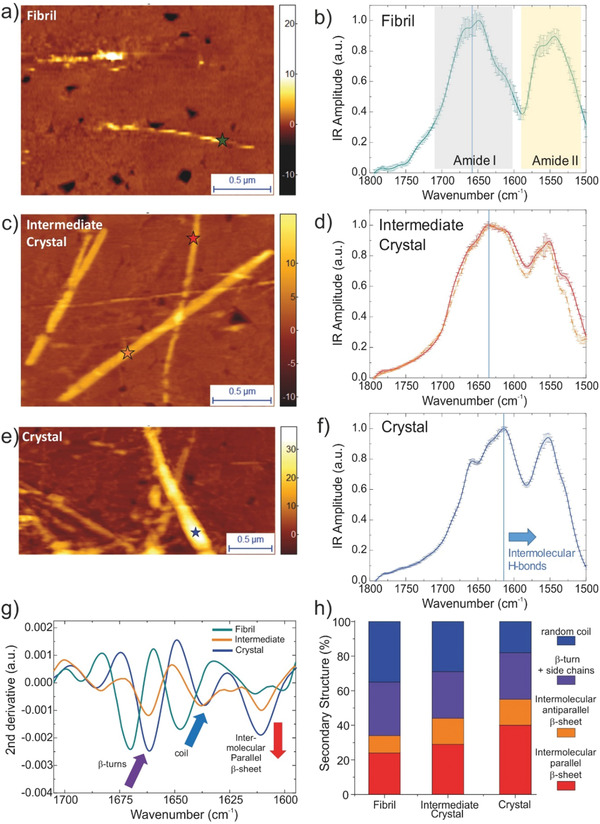
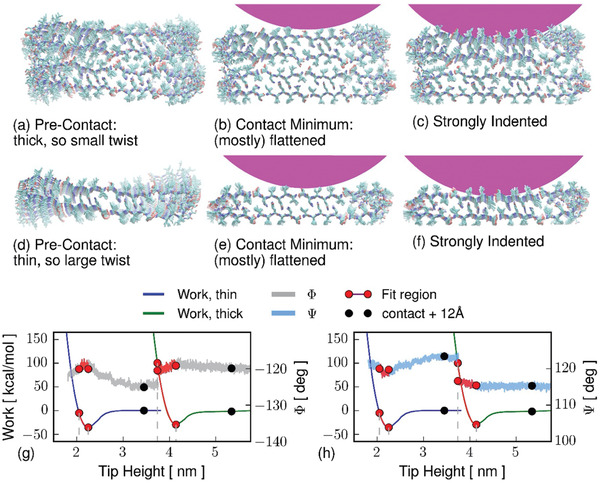
Nanomechanical properties of amyloid fibrils and nanocrystals depend on their secondary and quaternary structure, and the geometry of intermolecular hydrogen bonds. Advanced imaging methods based on atomic force microscopy (AFM) have unravelled the morphological and mechanical heterogeneity of amyloids, however a full understanding has been hampered by the limited resolution of conventional spectroscopic methods. Here, it is shown that single molecule nanomechanical mapping and infrared nanospectroscopy (AFM-IR) in combination with atomistic modelling enable unravelling at the single aggregate scale of the morphological, nanomechanical, chemical, and structural transition from amyloid fibrils to amyloid microcrystals in the hexapeptides, ILQINS, IFQINS, and TFQINS. Different morphologies have different Young's moduli, within 2-6 GPa, with amyloid fibrils exhibiting lower Young's moduli compared to amyloid microcrystals. The origins of this stiffening are unravelled and related to the increased content of intermolecular -sheet and the increased lengthscale of cooperativity following the transition from twisted fibril to flat nanocrystal. Increased stiffness in Young's moduli is correlated with increased density of intermolecular hydrogen bonding and parallel -sheet structure, which energetically stabilize crystals over the other polymorphs. These results offer additional evidence for the position of amyloid crystals in the minimum of the protein folding and aggregation landscape.
淀粉样纤维和纳米晶体的纳米力学性质取决于它们的二级和四级结构以及分子间氢键的几何结构。基于原子力显微镜(AFM)的先进成像方法揭示了淀粉样蛋白的形态和力学异质性,然而,传统光谱方法的有限分辨率阻碍了对其的全面理解。在此表明,单分子纳米力学映射和红外纳米光谱(AFM-IR)与原子模型相结合,能够在单个聚集体尺度上揭示六肽ILQINS、IFQINS和TFQINS中从淀粉样纤维到淀粉样微晶的形态、纳米力学、化学和结构转变。不同形态具有不同的杨氏模量,在2 - 6吉帕范围内,与淀粉样微晶相比,淀粉样纤维表现出较低的杨氏模量。这种硬化的起源得以揭示,并与分子间β-折叠含量的增加以及从扭曲纤维向扁平纳米晶体转变后协同作用长度尺度的增加有关。杨氏模量的增加刚度与分子间氢键密度和平行β-折叠结构的增加相关,这在能量上使晶体比其他多晶型更稳定。这些结果为淀粉样晶体在蛋白质折叠和聚集态势图最小值中的位置提供了额外证据。