Department of Medical, Surgical and Experimental Sciences, University of Sassari, Viale San Pietro 43, 07100, Sassari, Italy.
Discipline of Clinical Pharmacology, College of Medicine and Public Health, Flinders Medical Centre, Flinders University, Adelaide, Australia.
Clin Exp Med. 2021 Aug;21(3):343-354. doi: 10.1007/s10238-021-00686-z. Epub 2021 Jan 28.
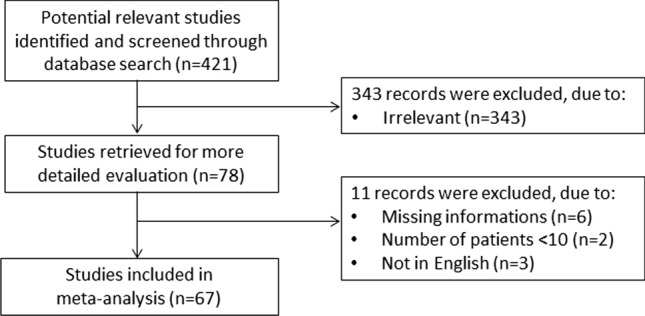
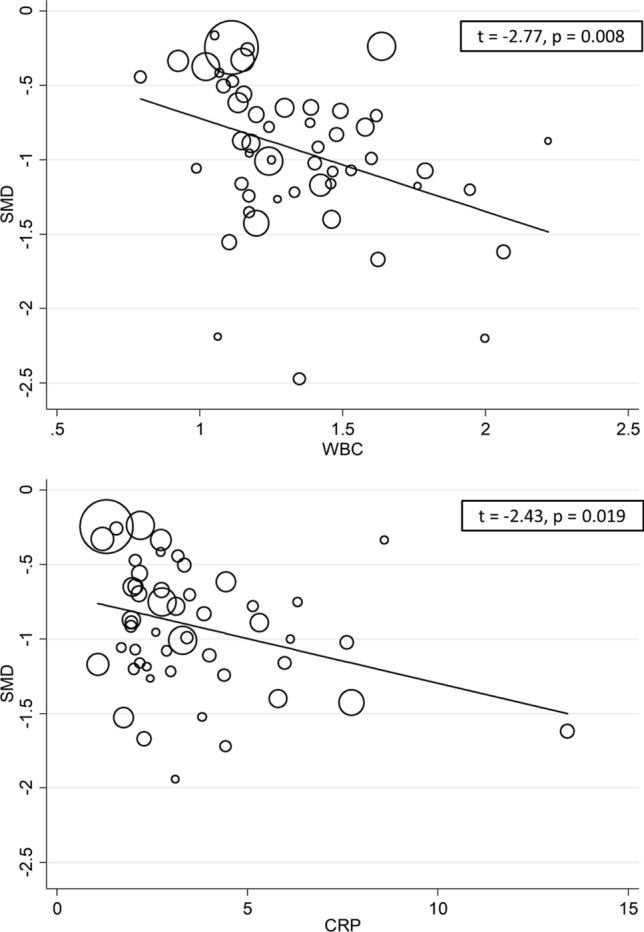
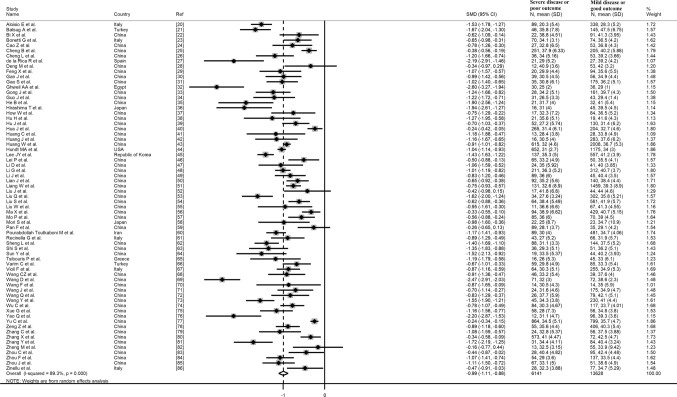
Coronavirus disease 2019 (COVID-19), an infectious disease caused by the severe acute respiratory syndrome coronavirus 2 (SARS-CoV-2), is responsible for the most threatening pandemic in modern history. The aim of this systematic review and meta-analysis was to investigate the associations between serum albumin concentrations and COVID-19 disease severity and adverse outcomes. A systematic literature search was conducted in PubMed, from inception to October 30, 2020. Sixty-seven studies in 19,760 COVID-19 patients (6141 with severe disease or poor outcome) were selected for analysis. Pooled results showed that serum albumin concentrations were significantly lower in patients with severe disease or poor outcome (standard mean difference, SMD: - 0.99 g/L; 95% CI, - 1.11 to - 0.88, p < 0.001). In multivariate meta-regression analysis, age (t = - 2.13, p = 0.043), publication geographic area (t = 2.16, p = 0.040), white blood cell count (t = - 2.77, p = 0.008) and C-reactive protein (t = - 2.43, p = 0.019) were significant contributors of between-study variance. Therefore, lower serum albumin concentrations are significantly associated with disease severity and adverse outcomes in COVID-19 patients. The assessment of serum albumin concentrations might assist with early risk stratification and selection of appropriate care pathways in this group.
新型冠状病毒病(COVID-19)是一种由严重急性呼吸综合征冠状病毒 2(SARS-CoV-2)引起的传染病,是现代历史上最具威胁性的大流行疾病。本系统评价和荟萃分析旨在探讨血清白蛋白浓度与 COVID-19 疾病严重程度和不良结局之间的关系。我们对 PubMed 进行了系统的文献检索,检索时间从建库到 2020 年 10 月 30 日。共纳入了 67 项研究的 19760 例 COVID-19 患者(6141 例患者患有严重疾病或预后不良),用于分析。汇总结果表明,严重疾病或预后不良患者的血清白蛋白浓度明显较低(标准化均数差值,SMD:-0.99 g/L;95%置信区间,-1.11 至-0.88,p < 0.001)。多元荟萃回归分析显示,年龄(t =-2.13,p =0.043)、发表地理区域(t =2.16,p =0.040)、白细胞计数(t =-2.77,p =0.008)和 C 反应蛋白(t =-2.43,p =0.019)是研究间变异的显著影响因素。因此,血清白蛋白浓度较低与 COVID-19 患者的疾病严重程度和不良结局显著相关。评估血清白蛋白浓度可能有助于对该人群进行早期风险分层和选择适当的治疗途径。