Kosar Cyrus M, Rahman Momotazur
Department of Health Services, Policy & Practice, Brown University School of Public Health, Providence, RI, USA.
Center for Gerontology and Healthcare Research, Brown University, Providence, RI, USA.
J Gen Intern Med. 2021 Apr;36(4):990-997. doi: 10.1007/s11606-020-06518-2. Epub 2021 Jan 28.
Severe acute respiratory syndrome coronavirus 2 (SARS-CoV-2) outbreaks have become common in large nursing homes, placing not only residents but also staff and community members at risk for infection. However, the relationship between larger nursing homes and the community spread of SARS-CoV-2 has not yet been documented.
To examine the association between county average nursing home bed size and presence of certificate of need (CON) laws, which influence nursing home size, with county-level SARS-CoV-2 prevalence over time.
Cross-sectional study using county-level data from March 11 through June 12, 2020.
All US counties with at least one nursing home (n = 2,883).
The main explanatory variables were county average nursing home bed size and presence of a CON law. The main outcome was the cumulative number of SARS-CoV-2 cases on each day of the study period adjusted for county population size and density, demographic and socioeconomic characteristics, total nursing home bed supply, other health care supply measures, epidemic stage, and census region.
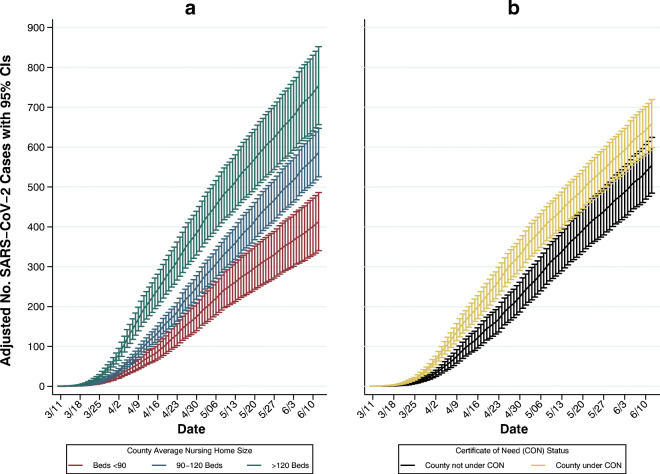
By June 12, a between-county difference in average nursing home size equal to 1 bed was associated with 3.92 additional SARS-COV-2 cases (95% CI = 2.14 to 5.69; P < 0.001), on average, and counties subject to CON laws had 104.53 additional SARS-CoV-2 cases (95% CI = 7.68 to 201.38; P < 0.05), on average. Counties with larger nursing homes also demonstrated higher growth in the frequency of SARS-COV-2 throughout the study period.
At the county level, average nursing home size and CON law presence was associated with a greater frequency of SARS-CoV-2 cases. Controlling the impact of the coronavirus 2019 pandemic may require additional resources for communities with larger nursing homes and more attention towards long-term care policies.
严重急性呼吸综合征冠状病毒2(SARS-CoV-2)疫情在大型养老院中已很常见,这不仅使居民,也使工作人员和社区成员面临感染风险。然而,大型养老院与SARS-CoV-2社区传播之间的关系尚未得到记录。
研究县平均养老院床位规模以及影响养老院规模的需求证书(CON)法律的存在与县级SARS-CoV-2随时间推移的患病率之间的关联。
采用2020年3月11日至6月12日的县级数据进行横断面研究。
所有至少有一家养老院的美国县(n = 2883)。
主要解释变量为县平均养老院床位规模和CON法律的存在。主要结果是在研究期间每天经县人口规模和密度、人口统计学和社会经济特征、养老院床位总供给、其他医疗保健供给措施、疫情阶段和普查区域调整后的SARS-CoV-2病例累计数。
到6月12日,县平均养老院规模每相差1张床位,平均会多出现3.92例SARS-CoV-2病例(95%置信区间 = 2.14至5.69;P < 0.001),并且受CON法律约束的县平均多出现104.53例SARS-CoV-2病例(95%置信区间 = 7.68至201.38;P < 0.05)。在整个研究期间,养老院规模较大的县SARS-CoV-2的发病频率增长也更高。
在县级层面,平均养老院规模和CON法律的存在与SARS-CoV-2病例的更频繁出现相关。控制2019冠状病毒病大流行的影响可能需要为养老院规模较大的社区提供额外资源,并更加关注长期护理政策。