Springer Jason M, Kalot Mohamad A, Husainat Nedaa M, Byram Kevin W, Dua Anisha B, James Karen E, Chang Lin Yih, Turgunbaev Marat, Villa-Forte Alexandra, Abril Andy, Langford Carol A, Maz Mehrdad, Chung Sharon A, Mustafa Reem A
Vanderbilt University Medical Center, Nashville.
State University of New York at Buffalo.
ACR Open Rheumatol. 2021 Feb;3(2):101-110. doi: 10.1002/acr2.11194. Epub 2021 Jan 29.
Eosinophilic granulomatosis with polyangiitis (EGPA) is part of a group of vasculitides commonly referred to as antineutrophil cytoplasmic antibody (ANCA)-associated vasculitis (AAV), in addition to granulomatosis with polyangiitis (GPA), microscopic polyangiitis (MPA), and renal-limited vasculitis. Patients with EGPA characteristically have asthma and marked peripheral eosinophilia with only approximately 30% to 35% of patients being myeloperoxidase (MPO)-ANCA positive, distinguishing it from other forms of AAV (1,2). The aim of this systematic review is to support the development of the American College of Rheumatology/Vasculitis Foundation guideline for the management of EGPA.
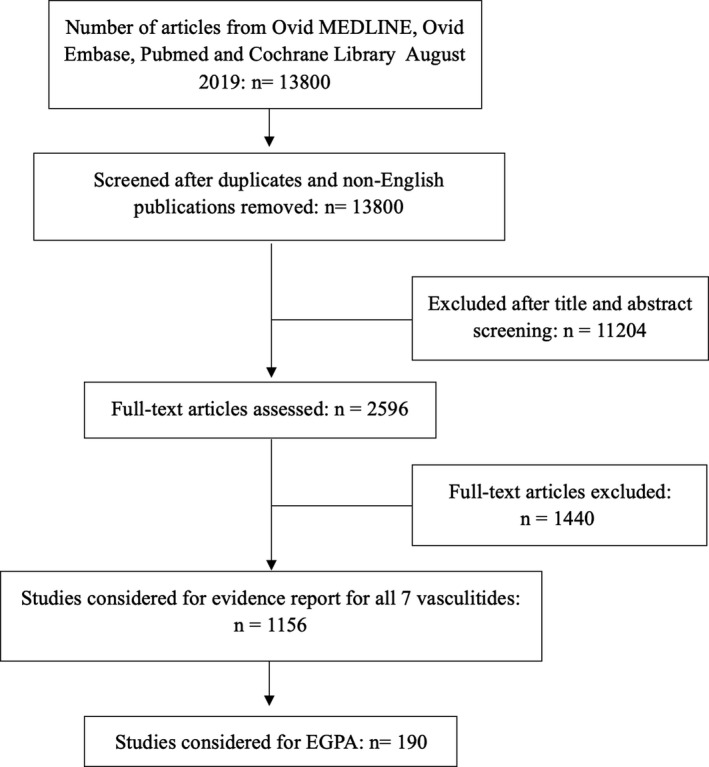
A systematic review was conducted of the literature for seven forms of primary systemic vasculitis (GPA, MPA, EGPA, polyarteritis nodosa, Kawasaki disease, giant cell arteritis, and Takayasu arteritis). The search was done for articles in English using Ovid Medline, PubMed, Embase, and the Cochrane Library. Articles were screened for suitability in addressing population/patients, intervention, comparator, and outcomes (PICO) questions, with studies presenting the highest level of evidence given preference. Two independent reviewers conducted a title/abstract screen and full-text review for each eligible study.
The initial search, conducted in August 2019, included 13 800 articles, of which 2596 full-text articles were reviewed. There were 190 articles (addressing 34 PICO questions) reporting on the diagnosis and management of EGPA.
This comprehensive systematic review synthesizes and evaluates the accuracy of commonly used tests for EGPA as well as benefits and toxicities of different treatment options.
嗜酸性肉芽肿性多血管炎(EGPA)是一组血管炎的一部分,通常被称为抗中性粒细胞胞浆抗体(ANCA)相关性血管炎(AAV),此外还包括肉芽肿性多血管炎(GPA)、显微镜下多血管炎(MPA)和局限于肾脏的血管炎。EGPA患者的特征是患有哮喘和明显的外周血嗜酸性粒细胞增多,只有约30%至35%的患者髓过氧化物酶(MPO)-ANCA呈阳性,这使其有别于其他形式的AAV(1,2)。本系统评价的目的是支持美国风湿病学会/血管炎基金会制定EGPA管理指南。
对七种原发性系统性血管炎(GPA、MPA、EGPA、结节性多动脉炎、川崎病、巨细胞动脉炎和高安动脉炎)的文献进行了系统评价。使用Ovid Medline、PubMed、Embase和Cochrane图书馆检索英文文章。筛选文章是否适合解决人群/患者、干预措施、对照和结局(PICO)问题,优先选择提供最高证据水平的研究。两名独立评审员对每项符合条件的研究进行标题/摘要筛选和全文评审。
2019年8月进行的初步检索共纳入13800篇文章,其中2596篇全文文章接受了评审。有190篇文章(涉及34个PICO问题)报告了EGPA的诊断和管理情况。
这项全面的系统评价综合并评估了EGPA常用检测方法的准确性以及不同治疗方案的益处和毒性。