Center for Colorectal Disease, St Vincent's University Hospital, Dublin 4, Ireland.
National Screening Service, Kings Inn House, Dublin 1, Ireland.
Clin Transl Gastroenterol. 2021 Jan 12;12(1):e00277. doi: 10.14309/ctg.0000000000000277.
Fecal immunochemical testing (FIT) positivity is determined by a threshold decided by individual screening programs. Data are limited on correlation between FIT levels and pathology identified at colonoscopy. Our aim was to examine the correlation between FIT levels and pathology identified in a national colorectal cancer screening program.
FIT levels (n = 9,271) were analyzed and correlated with patient demographics and pathology identified, including adenomas, sessile serrated lesions, number/size of adenomas, and presence of dysplasia. Levels were divided into 2 categories: FIT levels were defined as "high" or "low" based on whether they were above or below the median (479 ngHb/mL). Multivariate analysis was performed.
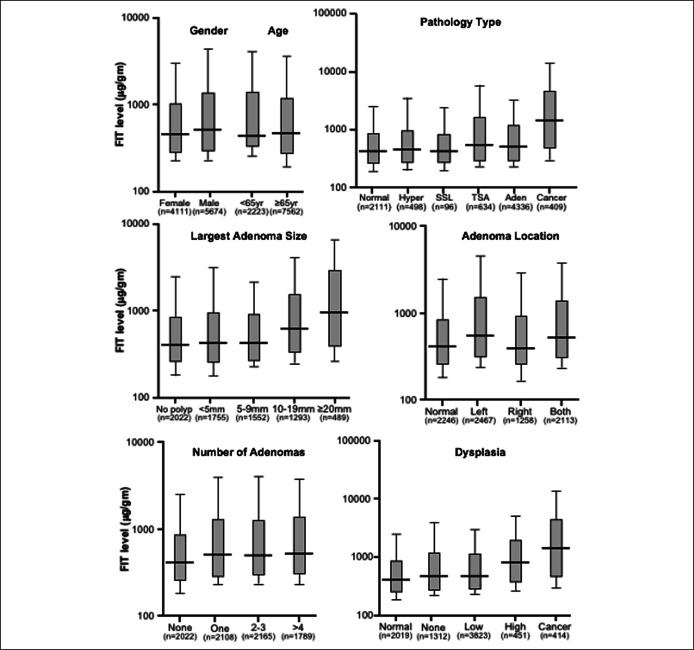
A total of 8,084 patients (87%) underwent colonoscopy. Those younger than 65 years (odds ratio [OR] 1.267, 95% confidence interval [CI] 1.107-1.45, P = 0.001), those with an adenoma >10 mm (OR 1.736, 95% CI 01.512-1.991, P < 0.001), and those with left-sided adenomas (OR 1.484, 95% CI 1.266-1.74, P < 0.001) had higher FIT levels. Cancers (OR 2.8, 95% CI 2.09-3.75, P < 0.001) and high-grade dysplasia (OR 1.356, 95% CI 1.08-1.7, P = 0.008) had higher FIT levels, but varied greatly. The number of adenomas was not significant.
In this study, FIT levels were high for left-sided and large adenomas, suggesting that FIT has poor sensitivity for detection of diminutive and right-sided neoplasia. FIT levels had no association with gender and declined with age. Adenoma burden did not correlate with FIT levels; this is a novel finding. FIT levels vary greatly even in those with advanced neoplasia; therefore, FIT is unlikely to be useful as a risk stratification tool.
粪便免疫化学检测(FIT)的阳性结果由各个筛查项目确定的阈值决定。目前有关 FIT 水平与结肠镜检查中发现的病理学之间相关性的数据有限。我们的目的是研究全国结直肠癌筛查项目中 FIT 水平与病理学之间的相关性。
分析了 9271 例 FIT 水平,并将其与患者的人口统计学特征和病理学特征进行了相关性分析,包括腺瘤、无蒂锯齿状病变、腺瘤的数量/大小以及是否存在异型增生。水平分为 2 类:根据是否高于或低于中位数(479ngHb/mL),将 FIT 水平定义为“高”或“低”。进行了多变量分析。
共有 8084 例患者(87%)接受了结肠镜检查。年龄小于 65 岁的患者(比值比 [OR] 1.267,95%置信区间 [CI] 1.107-1.45,P = 0.001)、腺瘤>10mm 的患者(OR 1.736,95%CI 01.512-1.991,P<0.001)和左半结肠腺瘤患者(OR 1.484,95%CI 1.266-1.74,P<0.001)的 FIT 水平较高。癌症(OR 2.8,95%CI 2.09-3.75,P<0.001)和高级别异型增生(OR 1.356,95%CI 1.08-1.7,P = 0.008)的 FIT 水平较高,但差异很大。腺瘤的数量没有显著相关性。
在这项研究中,左半结肠和大腺瘤的 FIT 水平较高,表明 FIT 对检测微小和右半结肠肿瘤的敏感性较差。FIT 水平与性别无关,且随年龄增长而下降。腺瘤负担与 FIT 水平无关;这是一个新的发现。即使在有进展性肿瘤的患者中,FIT 水平也差异很大;因此,FIT 不太可能作为一种风险分层工具。