Gavin Herbert Eye Institute, University of California Irvine, Irvine, CA, United States of America.
Institute for Mathematical Behavioral Science, University of California Irvine, Irvine, CA, United States of America.
PLoS One. 2021 Jan 29;16(1):e0246114. doi: 10.1371/journal.pone.0246114. eCollection 2021.
Mitochondrial (mt) DNA damage is associated with age-related macular degeneration (AMD) and other human aging diseases. This study was designed to quantify and characterize mtDNA low-frequency heteroplasmy single nucleotide polymorphisms (SNPs) of three different tissues isolated from AMD subjects using Next Generation Sequencing (NGS) technology.
DNA was extracted from neural retina, [RPE+choroid] and blood from three deceased age-related macular degeneration (AMD) subjects. Entire mitochondrial genomes were analyzed for low-frequency heteroplasmy SNPs using NGS technology that independently sequenced both mtDNA strands. This deep sequencing method (average sequencing depth of 30,000; range 1,000-100,000) can accurately differentiate low-frequency heteroplasmy SNPs from DNA modification artifacts. Twenty-three 'hot-spot' heteroplasmy mtDNA SNPs were analyzed in 222 additional blood samples.
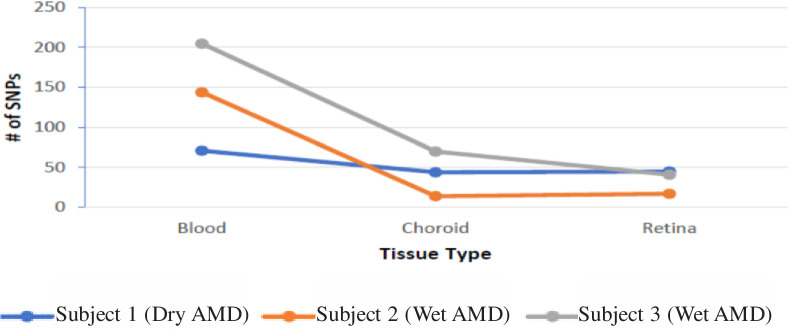
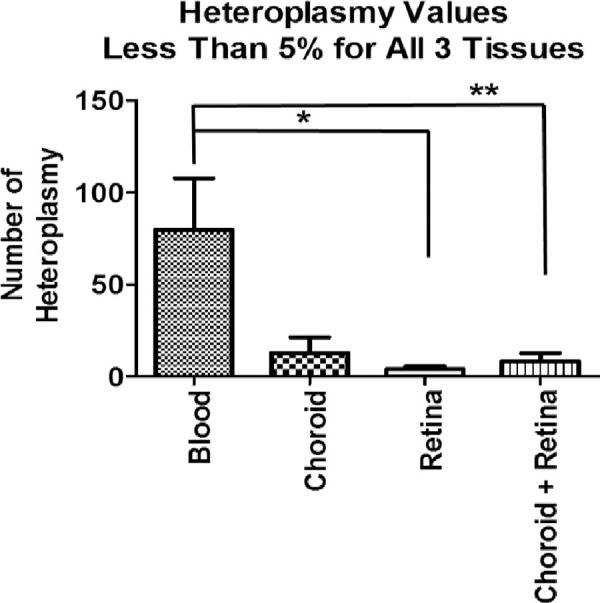
Germline homoplasmy SNPs that defined mtDNA haplogroups were consistent in the three tissues of each subject. Analyses of SNPs with <40% heteroplasmy revealed the blood had significantly greater numbers of heteroplasmy SNPs than retina alone (p≤0.05) or retina+choroid combined (p = 0.008). Twenty-three 'hot-spot' mtDNA heteroplasmy SNPs were present, with three being non-synonymous (amino acid change). Four 'hot-spot' heteroplasmy SNPs (m.1120C>T, m.1284T>C, m.1556C>T, m.7256C>T) were found in additional samples (n = 222). Five heteroplasmy SNPs (m.4104A>G, m.5320C>T, m.5471G>A, m.5474A>G, m.5498A>G) declined with age. Two heteroplasmy SNPs (m.13095T>C, m.13105A>G) increased in AMD compared to Normal samples. In the heteroplasmy SNPs, very few transversion mutations (purine to pyrimidine or vice versa, associated with oxidative damage) were found and the majority were transition changes (purine to purine or pyrimidine to pyrimidine, associated with replication errors).
Within an individual, the blood, retina and [RPE+choroid] contained identical homoplasmy SNPs representing inherited germline mtDNA haplogroup. NGS methodology showed significantly more mtDNA heteroplasmy SNPs in blood compared to retina and [RPE+choroid], suggesting the latter tissues have substantial protection. Significantly higher heteroplasmy levels of m.13095T>C and m.13105A>G may represent potential AMD biomarkers. Finally, high levels of transition mutations suggest that accumulation of heteroplasmic SNPs may occur through replication errors rather than oxidative damage.
线粒体 (mt) DNA 损伤与年龄相关性黄斑变性 (AMD) 和其他人类衰老疾病有关。本研究旨在使用下一代测序 (NGS) 技术定量和表征从 AMD 患者中分离的三种不同组织中的 mtDNA 低频异质性单核苷酸多态性 (SNP)。
从三名已故年龄相关性黄斑变性 (AMD) 患者的神经视网膜、[RPE+脉络膜]和血液中提取 DNA。使用 NGS 技术独立地对两条 mtDNA 链进行测序,分析低频异质性 SNP 的整个线粒体基因组。这种深度测序方法(平均测序深度为 30,000;范围为 1,000-100,000)可以准确地区分低频异质性 SNP 与 DNA 修饰伪影。在 222 份额外的血液样本中分析了 23 个“热点”异质性 mtDNA SNP。
每个受试者的三种组织中都存在定义 mtDNA 单倍型的种系同质性 SNP。分析异质性低于 40%的 SNP 表明,血液中的异质性 SNP 数量明显多于单独的视网膜(p≤0.05)或视网膜+脉络膜的组合(p=0.008)。存在 23 个“热点”mtDNA 异质性 SNP,其中 3 个是非同义的(氨基酸变化)。在另外的样本(n=222)中发现了四个“热点”异质性 SNP(m.1120C>T、m.1284T>C、m.1556C>T、m.7256C>T)。另外 5 个异质性 SNP(m.4104A>G、m.5320C>T、m.5471G>A、m.5474A>G、m.5498A>G)随年龄下降。与正常样本相比,AMD 中两个异质性 SNP(m.13095T>C、m.13105A>G)增加。在异质性 SNP 中,发现很少的颠换突变(嘌呤到嘧啶或反之,与氧化损伤有关),大多数是转换突变(嘌呤到嘌呤或嘧啶到嘧啶,与复制错误有关)。
在个体内,血液、视网膜和[RPE+脉络膜]中存在相同的同质性 SNP,代表遗传的种系 mtDNA 单倍型。NGS 方法显示,血液中的 mtDNA 异质性 SNP 明显多于视网膜和[RPE+脉络膜],这表明后两种组织具有显著的保护作用。m.13095T>C 和 m.13105A>G 的异质性水平显著升高,可能代表潜在的 AMD 生物标志物。最后,高水平的转换突变表明,异质 SNP 的积累可能是通过复制错误而不是氧化损伤发生的。