Gómez-Cebrián Nuria, Rojas-Benedicto Ayelén, Albors-Vaquer Arturo, Bellosillo Beatriz, Besses Carlos, Martínez-López Joaquín, Pineda-Lucena Antonio, Puchades-Carrasco Leonor
Drug Discovery Unit, Instituto de Investigación Sanitaria La Fe, 46026 Valencia, Spain.
Department of Pathology, Hospital Del Mar Medical Research Institute, 08003 Barcelona, Spain.
Cancers (Basel). 2021 Jan 27;13(3):482. doi: 10.3390/cancers13030482.
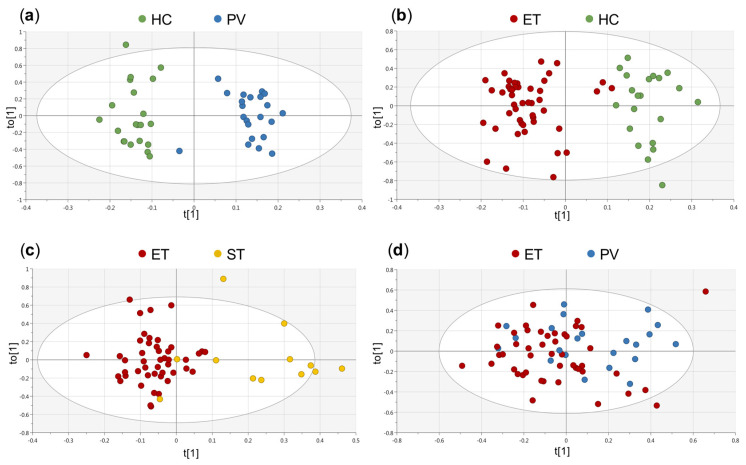
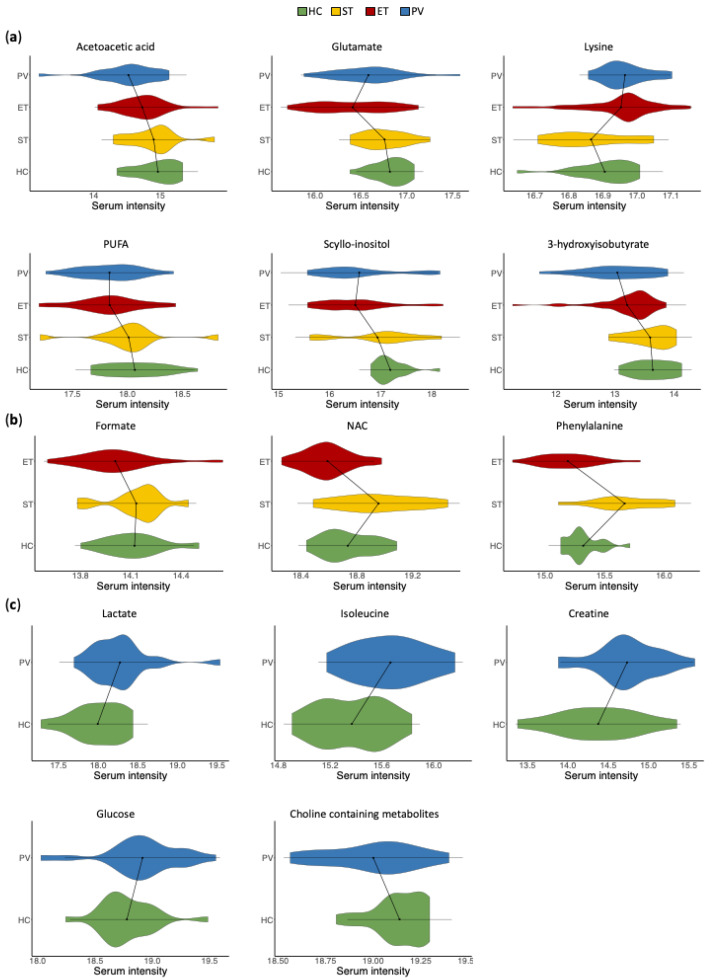
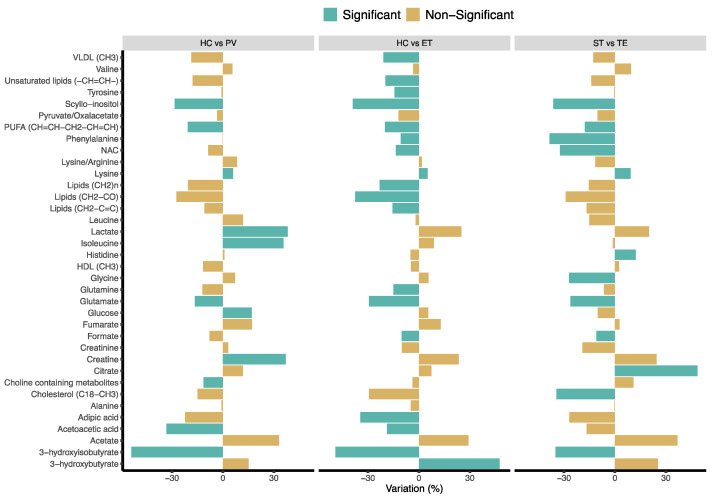
Most common myeloproliferative neoplasms (MPNs) include polycythemia vera (PV) and essential thrombocythemia (ET). Accurate diagnosis of these disorders remains a clinical challenge due to the lack of specific clinical or molecular features in some patients enabling their discrimination. Metabolomics has been shown to be a powerful tool for the discrimination between different hematological diseases through the analysis of patients' serum metabolic profiles. In this pilot study, the potential of NMR-based metabolomics to characterize the serum metabolic profile of MPNs patients (PV, ET), as well as its comparison with the metabolic profile of healthy controls (HC) and secondary thrombocytosis (ST) patients, was assessed. The metabolic profile of PV and ET patients, compared with HC, exhibited higher levels of lysine and decreased levels of acetoacetic acid, glutamate, polyunsaturated fatty acids (PUFAs), scyllo-inositol and 3-hydroxyisobutyrate. Furthermore, ET patients, compared with HC and ST patients, were characterized by decreased levels of formate, N-acetyl signals from glycoproteins (NAC) and phenylalanine, while the serum profile of PV patients, compared with HC, showed increased concentrations of lactate, isoleucine, creatine and glucose, as well as lower levels of choline-containing metabolites. The overall analysis revealed significant metabolic alterations mainly associated with energy metabolism, the TCA cycle, along with amino acid and lipid metabolism. These results underscore the potential of metabolomics for identifying metabolic alterations in the serum of MPNs patients that could contribute to improving the clinical management of these diseases.
大多数常见的骨髓增殖性肿瘤(MPN)包括真性红细胞增多症(PV)和原发性血小板增多症(ET)。由于一些患者缺乏能够区分这些疾病的特异性临床或分子特征,因此对这些疾病进行准确诊断仍然是一项临床挑战。代谢组学已被证明是一种通过分析患者血清代谢谱来区分不同血液系统疾病的强大工具。在这项初步研究中,评估了基于核磁共振(NMR)的代谢组学对MPN患者(PV、ET)血清代谢谱进行特征分析的潜力,以及将其与健康对照(HC)和继发性血小板增多症(ST)患者的代谢谱进行比较的情况。与HC相比,PV和ET患者的代谢谱显示赖氨酸水平较高,而乙酰乙酸、谷氨酸、多不饱和脂肪酸(PUFA)、异肌醇和3-羟基异丁酸水平降低。此外,与HC和ST患者相比,ET患者的特征在于甲酸、糖蛋白的N-乙酰信号(NAC)和苯丙氨酸水平降低,而与HC相比,PV患者的血清谱显示乳酸、异亮氨酸、肌酸和葡萄糖浓度升高,以及含胆碱代谢物水平降低。总体分析揭示了主要与能量代谢、三羧酸循环以及氨基酸和脂质代谢相关的显著代谢改变。这些结果强调了代谢组学在识别MPN患者血清中代谢改变方面的潜力,这可能有助于改善这些疾病的临床管理。