Institute of Surgical Pathology, Faculty of Medicine, Medical Center - University of Freiburg, Freiburg, Germany.
Department of Medicine IV, Faculty of Medicine, Medical Center - University of Freiburg, Freiburg, Germany.
J Am Soc Nephrol. 2021 Mar;32(3):563-579. doi: 10.1681/ASN.2020081126. Epub 2021 Jan 29.
Previous research demonstrated that small Rho GTPases, modulators of the actin cytoskeleton, are drivers of podocyte foot-process effacement in glomerular diseases, such as FSGS. However, a comprehensive understanding of the regulatory networks of small Rho GTPases in podocytes is lacking.
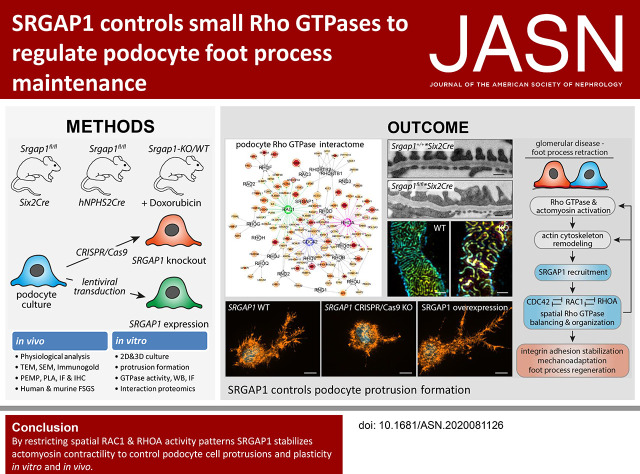
We conducted an analysis of podocyte transcriptome and proteome datasets for Rho GTPases; mapped , podocyte-specific Rho GTPase affinity networks; and examined conditional knockout mice and murine disease models targeting . To evaluate podocyte foot-process morphology, we used super-resolution microscopy and electron microscopy; proximity ligation assays were used to determine the subcellular localization of the small GTPase-activating protein SRGAP1. We performed functional analysis of CRISPR/Cas9-generated knockout podocytes in two-dimensional and three-dimensional cultures and quantitative interaction proteomics.
We demonstrated SRGAP1 localization to podocyte foot processes and to cellular protrusions . but not knockout mice developed an FSGS-like phenotype at adulthood. Podocyte-specific deletion of by resulted in increased susceptibility to doxorubicin-induced nephropathy. Detailed analysis demonstrated significant effacement of podocyte foot processes. Furthermore, -knockout podocytes showed excessive protrusion formation and disinhibition of the small Rho GTPase machinery . Evaluation of a SRGAP1-dependent interactome revealed the involvement of SRGAP1 with protrusive and contractile actin networks. Analysis of glomerular biopsy specimens translated these findings toward human disease by displaying a pronounced redistribution of SRGAP1 in FSGS.
SRGAP1, a podocyte-specific RhoGAP, controls podocyte foot-process architecture by limiting the activity of protrusive, branched actin networks. Therefore, elucidating the complex regulatory small Rho GTPase affinity network points to novel targets for potentially precise intervention in glomerular diseases.
先前的研究表明,调节细胞骨架肌动蛋白的小 Rho GTPases 是肾小球疾病(如 FSGS)中足细胞足突消失的驱动因素。然而,我们对小 Rho GTPases 在足细胞中的调控网络还缺乏全面的了解。
我们对 Rho GTPase 的足细胞转录组和蛋白质组数据集进行了分析;绘制了,足细胞特异性 Rho GTPase 亲和力网络;并检查了针对的条件性基因敲除小鼠和鼠疾病模型。为了评估足细胞足突形态,我们使用了超分辨率显微镜和电子显微镜;使用邻近连接分析来确定小 GTP 酶激活蛋白 SRGAP1 的亚细胞定位。我们在二维和三维培养物中对 CRISPR/Cas9 生成的进行了功能分析,并进行了定量相互作用蛋白质组学分析。
我们证明了 SRGAP1 定位于足细胞足突和细胞突起。然而,在成年时,缺失并没有导致 FSGS 样表型。通过 导致的足细胞特异性缺失增加了对阿霉素诱导的肾病的易感性。详细分析表明,足细胞足突明显消失。此外, - 敲除的足细胞表现出过度的突起形成和小 Rho GTPase 机制的失抑制。对 SRGAP1 依赖性相互作用组的评估表明,SRGAP1 与突起和收缩肌动蛋白网络有关。对肾小球活检标本的分析通过在 FSGS 中显示 SRGAP1 的明显重新分布,将这些发现转化为人类疾病。
SRGAP1 是一种足细胞特异性的 RhoGAP,通过限制突起的分支肌动蛋白网络的活性来控制足细胞足突的结构。因此,阐明复杂的调节性小 Rho GTPase 亲和力网络为肾小球疾病的潜在精确干预提供了新的靶点。