National Research Council of Italy, Institute of Sustainable Plant Protection (CNR-IPSP), Via Madonna del Piano 10, 50019, Sesto Fiorentino, FI, Italy.
Department of Biology, Agriculture and Food Sciences (CNR-DiSBA), National Research Council of Italy, Rome, Italy.
Oecologia. 2021 Dec;197(4):867-883. doi: 10.1007/s00442-021-04857-3. Epub 2021 Jan 30.
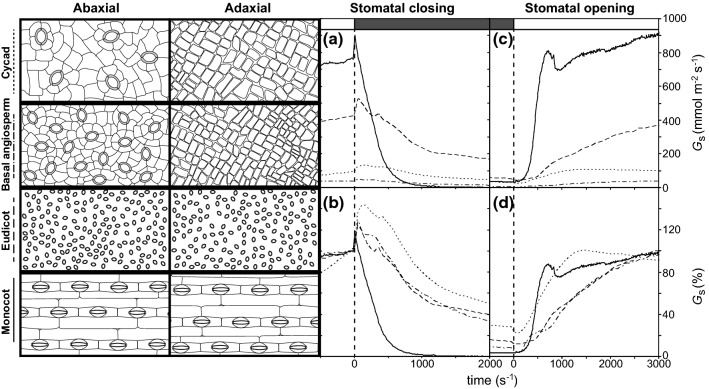
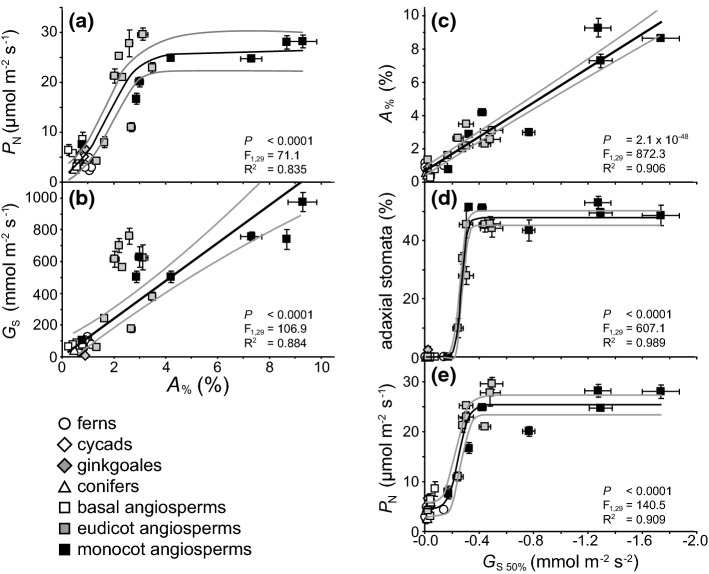
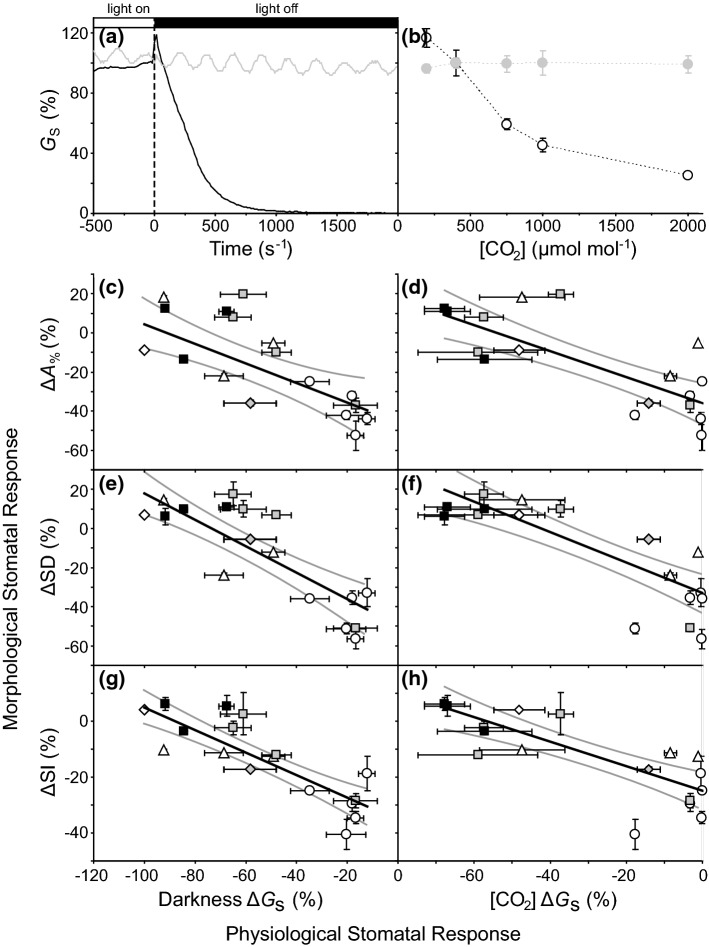
Stomata are central players in the hydrological and carbon cycles, regulating the uptake of carbon dioxide (CO) for photosynthesis and transpirative loss of water (HO) between plants and the atmosphere. The necessity to balance water-loss and CO-uptake has played a key role in the evolution of plants, and is increasingly important in a hotter and drier world. The conductance of CO and water vapour across the leaf surface is determined by epidermal and stomatal morphology (the number, size, and spacing of stomatal pores) and stomatal physiology (the regulation of stomatal pore aperture in response to environmental conditions). The proportion of the epidermis allocated to stomata and the evolution of amphistomaty are linked to the physiological function of stomata. Moreover, the relationship between stomatal density and [CO] is mediated by physiological stomatal behaviour; species with less responsive stomata to light and [CO] are most likely to adjust stomatal initiation. These differences in the sensitivity of the stomatal density-[CO] relationship between species influence the efficacy of the 'stomatal method' that is widely used to infer the palaeo-atmospheric [CO] in which fossil leaves developed. Many studies have investigated stomatal physiology or morphology in isolation, which may result in the loss of the 'overall picture' as these traits operate in a coordinated manner to produce distinct mechanisms for stomatal control. Consideration of the interaction between stomatal morphology and physiology is critical to our understanding of plant evolutionary history, plant responses to on-going climate change and the production of more efficient and climate-resilient food and bio-fuel crops.
气孔是水分和碳循环的核心参与者,调节着植物从大气中吸收二氧化碳(CO)用于光合作用以及蒸腾作用失水(HO)。在植物的进化过程中,水损失和 CO 吸收之间的平衡起着关键作用,在一个更加炎热和干燥的世界中,这种平衡变得越来越重要。CO 和水蒸气在叶片表面的传导取决于表皮和气孔的形态(气孔的数量、大小和间距)以及气孔的生理特性(气孔孔径对环境条件的调节)。分配给气孔的表皮比例和气孔的演化与气孔的生理功能有关。此外,气孔密度与 [CO] 之间的关系受生理气孔行为的调节;对光和 [CO] 反应不敏感的物种最有可能调节气孔的起始。这些物种间气孔密度-[CO]关系敏感性的差异影响了广泛用于推断化石叶片发育时古大气 [CO] 的“气孔法”的有效性。许多研究孤立地研究了气孔的生理或形态,这可能导致“整体情况”的丧失,因为这些特征以协调的方式运作,产生了不同的气孔控制机制。考虑到气孔形态和生理之间的相互作用,对于我们理解植物进化历史、植物对正在发生的气候变化的反应以及生产更高效和适应气候变化的粮食和生物燃料作物至关重要。