Institute of Health and Sports Science & Medicine, Juntendo University, 1-1 Hiraka-gakuendai, Inzai, Chiba, 270-1695, Japan.
Graduate School of Health and Sports Science, Juntendo University, 1-1 Hiraka-gakuendai, Inzai, Chiba, 270-1695, Japan.
BMC Geriatr. 2021 Jan 30;21(1):89. doi: 10.1186/s12877-021-02047-7.
Physical fitness and motor ability are associated with the incidence of locomotive syndrome (LS) in older adults. The relationships between physical fitness and motor ability at a young age to LS risk in later life remain unclear. This study examined the association between physical fitness and motor ability among university students and their risk of LS in middle and old age.
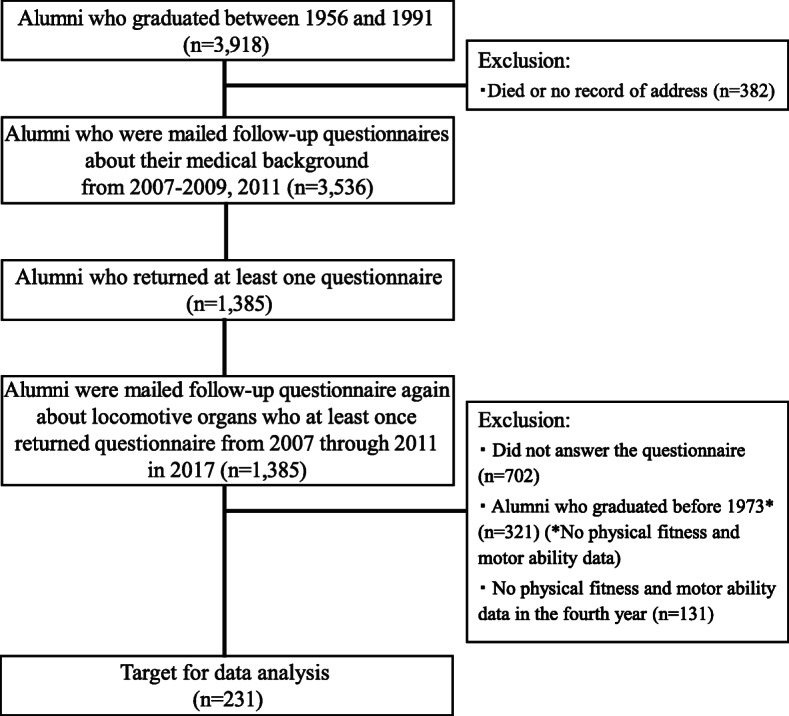
The participants were 231 male alumni aged 48-65 years from the Department of Physical Education of a university in Japan. Physical fitness and motor ability test results during their fourth year at the university were used. Physical fitness tests included the side-step test, vertical jump test, back muscle, grip strength, trunk lift, standing trunk flexion, and step-test. Motor ability was tested using the 50-m and 1500-m run, running long jump, hand-ball throw, and pull-up test. LS risk was assessed using a seven-question standardized self-administered Loco-check questionnaire. Participants were divided into three groups (low, medium, and high) based on physical fitness and motor ability test results at young age, and LS risk was assessed at an older age across the three groups using Cox proportional hazards models.
From the 2017 follow-up survey, the median follow-up period was 37 years (interquartile range, 33-41), and LS risk was suspected for 31 (13.4%) participants. Better performance on the side-step test was associated with the reduced risk of LS (hazard ratio 0.32; 95% confidence interval, 0.101-0.983, P = 0.047).
Good agility (side-step test) at a young age may reduce the future risk of LS among middle-aged and older men.
体能和运动能力与老年人发生行动不便综合征(LS)的几率相关。年轻时的体能和运动能力与晚年 LS 风险之间的关系尚不清楚。本研究旨在探讨大学生的体能和运动能力与中年和老年 LS 风险之间的关系。
本研究的参与者为来自日本某大学体育系的 231 名 48-65 岁的男性校友。研究使用了他们在大学四年级时的体能和运动能力测试结果。体能测试包括侧步测试、垂直跳跃测试、背肌测试、握力测试、躯干提升测试、站立躯干弯曲测试和台阶测试。运动能力测试包括 50 米跑和 1500 米跑、长跑跳、手球投掷和引体向上测试。LS 风险使用经过标准化的七项自我管理 Loco-check 问卷进行评估。根据年轻时的体能和运动能力测试结果,将参与者分为低、中、高三组,然后使用 Cox 比例风险模型在老年时评估三组的 LS 风险。
在 2017 年的随访调查中,中位随访期为 37 年(四分位距为 33-41 年),有 31 名(13.4%)参与者疑似患有 LS。侧步测试表现较好与 LS 风险降低相关(风险比 0.32;95%置信区间,0.101-0.983;P=0.047)。
年轻时良好的敏捷性(侧步测试)可能会降低中老年男性未来发生 LS 的风险。