Sunovion Pharmaceuticals Inc., 84 Waterford Dr, Marlborough, MA, 01752, USA.
Adelphi Real World, Manchester, UK.
BMC Neurol. 2021 Jan 30;21(1):46. doi: 10.1186/s12883-021-02074-2.
Many patients with Parkinson's disease (PD) who receive carbidopa/levodopa experience symptom reemergence or worsening, or "OFF" episodes. This study assessed the association of "OFF" episodes with health-related quality of life (HRQoL).
US-specific data from the 2017 and 2019 Adelphi Real World Disease Specific Programme for PD, a real-world cross-sectional survey, were used. Neurologists provided data for 10-12 consecutive patients with PD who completed the 39-item Parkinson's Disease Questionnaire (PDQ-39) and the EuroQol 5-Dimension (EQ-5D). Data were grouped by patients who experienced "OFF" episodes versus those who did not and by average hours of daily "OFF" time. Differences between patient groups were assessed for demographics and clinical characteristics; regression analyses were used to model the relationship between HRQoL and "OFF" episodes with age, sex, body mass index, current PD stage on the Hoehn and Yahr scale, and number of concomitant conditions related and unrelated to mobility as covariates.
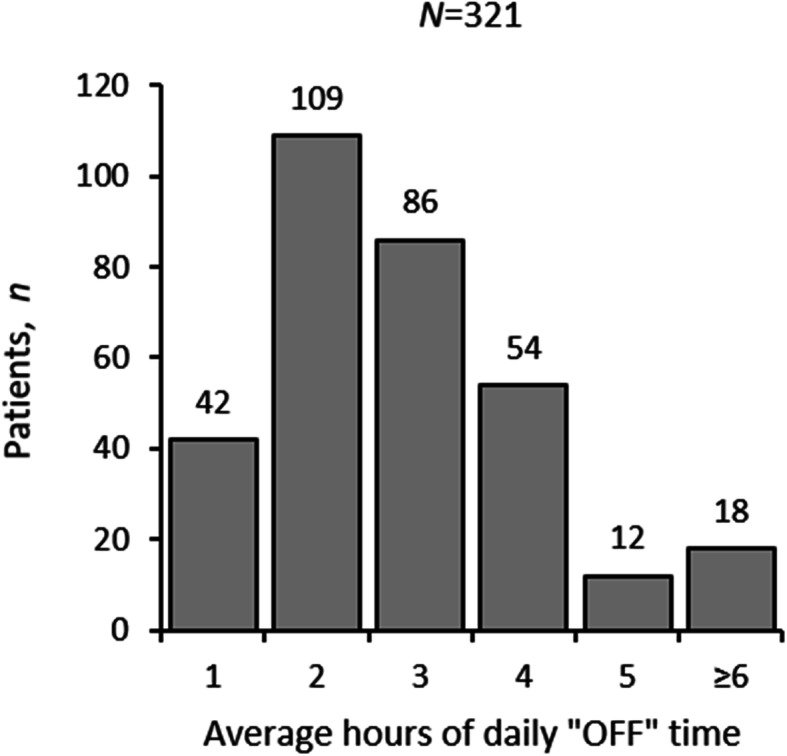
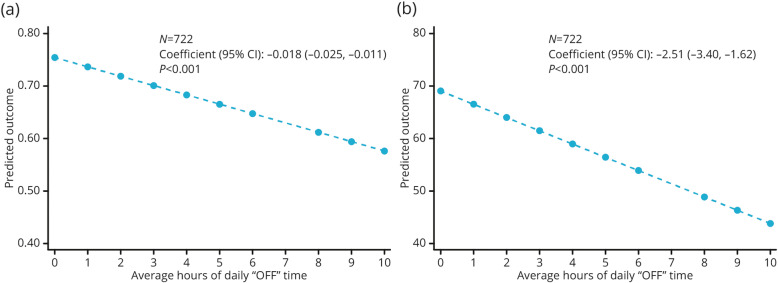
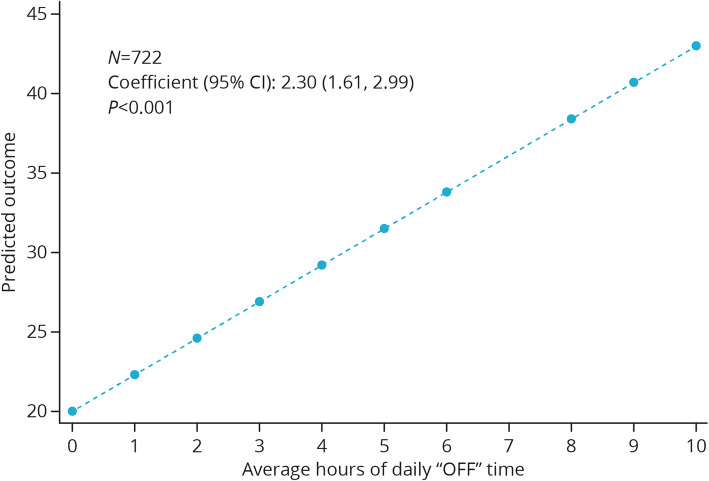
Data from 722 patients were analyzed. Overall, 321 patients (44%) had "OFF" episodes (mean of 2.9 h of daily "OFF" time). Patients who experienced "OFF" episodes were less likely to work full-time and more likely to live with family members other than their spouse/partner or reside in a long-term care facility than those without "OFF" episodes. The presence of "OFF" episodes, regardless of the average hours of daily "OFF" time, was significantly associated with high scores (reflecting poor HRQoL) on most PDQ-39 dimensions and the summary index and low scores (reflecting poor health status) on the EQ-5D health utility index, visual analog scale (VAS), and all dimensions. Furthermore, increased average hours of daily "OFF" time was significantly correlated with higher scores for all PDQ-39 dimensions and the summary index, as well as with the EQ-5D health utility index and VAS scores. Patients with "OFF" episodes experienced reduced HRQoL even after correcting for potentially confounding variables.
This study demonstrated that the occurrence of "OFF" episodes in patients with PD is associated with reduced HRQoL and that the impact on HRQoL increased incrementally with increasing average hours of daily "OFF" time.
许多接受卡比多巴/左旋多巴治疗的帕金森病(PD)患者会出现症状再现或恶化,或“OFF”发作。本研究评估了“OFF”发作与健康相关生活质量(HRQoL)的关系。
使用了来自 2017 年和 2019 年 Adelphi 帕金森病特定现实世界计划的美国特定数据,这是一项真实世界的横断面调查。神经病学家为 10-12 名连续的 PD 患者提供数据,这些患者完成了 39 项帕金森病问卷(PDQ-39)和欧洲五维健康量表(EQ-5D)。根据患者是否经历“OFF”发作以及平均每天“OFF”时间分组。使用回归分析对患者组之间的人口统计学和临床特征进行评估,以模型的方式建立 HRQoL 与“OFF”发作与年龄、性别、体重指数、Hoehn 和 Yahr 量表上当前 PD 阶段以及与移动性相关和不相关的并存疾病数量之间的关系。
对 722 名患者的数据进行了分析。总体而言,321 名患者(44%)出现“OFF”发作(每天平均“OFF”时间为 2.9 小时)。与没有“OFF”发作的患者相比,经历“OFF”发作的患者更不可能全职工作,更有可能与配偶/伴侣以外的家庭成员居住,或居住在长期护理机构中。存在“OFF”发作,无论平均每天“OFF”时间如何,与 PDQ-39 大部分维度和综合指数的高分(反映 HRQoL 较差)以及 EQ-5D 健康效用指数、视觉模拟量表(VAS)和所有维度的低分(反映健康状况较差)显著相关。此外,平均每天“OFF”时间增加与 PDQ-39 所有维度和综合指数的高分,以及 EQ-5D 健康效用指数和 VAS 评分的高分显著相关。即使在纠正了潜在混杂变量后,患有“OFF”发作的患者的 HRQoL 也会降低。
本研究表明,PD 患者“OFF”发作的发生与 HRQoL 降低有关,并且随着每天平均“OFF”时间的增加,对 HRQoL 的影响呈递增趋势。