Department of Pharmacology, Maulana Azad Medical College, New Delhi, India.
Department of Microbiology, Maulana Azad Medical College, New Delhi, India.
Trials. 2021 Jan 30;22(1):105. doi: 10.1186/s13063-021-05053-7.
To compare the efficacy and safety of bioavailable turmeric extract versus paracetamol in patients with knee osteoarthritis (OA).
In this randomized, non-inferiority, controlled clinical study, patients of knee OA were randomized to receive bioavailable turmeric extract (BCM-95®) 500 mg capsule two times daily or paracetamol 650 mg tablet three times daily for 6 weeks. The primary outcome measure was Western Ontario and McMaster Universities Osteoarthritis Index (WOMAC) pain subscale. The secondary outcome measures were WOMAC total, WOMAC stiffness, and WOMAC physical function scores. Responder analysis of individual patients at different levels (≥ 20%, ≥ 50%, and ≥ 70%) for WOMAC score was calculated. TNF alpha and CRP levels were evaluated and adverse events (AE) were also recorded.
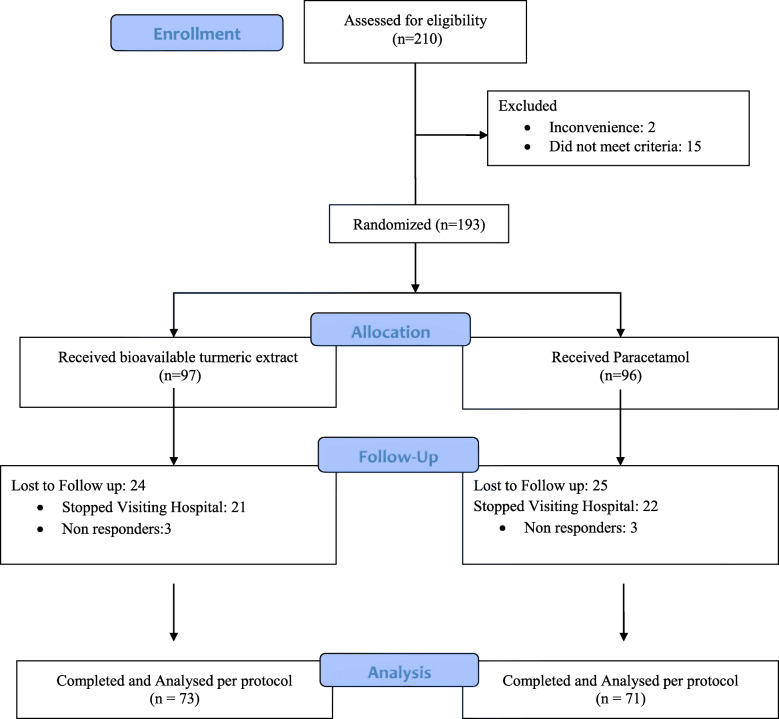
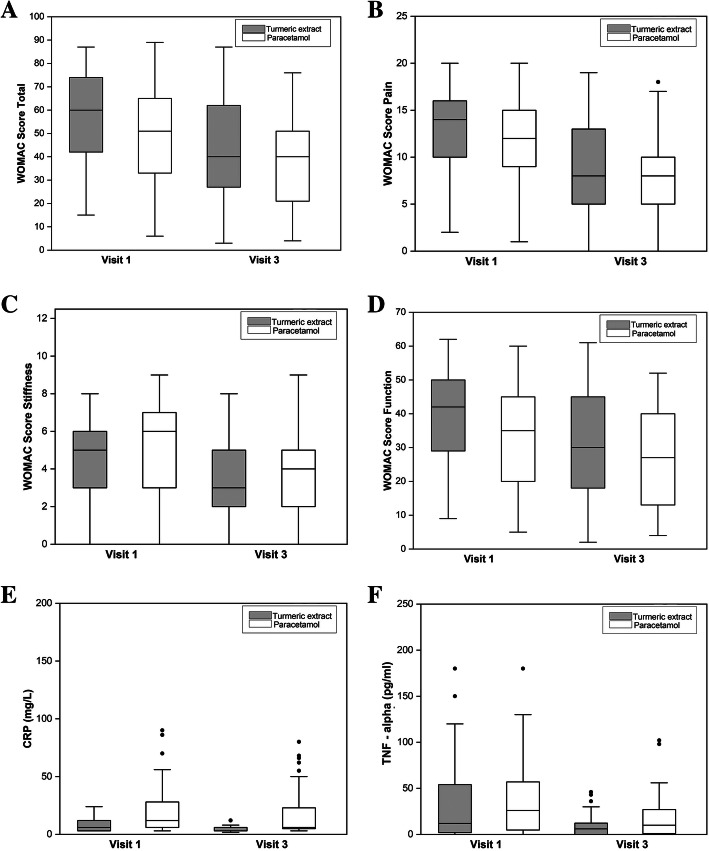
Seventy-one and seventy-three knee OA patients, respectively in bioavailable turmeric extract and paracetamol groups, completed the study. Non-inferiority (equivalence) test showed that WOMAC scores were equivalent in both the groups (p value < 0.05) in all the domains within the equivalence limit defined by effect size (Cohen's d) of 0.5 whereas CRP and TNF-α were better reduced with turmeric extract than paracetamol. After 6 weeks of treatment, WOMAC total score, pain, stiffness, and function scores got a significant improvement of 23.59, 32.09, 28.5, and 20.25% respectively with turmeric extract. In the turmeric extract group, 18% of patients got more than 50% improvement and 3% of patients got more than 70% improvement in WOMAC pain and function/stiffness score and none of the patients in the paracetamol group met the criteria. CRP and TNF-α got significantly reduced (37.21 and 74.81% respectively) in the turmeric extract group. Adverse events reported were mild and comparatively less in the turmeric extract group (5.48%) than in the paracetamol group (12.68%).
The results of the study suggest that bioavailable turmeric extract is as effective as paracetamol in reducing pain and other symptoms of knee osteoarthritis and found to be safe and more effective in reducing CRP and TNF-α.
Clinical Trials Registry - India CTRI/2017/02/007962 . Registered on 27 February 2017.
比较生物利用型姜黄提取物与对乙酰氨基酚在膝骨关节炎(OA)患者中的疗效和安全性。
在这项随机、非劣效性、对照临床试验中,将膝骨关节炎患者随机分为两组,分别接受生物利用型姜黄提取物(BCM-95®)500mg 胶囊,每日两次,或对乙酰氨基酚 650mg 片剂,每日三次,治疗 6 周。主要观察指标为 Western Ontario and McMaster Universities Osteoarthritis Index(WOMAC)疼痛量表。次要观察指标为 WOMAC 总分、WOMAC 僵硬度和 WOMAC 躯体功能评分。计算了个体患者在不同水平(≥20%、≥50%和≥70%)的 WOMAC 评分应答分析。评估了 TNFα和 CRP 水平,并记录了不良反应(AE)。
生物利用型姜黄提取物组和对乙酰氨基酚组分别有 71 例和 73 例膝骨关节炎患者完成了研究。等效性(等价)检验表明,两组在所有领域的 WOMAC 评分均等效(p 值<0.05),且在等效性范围内,效应大小(Cohen's d)为 0.5,表明姜黄提取物的疗效与对乙酰氨基酚相当。治疗 6 周后,姜黄提取物组 WOMAC 总分、疼痛、僵硬和功能评分分别显著改善 23.59%、32.09%、28.50%和 20.25%。在姜黄提取物组中,18%的患者 WOMAC 疼痛和功能/僵硬评分改善超过 50%,3%的患者改善超过 70%,而对乙酰氨基酚组无患者符合标准。CRP 和 TNF-α在姜黄提取物组显著降低(分别为 37.21%和 74.81%)。报告的不良反应在姜黄提取物组为轻度,且与对乙酰氨基酚组(12.68%)相比相对较少(5.48%)。
研究结果表明,生物利用型姜黄提取物在减轻膝骨关节炎疼痛和其他症状方面与对乙酰氨基酚同样有效,且在降低 CRP 和 TNF-α方面被发现更安全、更有效。
印度临床试验注册中心 CTRI/2017/02/007962。于 2017 年 2 月 27 日注册。