Department of Radiology, Memorial Sloan Kettering Cancer Center, New York, NY.
Department of Diagnostic, Molecular, and Interventional Radiology, Mount Sinai Hospital, New York, NY.
Chest. 2021 Jul;160(1):238-248. doi: 10.1016/j.chest.2021.01.053. Epub 2021 Jan 29.
Chest radiography (CXR) often is performed in the acute setting to help understand the extent of respiratory disease in patients with COVID-19, but a clearly defined role for negative chest radiograph results in assessing patients has not been described.
Is portable CXR an effective exclusionary test for future adverse clinical outcomes in patients suspected of having COVID-19?
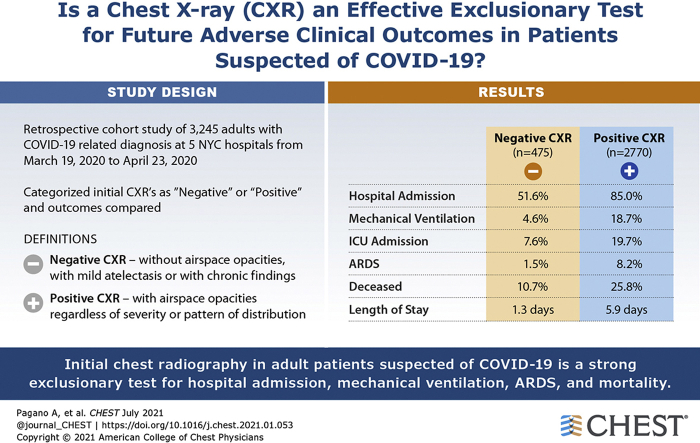
Charts of consecutive patients suspected of having COVID-19 at five EDs in New York City between March 19, 2020, and April 23, 2020, were reviewed. Patients were categorized based on absence of findings on initial CXR. The primary outcomes were hospital admission, mechanical ventilation, ARDS, and mortality.
Three thousand two hundred forty-five adult patients, 474 (14.6%) with negative initial CXR results, were reviewed. Among all patients, negative initial CXR results were associated with a low probability of future adverse clinical outcomes, with negative likelihood ratios of 0.27 (95% CI, 0.23-0.31) for hospital admission, 0.24 (95% CI, 0.16-0.37) for mechanical ventilation, 0.19 (95% CI, 0.09-0.40) for ARDS, and 0.38 (95% CI, 0.29-0.51) for mortality. Among the subset of 955 patients younger than 65 years and with a duration of symptoms of at least 5 days, no patients with negative CXR results died, and the negative likelihood ratios were 0.17 (95% CI, 0.12-0.25) for hospital admission, 0.09 (95% CI, 0.02-0.36) for mechanical ventilation, and 0.09 (95% CI, 0.01-0.64) for ARDS.
Initial CXR in adult patients suspected of having COVID-19 is a strong exclusionary test for hospital admission, mechanical ventilation, ARDS, and mortality. The value of CXR as an exclusionary test for adverse clinical outcomes is highest among young adults, patients with few comorbidities, and those with a prolonged duration of symptoms.
胸部 X 光(CXR)常在急性情况下进行,以帮助了解 COVID-19 患者呼吸疾病的严重程度,但尚未明确阴性胸部 X 光结果在评估患者方面的作用。
便携式 CXR 是否可作为疑似 COVID-19 患者未来不良临床结局的有效排除性检查?
回顾 2020 年 3 月 19 日至 4 月 23 日期间,纽约市五家急诊室连续疑似 COVID-19 患者的病历。根据初始 CXR 无发现结果对患者进行分类。主要结局为住院、机械通气、ARDS 和死亡率。
共纳入 3245 例成年患者,其中 474 例(14.6%)初始 CXR 结果阴性。所有患者中,初始 CXR 结果阴性与未来不良临床结局的低概率相关,住院的阴性似然比为 0.27(95%CI,0.23-0.31),机械通气为 0.24(95%CI,0.16-0.37),ARDS 为 0.19(95%CI,0.09-0.40),死亡率为 0.38(95%CI,0.29-0.51)。在 955 例年龄小于 65 岁且症状持续至少 5 天的患者亚组中,无阴性 CXR 结果的患者死亡,阴性似然比为 0.17(95%CI,0.12-0.25),住院为 0.09(95%CI,0.02-0.36),机械通气为 0.09(95%CI,0.01-0.64),ARDS 为 0.09(95%CI,0.01-0.64)。
疑似 COVID-19 的成年患者的初始 CXR 是住院、机械通气、ARDS 和死亡率的强有力排除性检查。CXR 作为排除不良临床结局的检查在年轻成年人、合并症较少的患者和症状持续时间较长的患者中的价值最高。