George and Fay Yee Centre for Healthcare Innovation.
Neil John Maclean Health Sciences Library, University of Manitoba, Winnipeg, Canada.
Fam Pract. 2021 Jul 28;38(4):524-536. doi: 10.1093/fampra/cmaa149.
Seasonal influenza vaccination (SIV) rates remain suboptimal in many populations, even in those with universal SIV.
To summarize the evidence on interventions on health care providers (physicians/nurses/pharmacists) to increase SIV rates.
We systematically searched/selected full-text English publications from January 2000 to July 2019 (PROSPERO-CRD42019147199). Our outcome was the difference in SIV rates between patients in intervention and non-intervention groups. We calculated pooled difference using an inverse variance, random-effects model.
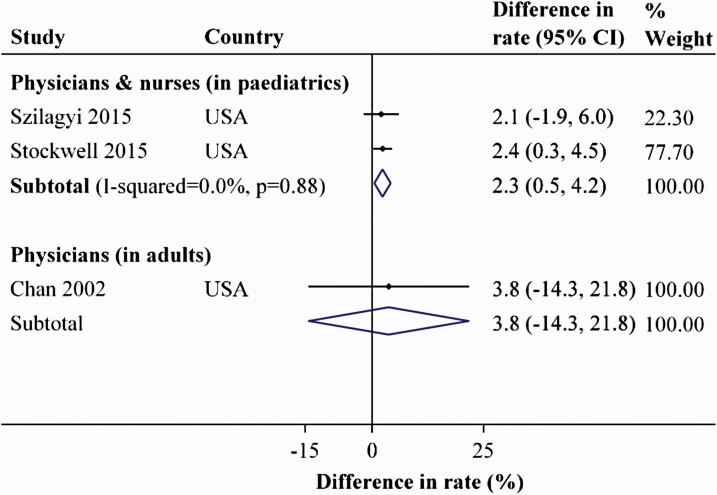
We included 39 studies from 8370 retrieved citations. Compared with no intervention, team-based training/education of physicians significantly increased SIV rates in adult patients: 20.1% [7.5-32.7%; I2 = 0%; two randomized controlled trials (RCTs)] and 13.4% [8.6-18.1%; I2 = 0%; two non-randomized intervention studies (NRS)]. A smaller increase was observed in paediatric patients: 7% (0.1-14%; I2 = 0%; two NRS), and in adult patients with team-based training/education of physicians and nurses together: 0.9% (0.2-1.5%; I2 = 30.6%; four NRS). One-off provision of guidelines/information to physicians, and to both physicians and nurses, increased SIV rates in adult patients: 23.8% (15.7-31.8%; I2 = 45.8%; three NRS) and paediatric patients: 24% (8.1-39.9%; I2 = 0%; two NRS), respectively. Use of reminders (prompts) by physicians and nurses slightly increased SIV rates in paediatric patients: 2.3% (0.5-4.2%; I2 = 0%; two RCTs). A larger increase was observed in adult patients: 18.5% (14.8-22.1%; I2 = 0%; two NRS). Evidence from both RCTs and NRS showed significant increases in SIV rates with varied combinations of interventions.
Limited evidence suggests various forms of physicians' and nurses' education and use of reminders may be effective for increasing SIV rates among patients.
在许多人群中,季节性流感疫苗接种(SIV)率仍然不理想,即使在普遍接种 SIV 的人群中也是如此。
总结干预医疗保健提供者(医生/护士/药剂师)以提高 SIV 接种率的证据。
我们系统地检索/选择了 2000 年 1 月至 2019 年 7 月的英文全文出版物(PROSPERO-CRD42019147199)。我们的结局是干预组和非干预组患者的 SIV 接种率差异。我们使用逆方差、随机效应模型计算汇总差异。
我们纳入了 8370 篇检索文献中的 39 项研究。与无干预相比,医生团队培训/教育显著提高了成年患者的 SIV 接种率:20.1%[7.5-32.7%;I2=0%;两项随机对照试验(RCT)]和 13.4%[8.6-18.1%;I2=0%;两项非随机干预研究(NRS)]。儿科患者的增幅较小:7%[0.1-14%;I2=0%;两项 NRS],以及医生和护士共同进行团队培训/教育的成年患者:0.9%[0.2-1.5%;I2=30.6%;四项 NRS]。一次性向医生提供指南/信息,以及向医生和护士同时提供,可提高成年患者的 SIV 接种率:23.8%[15.7-31.8%;I2=45.8%;三项 NRS]和儿科患者:24%[8.1-39.9%;I2=0%;两项 NRS]。医生和护士使用提醒(提示)可略微提高儿科患者的 SIV 接种率:2.3%[0.5-4.2%;I2=0%;两项 RCT]。成年患者的增幅较大:18.5%[14.8-22.1%;I2=0%;两项 NRS]。RCT 和 NRS 的证据均表明,各种形式的医生和护士教育以及使用提醒均可能有效提高患者的 SIV 接种率。
有限的证据表明,医生和护士的各种教育形式以及使用提醒可能会有效提高患者的 SIV 接种率。