Department of Animal and Rangeland Sciences, College of Agricultural Sciences, Oregon State University, Corvallis, OR 97331, USA.
Department of Biomedical Sciences, Carlson College of Veterinary Medicine, Oregon State University, Corvallis, OR 97331, USA.
Poult Sci. 2021 Feb;100(2):865-874. doi: 10.1016/j.psj.2020.10.069. Epub 2020 Nov 19.
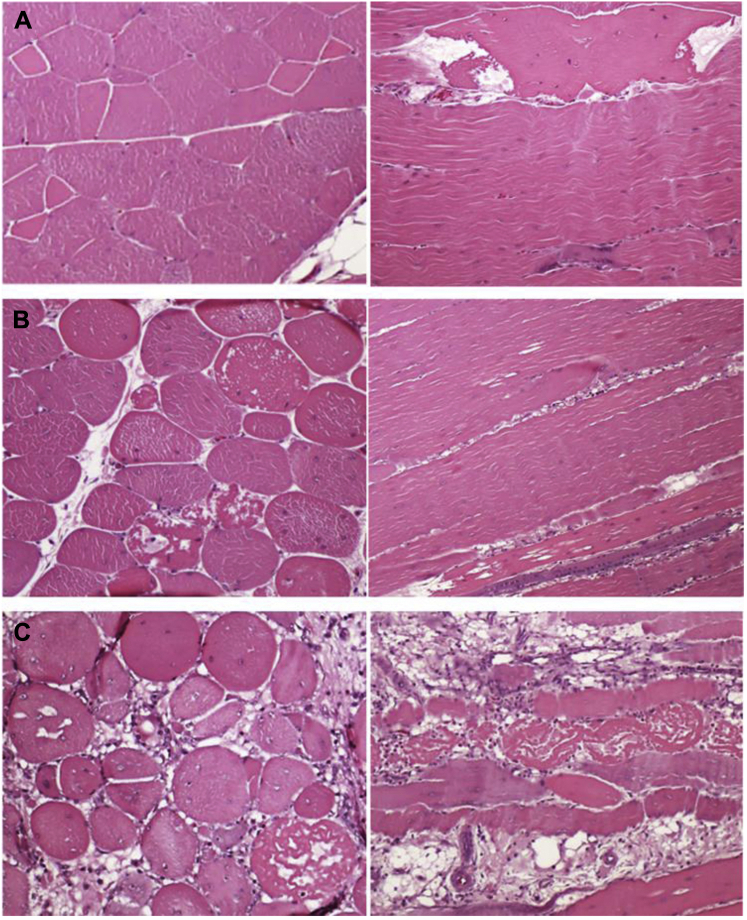
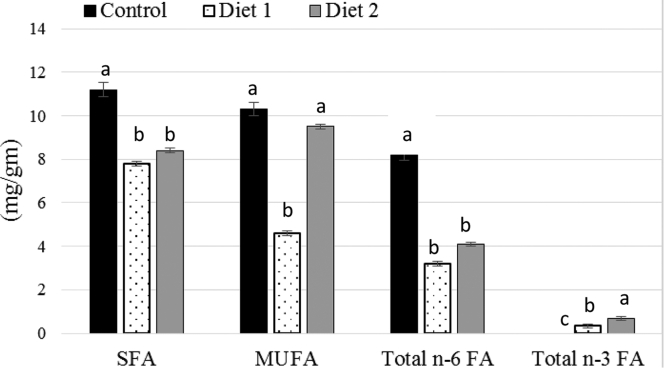
The effect of docosahexaenoic acid (DHA, 22:6 n-3)-rich microalgae and methionine (Met) supplementation on production performance, incidence of breast muscle white striping (WS), and pathology, lipid profile, and meat quality aspects in broiler chickens was investigated. The hypothesis tested was that feeding Met and n-3 fatty acid (FA)-rich diet enhances muscle n-3 FA content and meat quality while attenuating breast muscle WS and myopathy in broiler chickens. One hundred and forty four (n = 144) 10-day-old Cornish cross chicks were fed a corn-soybean meal-based diet containing 0% microalgae (control), 2% microalgae (diet 1), and diet 1 + 100% more National Research Council requirement of Met (diet 2) up to day 42 of growth. All diets were isocaloric and isonitrogenous. The chicks were kept in 6 pens with 8 chicks per replicate pen. Feed consumption and feed efficiency were calculated on day 21 and 42. On day 43, 3 chicks per pen (n = 18/treatment) were euthanized. The breast muscle (pectoralis major) was visually scored for muscle WS (1 = no striping, 2 = mild, 3 = severe) and was subjected to histopathology. Breast muscle lipid profile (total lipids, FA composition, cholesterol, lipid oxidation products), quality (moisture, color, drip loss, shear force, cook loss, pH), and chemical characterization (protein, minerals) were recorded. A one-way analysis of variance was carried out with diet as the main factor and significance was set at P < 0.05. The incidence of muscle WS was lower (P < 0.02) for control vs. diet 2 and a trend for reduction in WS was observed in birds fed diet 1 vs. control (P = 0.09). Histopathological changes consisted of floccular or vacuolar degeneration, fibrosis, lipidosis, interstitial inflammation, and lysis of fibers, and were minimal in diet 2 when compared to control (P < 0.05). The total lipid content was lowest in birds fed diet 1 (P < 0.05). Total n-3 and total long chain (≥20C) n-3 FA were highest in the breast muscle of diet 2 birds (P < 0.05). Muscle drip loss and shear force were highest in diet 2 (P < 0.05). Meat color (a∗, redness) was reduced (P < 0.05) and a trend for reduction in b∗ (yellowness) was observed in diet 2 (P = 0.07). No effect of diet on body weight gain, feed efficiency, breast muscle yield, pH, moisture, lipid oxidation products, cook loss, minerals (Ca, P, Mg, Na), cholesterol, or protein content was observed (P > 0.05). The results demonstrated a significant effect of DHA-rich microalgae along with Met supplementation in reducing the incidence of breast muscle striping and myopathy, while enriching meat with n-3 FA. However, inclusion of Met in microalgae-based diets could influence meat tenderness and color.
本研究旨在探讨二十二碳六烯酸(DHA,22:6n-3)丰富的微藻和蛋氨酸(Met)补充对肉鸡生产性能、胸肌白条发生率、病理学、脂质谱和肉质的影响。假设是,饲喂 Met 和 n-3 脂肪酸(FA)丰富的饮食可以提高肌肉 n-3 FA 含量和肉质,同时减轻肉鸡胸肌 WS 和肌病。将 144 只(n=144)10 日龄的科尼什鸡用含有 0%微藻(对照组)、2%微藻(饮食 1)和饮食 1+100%更多国家研究委员会要求的 Met(饮食 2)的玉米-豆粕基础饮食喂养至生长第 42 天。所有饮食均具有相同的能量和氮含量。小鸡被放在 6 个饲养笼中,每个饲养笼中有 8 只小鸡。在第 21 天和第 42 天计算饲料消耗和饲料效率。在第 43 天,每笼 3 只小鸡(n=18/处理)被安乐死。胸肌(胸大肌)根据肌肉 WS (1=无条纹,2=轻度,3=严重)进行视觉评分,并进行组织病理学检查。胸肌脂质谱(总脂质、脂肪酸组成、胆固醇、脂质氧化产物)、品质(水分、颜色、滴水损失、剪切力、蒸煮损失、pH 值)和化学特性(蛋白质、矿物质)进行记录。采用单因素方差分析,以饮食为主要因素,显著性水平设为 P<0.05。与对照组相比,肌肉 WS 的发生率较低(P<0.02),与对照组相比,饮食 1 组 WS 发生率呈下降趋势(P=0.09)。组织病理学变化包括絮状或空泡变性、纤维化、脂肪变性、间质炎症和纤维溶解,与对照组相比,饮食 2 组的变化最小(P<0.05)。饮食 1 组的总脂质含量最低(P<0.05)。饮食 2 组的胸肌中总 n-3 和总长链(≥20C)n-3 FA 含量最高(P<0.05)。饮食 2 组的肌肉滴水损失和剪切力最高(P<0.05)。肉色(a*,红色)降低(P<0.05),饮食 2 组 b*(黄色)呈降低趋势(P=0.07)。饮食对体重增重、饲料效率、胸肌产量、pH 值、水分、脂质氧化产物、蒸煮损失、矿物质(Ca、P、Mg、Na)、胆固醇或蛋白质含量无影响(P>0.05)。结果表明,DHA 丰富的微藻与 Met 补充剂联合使用可显著降低胸肌白条和肌病的发生率,同时使肌肉富含 n-3 FA。然而,在基于微藻的饮食中添加 Met 可能会影响肉的嫩度和颜色。