Department of Medicine, Richmond University Medical Center, Staten Island, NY, USA.
Department of Pulmonary and Critical Care, Richmond University Medical Center, Staten Island, NY, USA.
Med Sci Monit Basic Res. 2021 Feb 1;27:e927834. doi: 10.12659/MSMBR.927834.
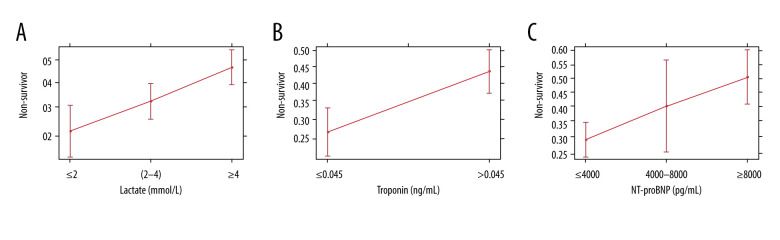
BACKGROUND Serum lactate, troponin, and N-terminal pro-B-type natriuretic peptide (NT-proBNP) have been proposed to be useful prognostic indicators in patients with sepsis and septic shock. This study aimed to evaluate the predictive ability of these biomarkers and assess how their prognostic utility may be improved by using them in combination. MATERIAL AND METHODS A retrospective review of the medical records of 1242 patients with sepsis and septic shock who were admitted to the Richmond University Medical Center between June 1, 2018, and June 1, 2019, was carried out; 427 patients met the study criteria and were included in the study. The primary outcome measures included 30-day mortality, APACHE II scores, length of hospital stay, and admission to the Medical Intensive Care Unit (MICU). RESULTS High levels of lactate (>4 mmol/L), troponin (>0.45 ng/mL), and NT-proBNP (>8000 pg/mL) were independent predictors of 30-day mortality, with an adjusted odds ratio of mortality being 3.19 times, 2.13 times, and 2.5 times higher, respectively, compared with corresponding reference groups, at 95% confidence intervals. Elevated levels of lactate, troponin, and NT-proBNP were associated with 9.12 points, 7.70 points, and 8.88 points in higher APACHE II scores, respectively. Only elevated troponin levels were predictive of a longer length of hospital stay. In contrast, elevated lactate and troponin were associated with an increased chance of admission to the MICU. CONCLUSIONS Elevated levels of serum lactate, troponin, and NT-proBNP are independent predictors of mortality and higher APACHE II scores in patients with sepsis and septic shock.
血清乳酸、肌钙蛋白和 N 末端脑利钠肽前体(NT-proBNP)已被提议作为脓毒症和感染性休克患者有用的预后指标。本研究旨在评估这些生物标志物的预测能力,并评估通过联合使用它们如何提高其预后效用。
对 2018 年 6 月 1 日至 2019 年 6 月 1 日期间入住里士满大学医学中心的 1242 例脓毒症和感染性休克患者的病历进行了回顾性分析;符合研究标准的 427 例患者被纳入研究。主要观察指标包括 30 天死亡率、APACHE II 评分、住院时间和入住重症监护病房(MICU)。
高乳酸水平(>4 mmol/L)、肌钙蛋白(>0.45 ng/mL)和 NT-proBNP(>8000 pg/mL)是 30 天死亡率的独立预测因素,与相应的参考组相比,调整后的死亡率比值分别高 3.19 倍、2.13 倍和 2.5 倍,置信区间为 95%。乳酸、肌钙蛋白和 NT-proBNP 水平升高与 APACHE II 评分分别升高 9.12 分、7.70 分和 8.88 分相关。只有升高的肌钙蛋白水平与住院时间延长相关。相反,升高的乳酸和肌钙蛋白水平与入住 MICU 的机会增加相关。
血清乳酸、肌钙蛋白和 NT-proBNP 水平升高是脓毒症和感染性休克患者死亡率和更高的 APACHE II 评分的独立预测因素。