Lu Manman, Wang Xindong, Ye Huan, Wang Huimin, Qiu Shan, Zhang Hongmao, Liu Ying, Luo Jinhong, Feng Jiang
Institute of Evolution and Ecology, School of Life Sciences, Central China Normal University, Wuhan 430079, China.
Jilin Provincial Key Laboratory of Animal Resource Conservation and Utilization, Northeast Normal University, Changchun 130117, China.
Biol Conserv. 2021 Feb;254:108952. doi: 10.1016/j.biocon.2021.108952. Epub 2021 Jan 5.
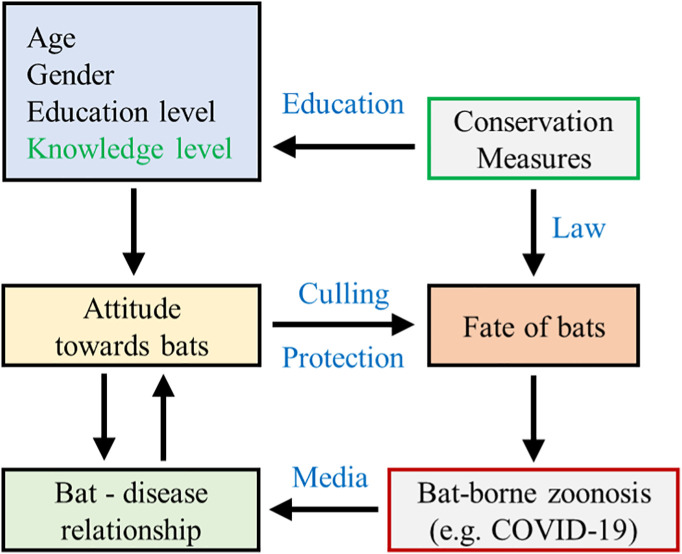
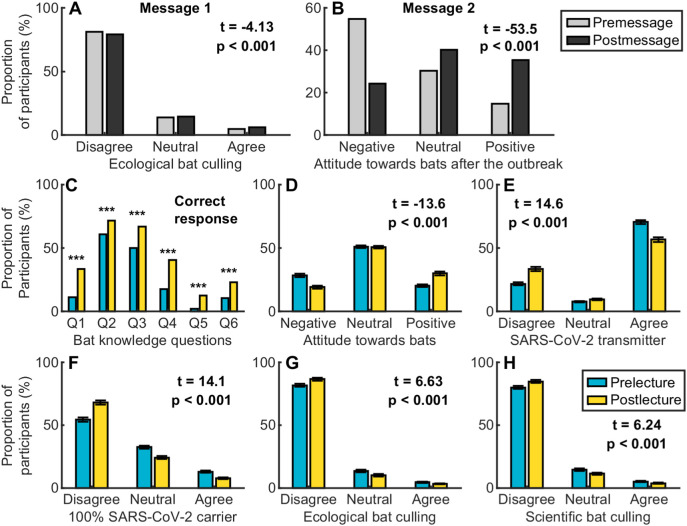
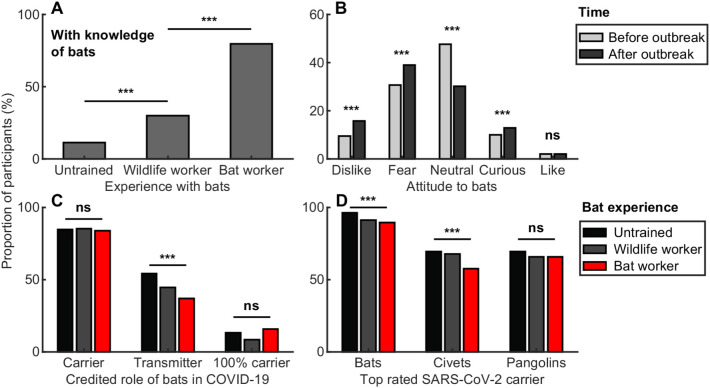
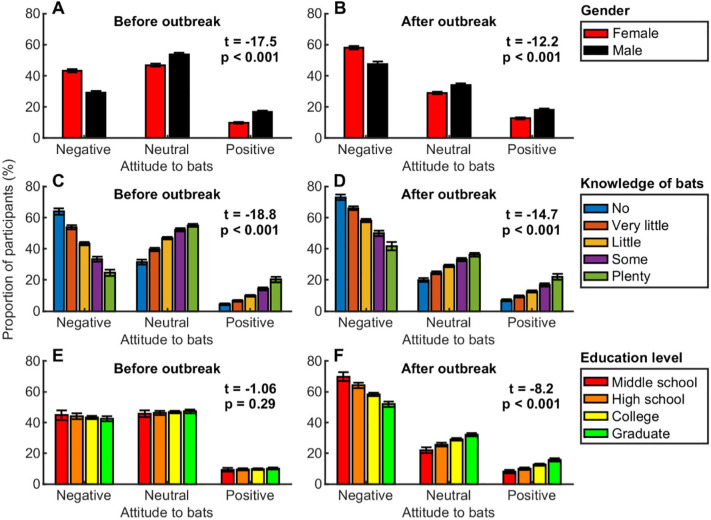
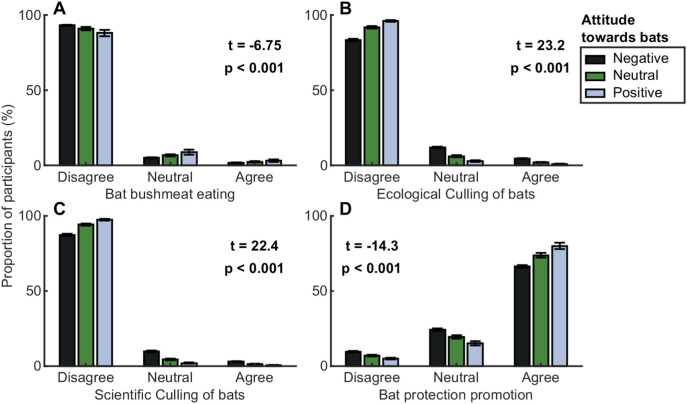
With >1 400 species, bats comprise the second-largest order of mammals and provide critical ecological services as insect consumers, pollinators, and seed dispersers. Yet, bats are frequently associated with infectious human diseases such as SARS, MERS, and Ebola. As early as the end of January 2020, several virological studies have suggested bats as a probable origin for SARS-CoV-2, the causative agent of COVID-19. How does the public view the role of bats in COVID-19? Here we report pilot data collected shortly after the outbreak of COVID-19 using two online surveys, combined with a conservation intervention experiment, primarily on people who are receiving or have received higher education in China. We found that 84% of the participants of an online survey (n = 13 589) have misunderstood the relationship between bats and COVID-19, which strengthened negative attitudes towards bats. Knowledge of bats, gender, and education level of the participants affected their attitudes towards bats. Participants who indicated a better knowledge of bats had a more positive attitude towards bats. The proportion of female participants who had negative attitudes towards bats was higher than that of male participants. Participants with a higher education level indicated a more positive attitude towards bats after the outbreak of COVID-19. A specially prepared bat conservation lecture improved peoples' knowledge of bats and the positive attitudes, but failed to correct the misconception that bats transmit SARS-CoV-2 to humans directly. We suggest that the way virologists frame the association of bats with diseases, the countless frequently inaccurate media coverages, and the natural perceptual bias of bats carrying and transmitting diseases to humans contributed to the misunderstandings. This probably led to a rise in the events of evicting bats from dwellings and structures by humans and the legislative proposal for culling disease-relevant wildlife in China. A better understanding of the relationship between disease, wildlife and human health could help guide the public and policymakers in an improved program for bat conservation.
蝙蝠是哺乳动物中的第二大目,有超过1400个物种,作为食虫动物、传粉者和种子传播者,它们提供了至关重要的生态服务。然而,蝙蝠常常与人类传染病联系在一起,比如非典、中东呼吸综合征和埃博拉病毒。早在2020年1月底,多项病毒学研究就已表明,蝙蝠可能是2019冠状病毒病(COVID-19)病原体严重急性呼吸综合征冠状病毒2(SARS-CoV-2)的起源。公众如何看待蝙蝠在COVID-19中的作用?在此,我们报告在COVID-19疫情爆发后不久收集的初步数据,这些数据来自两项在线调查,并结合了一项保护干预实验,主要针对在中国接受过或正在接受高等教育的人群。我们发现,一项在线调查(n = 13589)中有84%的参与者误解了蝙蝠与COVID-19之间的关系,这强化了对蝙蝠的负面态度。参与者对蝙蝠的了解程度、性别和教育水平影响了他们对蝙蝠的态度。表示对蝙蝠了解较多的参与者对蝙蝠的态度更积极。对蝙蝠持负面态度的女性参与者比例高于男性参与者。在COVID-19疫情爆发后,受过高等教育的参与者对蝙蝠的态度更积极。一场专门准备的蝙蝠保护讲座提高了人们对蝙蝠的认识以及积极态度,但未能纠正蝙蝠直接将SARS-CoV-2传播给人类的误解。我们认为,病毒学家阐述蝙蝠与疾病关联的方式、媒体无数次往往不准确的报道,以及蝙蝠携带并向人类传播疾病的自然认知偏差,都导致了这些误解。这可能导致人类驱赶住宅和建筑物中蝙蝠的事件增多,以及中国出现捕杀与疾病相关野生动物的立法提案。更好地理解疾病、野生动物和人类健康之间的关系,有助于指导公众和政策制定者制定更好的蝙蝠保护计划。