Zhang Yun-Xiao, Mu Dong-Liang, Jin Ke-Min, Li Xue-Ying, Wang Dong-Xin
Department of Anesthesiology and Critical Care Medicine, Peking University First Hospital, Beijing, People's Republic of China.
Key Laboratory of Carcinogenesis and Translational Research (Ministry of Education/Beijing), The Department of Anesthesiology, Peking University Cancer Hospital & Institute, Beijing, People's Republic of China.
Ther Clin Risk Manag. 2021 Jan 22;17:87-101. doi: 10.2147/TCRM.S287572. eCollection 2021.
Perioperative anesthetic management may affect long-term outcome after cancer surgery. This study investigated the effect of perioperative glucocorticoids on long-term survival in patients after radical resection for pancreatic cancer.
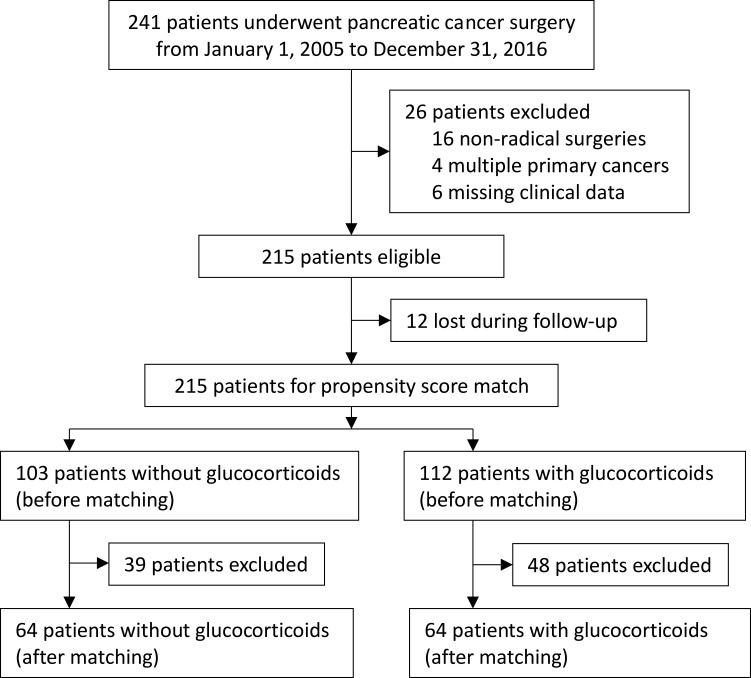
In this retrospective cohort study with propensity score-matching, patients who underwent radical resection for pancreatic cancer from January 2005 to December 2016 were recruited. Baseline and perioperative data including use of glucocorticoids for prevention of postoperative nausea and vomiting were collected. Patients were followed up by qualified personnel for cancer recurrence and survival. The primary outcome was the recurrence-free survival. Outcomes were compared before and after propensity matching. The association between perioperative glucocorticoid use and recurrence-free survival was analyzed with multivariable regression models.
A total of 215 patients were included in the study; of these, 112 received perioperative glucocorticoids and 103 did not. Patients were followed up for a median of 74.0 months (95% confidence interval [CI] 68.3-79.7). After propensity score-matching, 64 patients remained in each group. The recurrence-free survivals were significantly longer in patients with glucocorticoids than in those without (full cohort: median 12.0 months [95% CI 6.0-28.0] vs 6.9 months [4.2-17.0], P<0.001; matched cohort: median 12.0 months [95% CI 5.8-26.3] vs 8.3 months [4.3-18.2], P=0.015). After correction for confounding factors, perioperative glucocorticoids were significantly associated with prolonged recurrence-free survivals (full cohort: HR 0.66, 95% CI 0.48-0.92, P=0.015; matched cohort: HR 0.54, 95% CI 0.35-0.84, P=0.007).
Perioperative use of low-dose glucocorticoids is associated with improved recurrence-free survival in patients following radical surgery for pancreatic cancer.
围手术期麻醉管理可能会影响癌症手术后的长期预后。本研究调查了围手术期使用糖皮质激素对胰腺癌根治术后患者长期生存的影响。
在这项采用倾向评分匹配的回顾性队列研究中,纳入了2005年1月至2016年12月期间接受胰腺癌根治术的患者。收集包括使用糖皮质激素预防术后恶心和呕吐在内的基线和围手术期数据。由合格人员对患者进行癌症复发和生存情况的随访。主要结局是无复发生存期。在倾向评分匹配前后比较结局。使用多变量回归模型分析围手术期使用糖皮质激素与无复发生存期之间的关联。
本研究共纳入215例患者;其中,112例接受了围手术期糖皮质激素治疗,103例未接受。患者的中位随访时间为74.0个月(95%置信区间[CI]68.3 - 79.7)。倾向评分匹配后,每组各有64例患者。使用糖皮质激素的患者无复发生存期显著长于未使用的患者(全队列:中位12.0个月[95%CI 6.0 - 28.0]对6.9个月[4.2 - 17.0],P<0.001;匹配队列:中位12.0个月[95%CI 5.8 - 26.3]对8.3个月[4.3 - 18.2],P = 0.015)。校正混杂因素后,围手术期使用糖皮质激素与延长的无复发生存期显著相关(全队列:HR 0.66,95%CI 0.48 - 0.92,P = 0.015;匹配队列:HR 0.54,95%CI 0.35 - 0.84,P = 0.007)。
围手术期使用低剂量糖皮质激素与胰腺癌根治术后患者无复发生存期的改善相关。