AlShehry Nawal, Zaidi Syed Ziauddin A, AlAskar Ahmed, Al Odayani Abdurahman, Alotaibi Jawaher Mubarak, AlSagheir Ahmed, Al-Eyadhy Ayman, Balelah Saud, Salam Abdul, Zaidi Abdul Rehman Zia, Alawami Diea, Alshahrani Mohammed S, AlMozain Nour, Abulhamayel Yem M, Al Qunfoidi Reem, Alfaraj Mona, Qushmaq Nahid, Alansari Rehab, Dayel Afra, Elgohary Ghada, Al Bahrani Ahmed, Nabhan Abdelhameed Arwa A, AlZahrani Hazza Abdullah, Alturkistani Hanan, AlShehry Nada, Albalawi Mohammed Abdulhameed, Elalfy Ibrahim, Alhumaidan Hind, Al-Hashmi Hani
Department of Adult Hematology/BMT and, King Fahad Medical City, Riyadh, Saudi Arabia.
King Abdullah International Medical Research Center, King Saud bin Abdulaziz University for Health Sciences, King Abdulaziz Medical City, Ministry of National Guard - Heath Affairs, Riyadh, Saudi Arabia.
Saudi J Med Med Sci. 2021 Jan-Apr;9(1):16-23. doi: 10.4103/sjmms.sjmms_731_20. Epub 2020 Dec 26.
To present the interim findings from a national study investigating the safety and efficacy of convalescent plasma (CP) containing detectable IgG antibodies as a treatment strategy for severe coronavirus disease 2019 (COVID-19).
An open label, two-arm, phase-II clinical trial conducted across 22 hospitals from Saudi Arabia. The intervention group included 40 adults (aged ≥18 years) with confirmed severe COVID-19 and the control group included 124 patients matched using propensity score for age, gender, intubation status, and history of diabetes and/or hypertension. Intervention group included those (a) with severe symptoms (dyspnea; respiratory rate, ≥30/min; SpO, ≤93%, PaO2/FiO2 ratio, <300; and/or lung infiltrates >50% within 24-48 h), (b) requiring intensive care unit (ICU) care or (c) experiencing life-threatening conditions. The control group included confirmed severe COVID-19 patients of similar characteristics who did not consent for CP infusion or were not able to receive CP due to its nonavailability.
The intervention group participants were infused 300 ml (200-400 ml/treatment dose) CP at least once, and if required, daily for up to 5 sessions, along with receiving the best standard of care. The control group only received the best standard of care.
The primary endpoints were safety and ICU length of stay (LOS). The secondary endpoints included 30-day mortality, days on mechanical ventilation and days to clinical recovery.
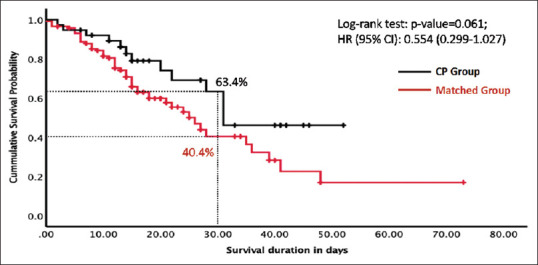
CP transfusion did not result in any adverse effects. There was no difference in the ICU LOS (median 8 days in both groups). The mortality risk was lower in the CP group: 13% absolute risk reduction ( = 0.147), hazard ratio (95% confidence interval): 0.554 (0.299-1.027; = 0.061) by log-rank test. There was no significant difference in the days on mechanical ventilation and days to clinical recovery.
CP containing detectable antibodies is a safe strategy and may result in a decrease in mortality in patients with severe COVID-19. The results of the completed trial with a larger study sample would provide more clarity if this difference in mortality is significant.
ClinicalTrials.gov Identifier: NCT04347681; Saudi Clinical Trials Registry No.: 20041102.
介绍一项全国性研究的中期结果,该研究调查含有可检测到的IgG抗体的恢复期血浆(CP)作为治疗重症2019冠状病毒病(COVID-19)的策略的安全性和有效性。
在沙特阿拉伯的22家医院进行的一项开放标签、双臂、II期临床试验。干预组包括40名确诊为重症COVID-19的成年人(年龄≥18岁),对照组包括124名根据年龄、性别、插管状态以及糖尿病和/或高血压病史使用倾向评分匹配的患者。干预组包括那些(a)有严重症状(呼吸困难;呼吸频率≥30次/分钟;SpO₂≤93%,动脉血氧分压/吸入氧分数比<300;和/或在24 - 48小时内肺部浸润>50%),(b)需要重症监护病房(ICU)护理或(c)处于危及生命状况的患者。对照组包括具有相似特征但不同意输注CP或因无法获得CP而无法接受CP的确诊重症COVID-19患者。
干预组参与者至少输注一次300毫升(200 - 400毫升/治疗剂量)CP,如有需要,每天输注一次,最多输注5次,同时接受最佳标准治疗。对照组仅接受最佳标准治疗。
主要终点是安全性和ICU住院时间(LOS)。次要终点包括30天死亡率、机械通气天数和临床恢复天数。
CP输血未导致任何不良反应。两组的ICU住院时间无差异(两组中位数均为8天)。CP组的死亡风险较低:绝对风险降低13%(P = 0.147),对数秩检验得出的风险比(95%置信区间):0.554(0.299 - 1.027;P = 0.061)。机械通气天数和临床恢复天数无显著差异。
含有可检测抗体的CP是一种安全的策略,可能会降低重症COVID-19患者的死亡率。如果这种死亡率差异显著,更大样本量的完整试验结果将提供更清晰的结论。
ClinicalTrials.gov标识符:NCT04347681;沙特临床试验注册号:20041102。