Altwijri Sulaiman, Alotaibi Abdulaziz, Alsaeed Mohammed, Alsalim Abdulrahman, Alatiq Abdulrahman, Al-Sarheed Saud, Agha Sajida, Omair Aamir
Department of Medical Education, College of Medicine, King Saud Bin Abdulaziz University for Health Sciences, Riyadh, Saudi Arabia.
King Abdulaziz Medical City, National Guard Health Affairs, Riyadh, Saudi Arabia.
Saudi J Med Med Sci. 2021 Jan-Apr;9(1):31-37. doi: 10.4103/sjmms.sjmms_375_19. Epub 2020 Dec 26.
Emotional intelligence (EI) is potentially associated with higher academic performance. However, no study from the Gulf region has previously assessed if EI affects academic success and academic performance in medical students.
To examine the relationship between EI and academic success and academic performance in a sample of Saudi Arabian medical students.
This cross-sectional, questionnaire study included all 4-6 year medical students enrolled at King Saud bin Abdulaziz University for Health Sciences (KSAU-HS), Riyadh, Saudi Arabia, in the academic year 2017-18. Eligible students were invited to complete the self-administered Schutte Self-Report Emotional Intelligence Test and the Academic Success Inventory for College Students (ASICS) along with a questionnaire eliciting demographic information between January and April 2018. Academic achievement was assessed based on each student's self-reported grade point average in the most recent examination.
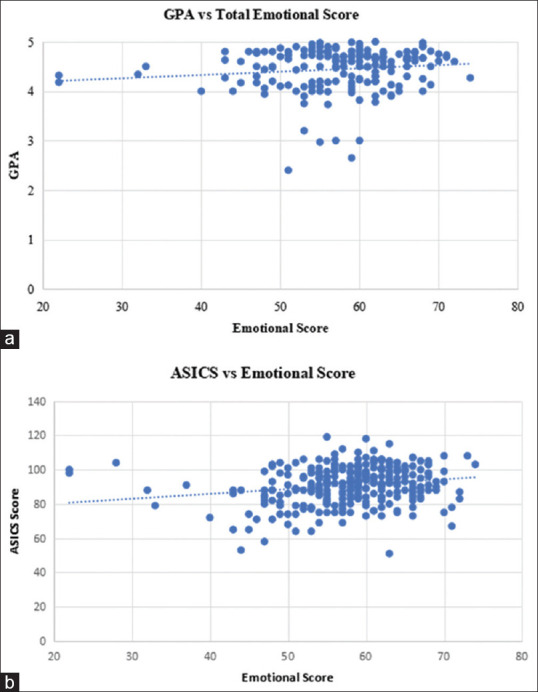
Of 377 eligible students, 296 (78%) completed the questionnaires. A significant association was identified between overall EI and ASICS scores ( = 0.197; < 0.001). EI scores were constant in males and females and the year of study. No statistically significant association was observed between EI and academic success across gender and academic years ( > 0.05 for all values). However, in terms of external motivation and career decidedness by level of study, final-year students had higher scores compared with students in the other two study years ( = 0.02 and = 0.01, respectively).
This study offers primary data on the impact of EI scores on academic success in medical education, and it identified several factors associated with EI and academic success. The findings of this study suggest that EI and academic success are linked, and that both are vital for increasing academic performance.
情商(EI)可能与更高的学业成绩相关。然而,海湾地区此前尚无研究评估情商是否会影响医学生的学业成就和学业表现。
在沙特阿拉伯医学生样本中研究情商与学业成就和学业表现之间的关系。
这项横断面问卷调查研究纳入了沙特阿拉伯利雅得国王沙特·本·阿卜杜勒阿齐兹卫生科学大学(KSAU - HS)2017 - 18学年注册的所有4至6年制医学生。符合条件的学生被邀请在2018年1月至4月期间完成自我管理的舒特自我报告情商测试和大学生学业成就量表(ASICS),以及一份获取人口统计学信息的问卷。根据每位学生在最近一次考试中自我报告的平均绩点来评估学业成绩。
在377名符合条件的学生中,296名(78%)完成了问卷。总体情商与ASICS得分之间存在显著关联(= 0.197;< 0.001)。男性和女性以及不同学习年份的情商得分保持不变。在不同性别和学年中,未观察到情商与学业成就之间存在统计学上的显著关联(所有值均> 0.05)。然而,就按学习水平划分的外部动机和职业确定性而言,最后一年的学生得分高于其他两个学习年份的学生(分别为= 0.02和= 0.01)。
本研究提供了关于情商得分对医学教育中学业成就影响的初步数据,并确定了与情商和学业成就相关的几个因素。本研究结果表明,情商与学业成就相关联,且两者对于提高学业表现都至关重要。