Stuckenschneider Tim, Sanders Marit L, Devenney Kate E, Aaronson Justine A, Abeln Vera, Claassen Jurgen A H R, Guinan Emer, Lawlor Brian, Meeusen Romain, Montag Christian, Olde Rikkert Marcel G M, Polidori M Cristina, Reuter Martin, Schulz Ralf-Joachim, Vogt Tobias, Weber Bernd, Kessels Roy P C, Schneider Stefan
Institute of Movement and Neurosciences, German Sport University, Cologne, Germany.
VasoActive Research Group, School of Health and Sport Sciences, University of the Sunshine Coast, Maroochydore, QLD, Australia.
Front Aging Neurosci. 2021 Jan 14;12:621947. doi: 10.3389/fnagi.2020.621947. eCollection 2020.
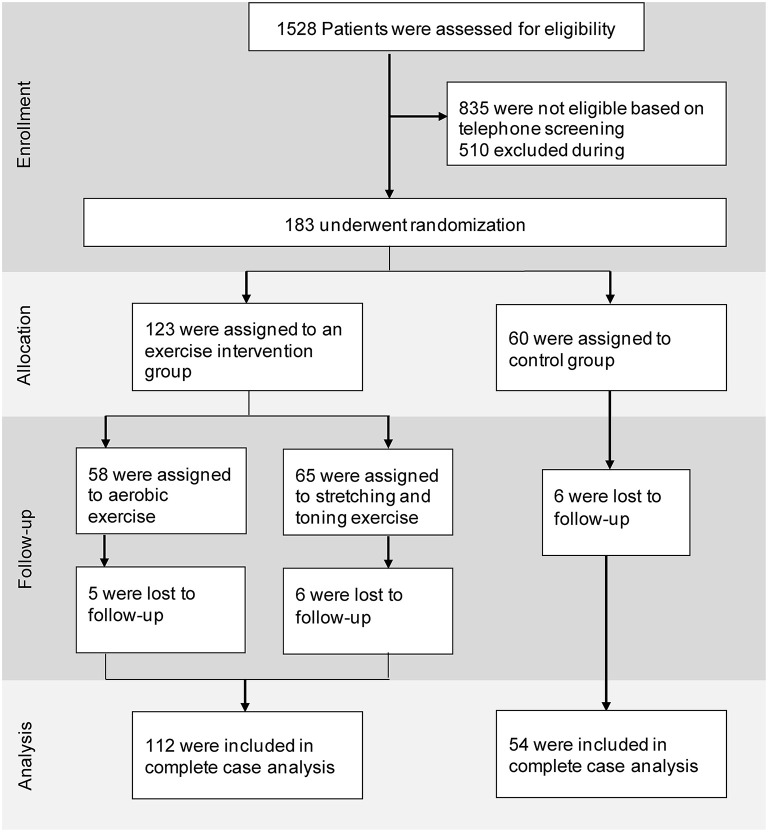
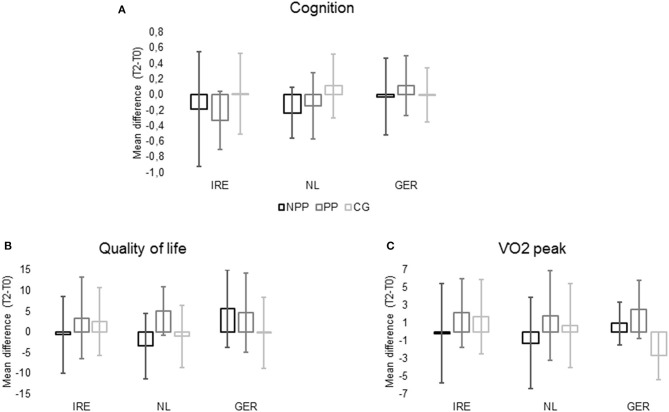
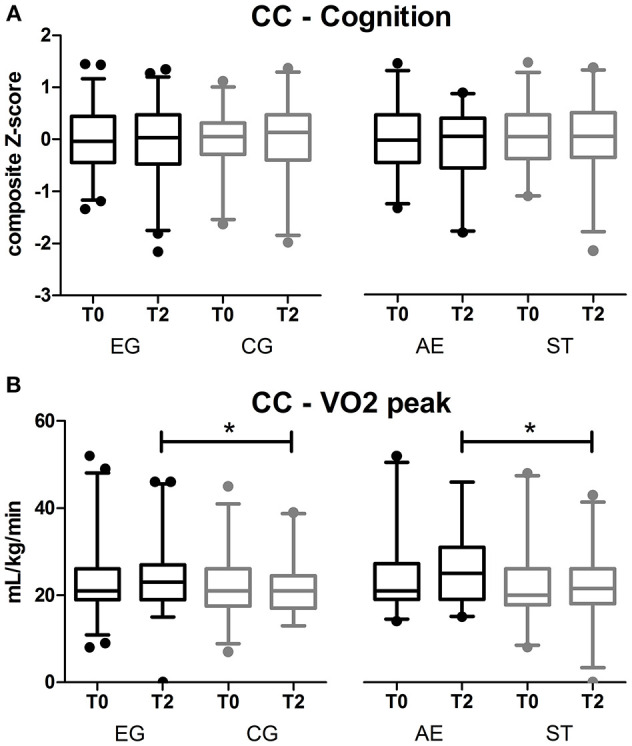
Exercise intervention studies in mild cognitive impairment (MCI), a prodromal stage of Alzheimer's disease (AD), have demonstrated inconsistent yet promising results. Addressing the limitations of previous studies, this trial investigated the effects of a 12-month structured exercise program on the progression of MCI. The NeuroExercise study is a multicenter randomized controlled trial across three European countries (Ireland, Netherlands, Germany). Hundred and eighty-three individuals with amnestic MCI were included and were randomized to a 12-month exercise intervention (3 units of 45 min) of either aerobic exercise (AE; = 60), stretching and toning exercise (ST; = 65) or to a non-exercise control group (CG; = 58). The primary outcome, cognitive performance, was determined by an extensive neuropsychological test battery. For the primary complete case (CC) analyses, between-group differences were analyzed with analysis of covariance under two conditions: (1) the exercise group (EG = combined AE and ST groups) compared to the CG and (2) AE compared to ST. Primary analysis of the full cohort ( = 166, 71.5 years; 51.8% females) revealed no between-group differences in composite cognitive score [mean difference (95% CI)], 0.12 [(-0.03, 0.27), = 0.13] or in any cognitive domain or quality of life. VO peak was significantly higher in the EG compared to the CG after 12 months [-1.76 (-3.39, -0.10), = 0.04]. Comparing the two intervention groups revealed a higher VOpeak level in the aerobic exercise compared to the stretching and toning group, but no differences for the other outcomes. A 12-month exercise intervention did not change cognitive performance in individuals with amnestic MCI in comparison to a non-exercise CG. An intervention effect on physical fitness was found, which may be an important moderator for long term disease progression and warrants long-term follow-up investigations. https://clinicaltrials.gov/ct2/show/NCT02913053, identifier: NCT02913053.
针对轻度认知障碍(MCI)这一阿尔茨海默病(AD)前驱阶段开展的运动干预研究,已呈现出不一致但颇具前景的结果。为解决既往研究的局限性,本试验调查了一项为期12个月的结构化运动计划对MCI进展的影响。“神经运动研究”是一项在三个欧洲国家(爱尔兰、荷兰、德国)开展的多中心随机对照试验。纳入了183名遗忘型MCI患者,并将他们随机分为接受为期12个月运动干预(每次45分钟,共3组)的有氧运动组(AE;n = 60)、伸展和塑形运动组(ST;n = 65)或非运动对照组(CG;n = 58)。主要结局指标,即认知表现,通过一套广泛的神经心理测试组合来确定。对于主要的完整病例(CC)分析,在两种情况下采用协方差分析来分析组间差异:(1)运动组(EG = AE组和ST组合并)与CG组比较;(2)AE组与ST组比较。对整个队列(n = 166,71.5岁;51.8%为女性)的初步分析显示,在综合认知评分[平均差异(95%置信区间)]、0.12[(-0.03,0.27),p = 0.13]或任何认知领域及生活质量方面,组间均无差异。12个月后,与CG组相比,EG组的峰值摄氧量显著更高[-1.76(-3.39,-0.10),p = 0.04]。比较两个干预组发现,有氧运动组的峰值摄氧量水平高于伸展和塑形运动组,但在其他结局指标上无差异。与非运动CG组相比,为期12个月的运动干预并未改变遗忘型MCI患者的认知表现。发现了对身体素质的干预效果,这可能是长期疾病进展的一个重要调节因素,值得进行长期随访研究。https://clinicaltrials.gov/ct2/show/NCT02913053,标识符:NCT02913053