Wu Jiamin, Li Yi, Yu Jiayao, Gan Zhending, Wei Wenyao, Wang Chao, Zhang Lili, Wang Tian, Zhong Xiang
College of Animal Science and Technology, Nanjing Agricultural University, Nanjing, China.
Front Pharmacol. 2020 Dec 18;11:568006. doi: 10.3389/fphar.2020.568006. eCollection 2020.
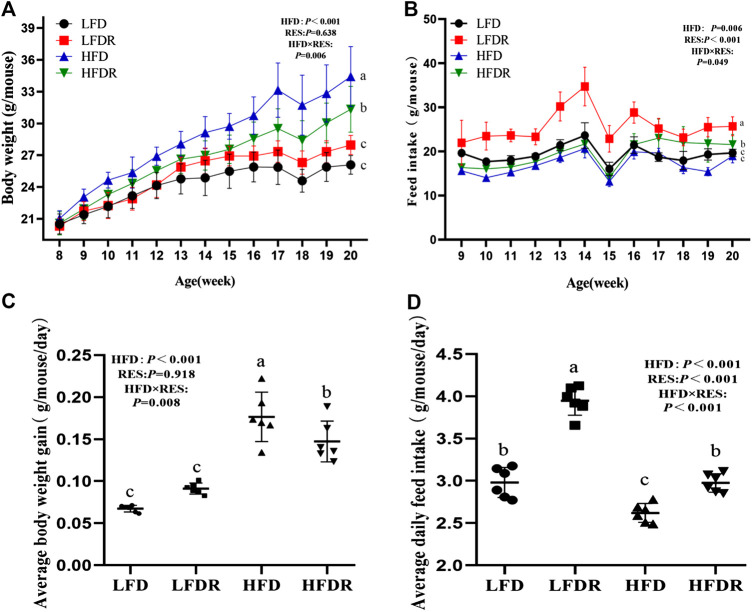
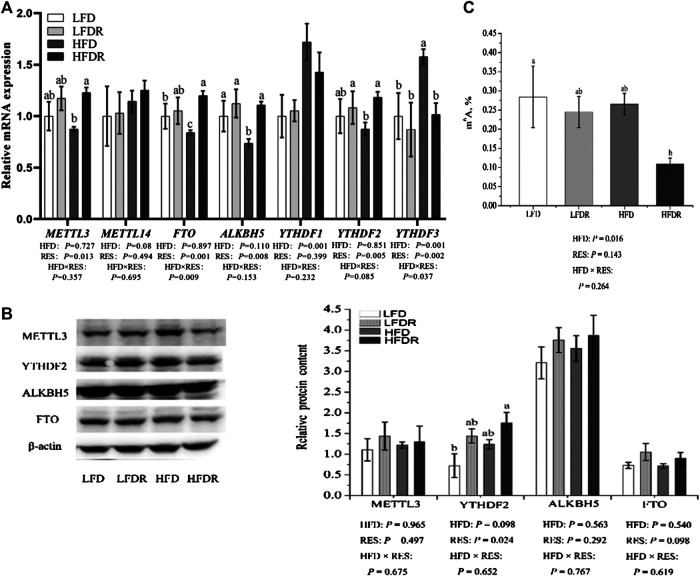
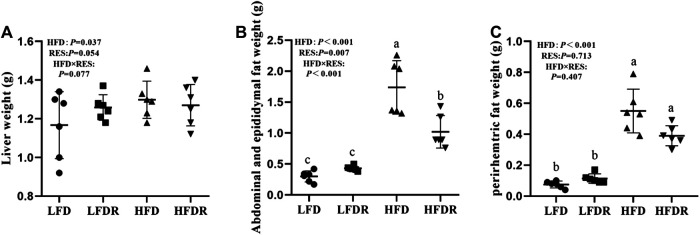
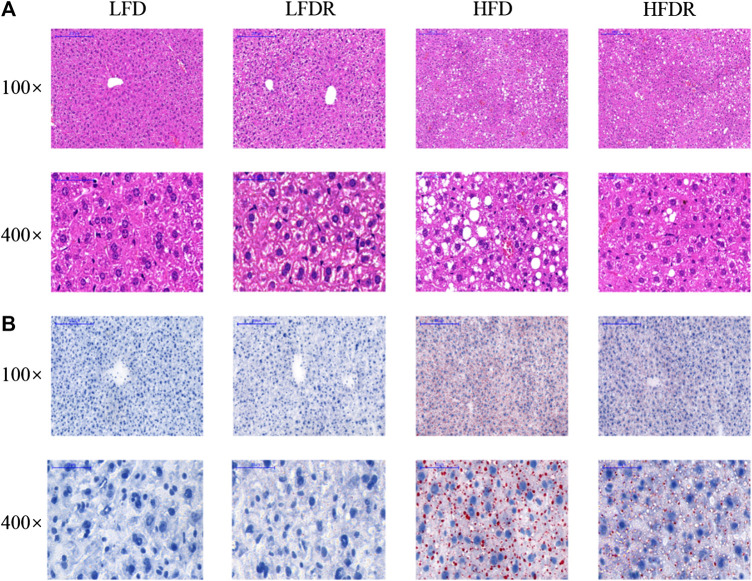
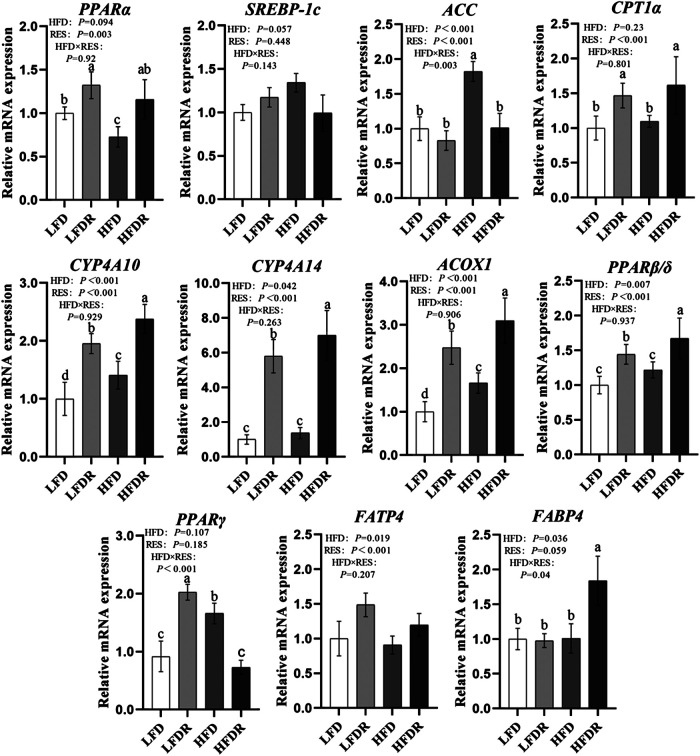
-methyladenosine (mA) mRNA methylation is affected by dietary factors and associated with lipid metabolism; however, whether the regulatory role of resveratrol in lipid metabolism is involved in mA mRNA methylation remains unknown. Here, the objective of this study was to investigate the effect of resveratrol on hepatic lipid metabolism and mA RNA methylation in the liver of mice. A total of 24 male mice were randomly allocated to LFD (low-fat diet), LFDR (low-fat diet + resveratrol), HFD (high-fat diet), and HFDR (high-fat diet + resveratrol) groups for 12 weeks ( = 6/group). Final body weight of mice was measured before sacrificing. Perirhemtric fat, abdominal and epididymal fat, liver tissues, and serum were collected at sacrifice and analyzed. Briefly, mice phenotype, lipid metabolic index, and mA modification in the liver were assessed. Compared to the HFD group, dietary resveratrol supplementation reduced the body weight and relative abdominal, epididymal, and perirhemtric fat weight in high-fat-exposed mice; however, resveratrol significantly increased average daily feed intake in mice given HFD. The amounts of serum low-density lipoprotein cholesterol (LDL), liver total cholesterol (TC), and triacylglycerol (TAG) were significantly decreased by resveratrol supplementation. In addition, resveratrol significantly enhanced the levels of peroxisome proliferator-activated receptor alpha (), peroxisome proliferator-activated receptor beta/delta (), cytochrome P450, family 4, subfamily a, polypeptide 10/14 (/), acyl-CoA oxidase 1 (), and fatty acid-binding protein 4 () mRNA and inhibited acyl-CoA carboxylase () mRNA levels in the liver. Furthermore, the resveratrol in HFD increased the transcript levels of methyltransferase like 3 (), alkB homolog 5 (), fat mass and obesity associated protein (), and YTH domain family 2 (), whereas it decreased the level of YTH domain family 3 () and mA abundance in mice liver. The beneficial effect of resveratrol on lipid metabolism disorder under HFD may be due to decrease of mA RNA methylation and increase of mRNA, providing mechanistic insights into the function of resveratrol in alleviating the disturbance of lipid metabolism in mice.
N6-甲基腺苷(m⁶A)mRNA甲基化受饮食因素影响并与脂质代谢相关;然而,白藜芦醇在脂质代谢中的调节作用是否涉及m⁶A mRNA甲基化仍不清楚。在此,本研究的目的是探讨白藜芦醇对小鼠肝脏脂质代谢和肝脏中m⁶A RNA甲基化的影响。总共24只雄性小鼠被随机分为低脂饮食(LFD)、低脂饮食+白藜芦醇(LFDR)、高脂饮食(HFD)和高脂饮食+白藜芦醇(HFDR)组,持续12周(每组n = 6)。在处死小鼠前测量其最终体重。处死时收集外周脂肪、腹部和附睾脂肪、肝脏组织及血清并进行分析。简要来说,评估了小鼠的表型、脂质代谢指标以及肝脏中的m⁶A修饰情况。与高脂饮食组相比,补充白藜芦醇的饮食降低了高脂暴露小鼠的体重以及相对腹部、附睾和外周脂肪重量;然而,白藜芦醇显著增加了给予高脂饮食小鼠的平均每日采食量。补充白藜芦醇显著降低了血清低密度脂蛋白胆固醇(LDL)、肝脏总胆固醇(TC)和甘油三酯(TAG)的含量。此外,白藜芦醇显著提高了过氧化物酶体增殖物激活受体α(PPARα)、过氧化物酶体增殖物激活受体β/δ(PPARβ/δ)、细胞色素P450 4A10/14(CYP4A10/14)、酰基辅酶A氧化酶1(ACOX1)和脂肪酸结合蛋白4(FABP4)mRNA的水平,并抑制了肝脏中酰基辅酶A羧化酶(ACC)mRNA的水平。此外,高脂饮食中的白藜芦醇增加了类甲基转移酶3(METTL3)、alkB同源物5(ALKBH5)、脂肪量和肥胖相关蛋白(FTO)以及YTH结构域家族2(YTHDF2)的转录水平,而降低了小鼠肝脏中YTH结构域家族3(YTHDF3)的水平和m⁶A丰度。白藜芦醇对高脂饮食下脂质代谢紊乱的有益作用可能归因于m⁶A RNA甲基化的降低和PPARα mRNA的增加,这为白藜芦醇在减轻小鼠脂质代谢紊乱中的作用提供了机制性见解。