Jiang Zhihui, Luo Maojun, Ma Wentao, Ma Shengming, Wang Yao, Zhang Kunpeng
Henan Joint International Research Laboratory of Veterinary Biologics Research and Application, Anyang Institute of Technology, Anyang, China.
College of Food Science and Technology, Henan Agricultural University, Zhengzhou, China.
Front Pharmacol. 2021 Jan 14;11:585945. doi: 10.3389/fphar.2020.585945. eCollection 2020.
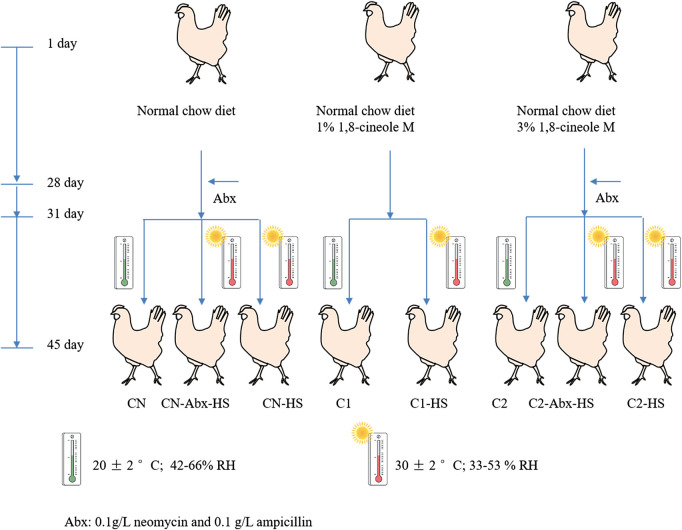
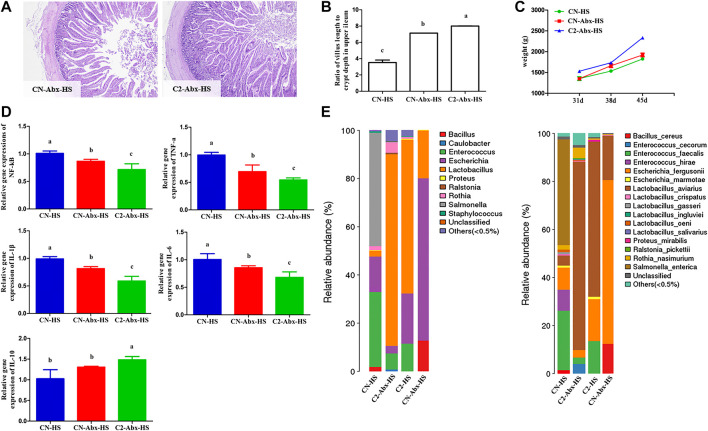
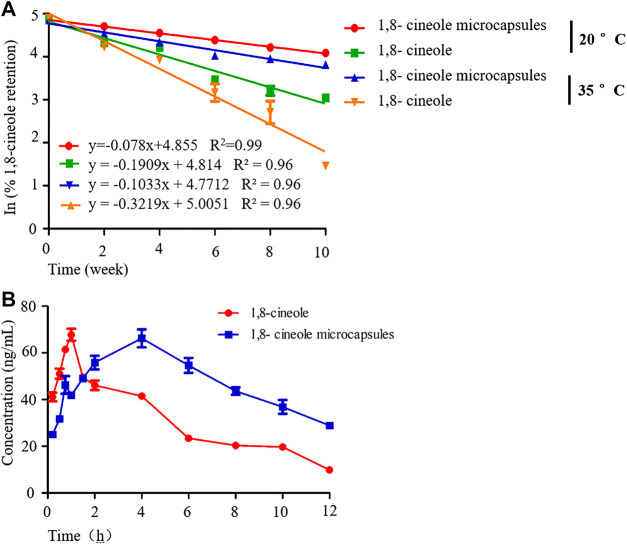
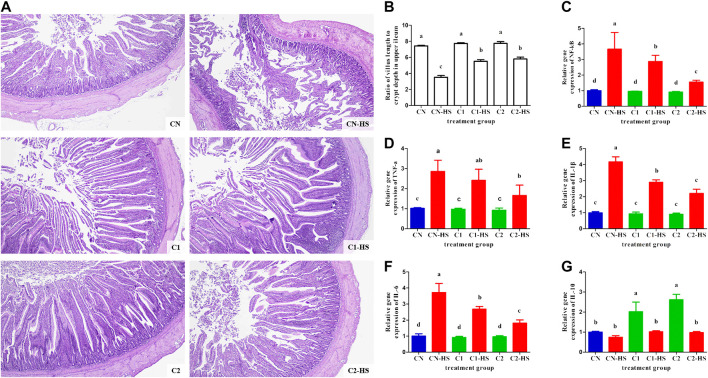
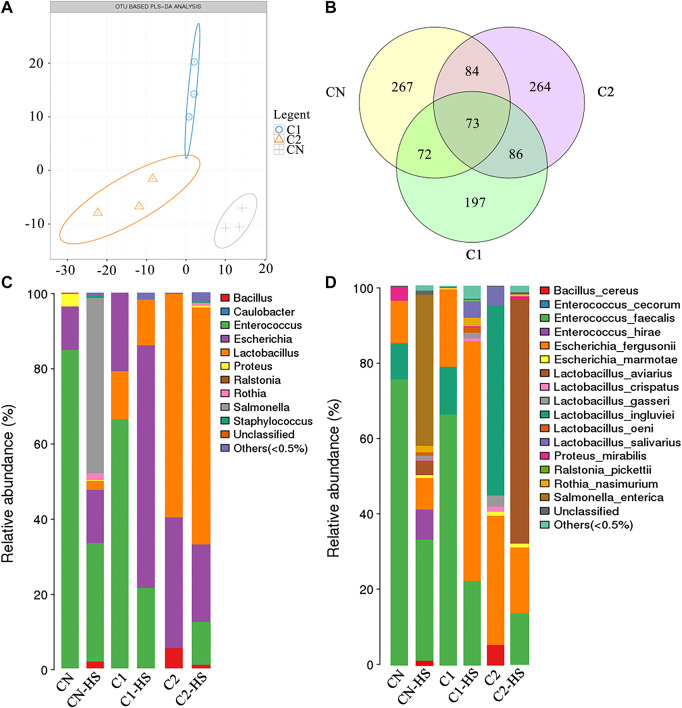
Intestinal microbiota dysregulation is considered the primary trigger of low-grade inflammation responsible for weight loss due to heat stress. 1,8-Cineole is the major bacteriostatic agent in eucalypt and possesses remarkable anti-inflammatory properties. However, the mechanisms of its effect on intestinal microbiota remain unclear. In this study, 1,8-cineole was prepared into microcapsules prior to use as feed supplement in chickens. The microencapsulation efficiency and chemical stability of 1,8-cineole microcapsules were evaluated. The chicken treatment with 1,8-cineole microcapsules (1 or 3%) for 45 days, in the presence or absence of heat stress for fifteen days, commenced on Day 31, with or without an antibiotics mix (Abx) for three days on Day 27. Performance parameters were measured once a week from Day 30 through Day 45. Surface and entrapped concentration of 1,8-cineole was estimated as 7.89 g/100 g powder in the microcapsules. The time to maximal concentration (T, terminal half-life (T), and the area under plasma concentration-time curve (AUC) of the encapsulated 1,8-cineole were higher than those of the nonencapsulated in treated chickens, although the maximal concentrations (C) were similar. Chickens treated under higher temperatures with 1,8-cineole microcapsules exhibited lower levels of grade inflammation and higher body weight gain. Dietary 1,8-cineole microcapsules recovered the normal structure of upper ileum and altered the ratio of gut microbiota under heat stress and increased the ratio of and , whereas the proportion of decreased based on 16S rRNA analysis of the upper ileum microbiota. , 1,8-cineole effectively inhibited the growth of as demonstrated by inhibition zone assay. In summary, our findings elucidated the interaction between 1,8-cineole and intestinal microbiota as a new mechanism for the anti-heat stress effect of 1,8-cineole in preventing low-grade inflammation and weight loss. The results suggest that 1,8-cineole microcapsules may be a good feed supplement to protect against heat stress injury.
肠道微生物群失调被认为是导致热应激引起体重减轻的低度炎症的主要触发因素。1,8-桉叶素是桉树叶中的主要抑菌剂,具有显著的抗炎特性。然而,其对肠道微生物群的作用机制仍不清楚。在本研究中,将1,8-桉叶素制成微胶囊,然后用作鸡的饲料补充剂。评估了1,8-桉叶素微胶囊的微囊化效率和化学稳定性。在第31天开始对鸡用1,8-桉叶素微胶囊(1%或3%)处理45天,在第15天存在或不存在热应激的情况下,在第27天添加或不添加抗生素混合物(Abx)处理三天。从第30天到第45天每周测量一次性能参数。微胶囊中1,8-桉叶素的表面和包封浓度估计为7.89 g/100 g粉末。尽管最大浓度(C)相似,但在处理的鸡中,包封的1,8-桉叶素的最大浓度时间(T)、末端半衰期(T)和血浆浓度-时间曲线下面积(AUC)高于未包封的。用1,8-桉叶素微胶囊在较高温度下处理的鸡表现出较低水平的炎症分级和较高的体重增加。日粮中的1,8-桉叶素微胶囊恢复了热应激下上回肠的正常结构,改变了肠道微生物群的比例,增加了 和 的比例,而上回肠微生物群的16S rRNA分析显示 的比例下降。通过抑菌圈试验证明,1,8-桉叶素能有效抑制 的生长。总之,我们的研究结果阐明了1,8-桉叶素与肠道微生物群之间的相互作用,这是1,8-桉叶素抗热应激作用预防低度炎症和体重减轻的新机制。结果表明,1,8-桉叶素微胶囊可能是一种很好的饲料补充剂,可预防热应激损伤。