Horváth Áron, Vig Luca, Ferentzi Eszter, Köteles Ferenc
Doctoral School of Psychology, ELTE Eötvös Loránd University, Budapest, Hungary.
Institute of Health Promotion and Sport Sciences, ELTE Eötvös Loránd University, Budapest, Hungary.
Front Psychol. 2021 Jan 14;11:575574. doi: 10.3389/fpsyg.2020.575574. eCollection 2020.
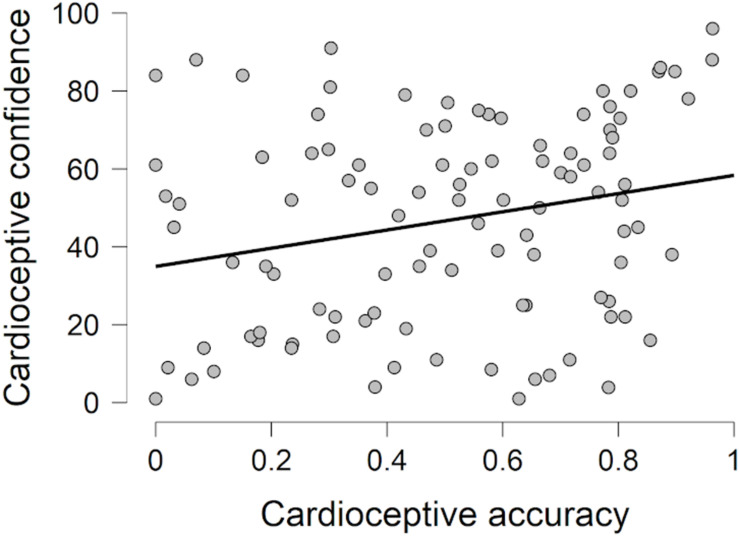
Interoception in the broader sense refers to the perception of internal states, including the perception of the actual state of the internal organs (visceroception) and the motor system (proprioception). Dimensions of interoception include (1) interoceptive accuracy, i.e., the ability to sense internal changes assessed with behavioral tests, (2) confidence rating with respect to perceived performance in an actual behavioral test, and (3) interoceptive sensibility, i.e., the self-reported generalized ability to perceive body changes. The relationship between dimension of cardioceptive and proprioceptive modalities and their association with affect are scarcely studied. In the present study, undergraduate students ( = 105, 53 males, age: 21.0 ± 1.87 years) filled out questionnaires assessing positive and negative affect (Positive and Negative Affect Schedule), interoceptive sensibility (Body Awareness Questionnaire), and body competence (Body Competence Scale of the Body Consciousness Questionnaire). Following this, they completed a behavioral task assessing cardioceptive accuracy (the mental heartbeat tracking task by Schandry) and two tasks assessing proprioceptive accuracy with respect to the tension of arm flexor muscles (weight discrimination task) and the angular position of the elbow joint (joint position reproduction task). Confidence ratings were measured with visual analog scales after the tasks. With the exception of a weak association between cardioceptive accuracy and the respective confidence rating, no associations between and within modalities were found with respect to various dimensions of interoception. Further, the interoceptive dimensions were not associated with state and trait positive and negative affect and perceived body competence. In summary, interoceptive accuracy scores do not substantially contribute to conscious representations of cardioceptive and proprioceptive ability. Within our data, non-pathological affective states (PANAS) are not associated with the major dimensions of interoception for the cardiac and proprioceptive modalities.
广义上的内感受是指对内部状态的感知,包括对内脏器官实际状态的感知(内脏感觉)和运动系统的感知(本体感觉)。内感受的维度包括:(1)内感受准确性,即通过行为测试评估的感知内部变化的能力;(2)在实际行为测试中对感知表现的信心评级;(3)内感受敏感性,即自我报告的感知身体变化的一般能力。关于心感受和本体感受方式的维度及其与情感的关联研究甚少。在本研究中,本科生(n = 105,53名男性,年龄:21.0 ± 1.87岁)填写了评估积极和消极情绪的问卷(积极和消极情绪量表)、内感受敏感性问卷(身体意识问卷)和身体能力问卷(身体意识问卷的身体能力量表)。在此之后,他们完成了一项评估心感受准确性的行为任务(Schandry的心理心跳追踪任务)以及两项评估手臂屈肌紧张度的本体感受准确性的任务(重量辨别任务)和肘关节角度位置的任务(关节位置再现任务)。任务完成后,用视觉模拟量表测量信心评级。除了心感受准确性与相应信心评级之间存在微弱关联外,在各种内感受维度方面,未发现方式之间及方式内部存在关联。此外,内感受维度与状态和特质性积极和消极情绪以及感知到的身体能力无关。总之,内感受准确性得分对心感受和本体感受能力的意识表征贡献不大。在我们的数据中,非病理性情感状态(积极和消极情绪量表)与心脏和本体感受方式的主要内感受维度无关。