Han Paul K J, Gutheil Caitlin, Hutchinson Rebecca N, LaChance Jason A
Center for Outcomes Research and Evaluation, Maine Medical Center, Portland, ME, United States.
Tufts University School of Medicine, Boston, MA, United States.
Front Psychol. 2021 Jan 15;11:626038. doi: 10.3389/fpsyg.2020.626038. eCollection 2020.
Fear of cancer recurrence (FCR) is an important cause of suffering for cancer survivors, and both empirical evidence and theoretical models suggest that prognostic uncertainty plays a causal role in its development. However, the relationship between prognostic uncertainty and FCR is incompletely understood.
To explore the relationship between prognostic uncertainty and FCR among patients with ovarian cancer (OC).
A qualitative study was conducted utilizing individual in-depth interviews with a convenience sample of patients with epithelial ovarian cancer who had completed first-line treatment with surgery and/or chemotherapy. Semi-structured interviews explored participants' (1) understanding of their prognosis; (2) experiences, preferences, and attitudes regarding prognostic information; and (3) strategies for coping with prognostic uncertainty. Inductive qualitative analysis and line-by-line software-assisted coding of interview transcripts was conducted to identify key themes and generate theoretical insights on the relationship between prognostic uncertainty and FCR.
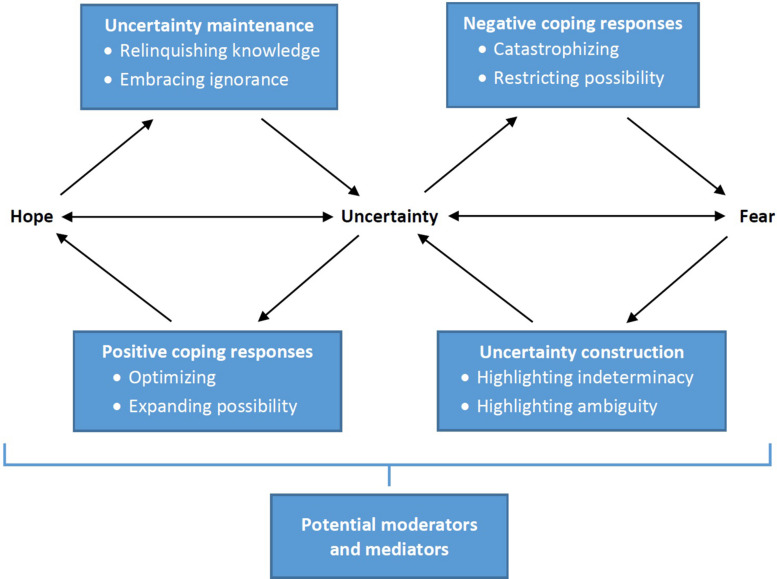
The study sample consisted of 21 participants, nearly all of whom reported experiencing significant FCR, which they traced to an awareness of the possibility of a bad outcome. Some participants valued and pursued prognostic information as a means of coping with this awareness, suggesting that prognostic uncertainty causes FCR. However, most participants acknowledged fundamental limits to both the certainty and value of prognostic information, and engaged in various strategies aimed not at reducing but constructing and maintaining prognostic uncertainty as a means of sustaining hope in the possibility of a good outcome. Participants' comments suggested that prognostic uncertainty, fear, and hope are connected by complex, bi-directional causal pathways mediated by processes that allow patients to cope with, construct, and maintain their uncertainty. A provisional dual-process theoretical model was developed to capture these pathways.
Among patients with OC, prognostic uncertainty is both a cause and an effect of FCR-a fear-inducing stimulus and a hope-sustaining response constructed and maintained through various strategies. More work is needed to elucidate the relationships between prognostic uncertainty, fear, and hope, to validate and refine our theoretical model, and to develop interventions to help patients with OC and other serious illnesses to achieve an optimal balance between these states.
癌症复发恐惧(FCR)是癌症幸存者痛苦的重要原因,实证证据和理论模型均表明预后不确定性在其形成过程中起因果作用。然而,预后不确定性与FCR之间的关系尚未完全明晰。
探讨卵巢癌(OC)患者中预后不确定性与FCR之间的关系。
采用定性研究,对完成手术和/或化疗一线治疗的上皮性卵巢癌患者便利样本进行个体深入访谈。半结构化访谈探讨了参与者(1)对自身预后的理解;(2)关于预后信息的经历、偏好和态度;(3)应对预后不确定性的策略。对访谈转录本进行归纳定性分析和逐行软件辅助编码,以识别关键主题并就预后不确定性与FCR之间的关系产生理论见解。
研究样本包括21名参与者,几乎所有人都报告经历了显著的FCR,他们将其归因于意识到可能出现不良结果。一些参与者重视并寻求预后信息作为应对这种意识的一种方式,表明预后不确定性导致FCR。然而,大多数参与者承认预后信息的确定性和价值都存在根本局限,并采取了各种策略,目的不是减少而是构建和维持预后不确定性,以此作为维持对良好结果可能性的希望的一种手段。参与者的评论表明,预后不确定性、恐惧和希望通过复杂的双向因果途径相互关联,这些途径由使患者能够应对、构建和维持其不确定性的过程介导。开发了一个临时的双过程理论模型来捕捉这些途径。
在OC患者中,预后不确定性既是FCR的原因也是结果——一种诱发恐惧的刺激因素,以及通过各种策略构建和维持的维持希望的反应。需要开展更多工作来阐明预后不确定性、恐惧和希望之间的关系,验证和完善我们的理论模型,并开发干预措施,以帮助OC患者和其他重症患者在这些状态之间实现最佳平衡。