Fuller Karla S, Torres Rivera Camila
Science Department, Stella and Charles Guttman Community College, City University of New York, New York, NY, United States.
Mathematics Department, Stella and Charles Guttman Community College, City University of New York, New York, NY, United States.
Front Microbiol. 2021 Jan 13;11:577852. doi: 10.3389/fmicb.2020.577852. eCollection 2020.
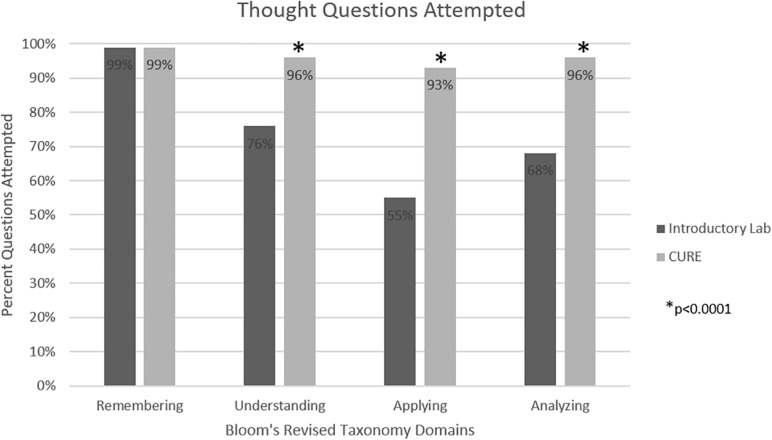
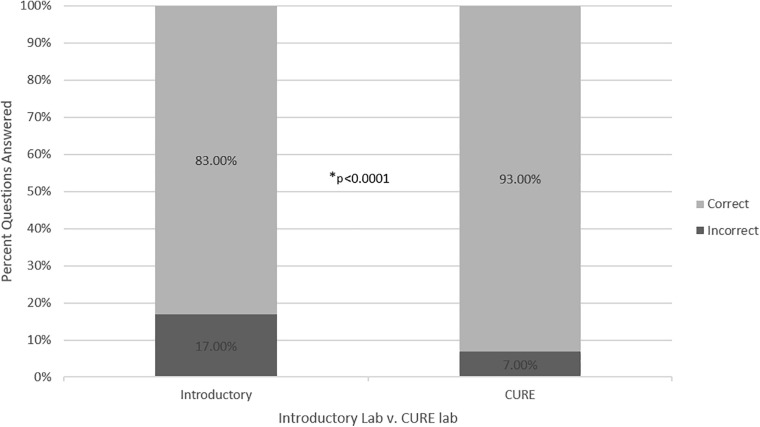
We seek to increase student engagement and success to subsequently lead to increased retention and degree attainment for students at our Hispanic-serving institution. We hypothesized that using a culturally responsive approach in an undergraduate microbiology lab would increase engagement and learning gains. Using a culturally responsive approach allowed students to start their learning from their own place of understanding-centering students' lived experiences. Students interviewed family members to learn about "home remedies," and then devised experiments to test whether those home remedies affected growth of bacteria commonly implicated in gastrointestinal distress (, , and ) or sore throat (, , and ). As a final assessment, students generated project posters which they presented at a class symposium. Implementation of a culturally responsive research experience focused on the gut microbiome resulted in increased learning gains as evidenced by movement up Bloom's Revised Taxonomy Scale. Student feedback indicated increased engagement, increased confidence in communicating science and a deeper understanding and appreciation for microbiology. Taken together, the results indicate that students appreciate a more culturally responsive and student-centered approach to learning in microbiology and encourages expansion of this approach to other modules in the course. This paper includes responsive data to support this claim, as well as a sample course calendar and supplementary learning material to support the human microbiome approach to microbiology.
我们致力于提高学生的参与度和成功率,进而提高我校这所西班牙裔服务机构学生的留校率和学位获得率。我们假设在本科微生物学实验室采用具有文化响应性的方法会提高参与度和学习收获。采用具有文化响应性的方法使学生能够从自己的理解起点出发进行学习——以学生的生活经历为中心。学生采访家庭成员以了解“家庭疗法”,然后设计实验来测试这些家庭疗法是否会影响通常与胃肠道不适(如 、 和 )或喉咙痛(如 、 和 )有关的细菌的生长。作为最终评估,学生制作项目海报并在班级研讨会上展示。实施以肠道微生物群为重点的具有文化响应性的研究体验,学习收获有所增加,这在布鲁姆修订分类法量表上的进步得到了证明。学生反馈表明参与度提高、在科学交流方面的信心增强,以及对微生物学有了更深入的理解和欣赏。总体而言,结果表明学生赞赏在微生物学学习中采用更具文化响应性和以学生为中心的方法,并鼓励将这种方法扩展到课程的其他模块。本文包含支持这一观点的响应性数据,以及一份示例课程日历和补充学习材料,以支持以人类微生物群方法教授微生物学。