Pérez-Losada Marcos, Crandall Kelly M, Crandall Keith A
Computational Biology Institute, Department of Biostatistics and Bioinformatics, Milken Institute School of Public Health, George Washington University, Washington, DC 20052-0066, USA.
CIBIO-InBIO, Centro de Investigação em Biodiversidade e Recursos Genéticos, Universidade do Porto, Campus Agrário de Vairão, Vairão 4485-661, Portugal.
J Microbiol Biol Educ. 2020 Feb 28;21(1). doi: 10.1128/jmbe.v21i1.2019. eCollection 2020.
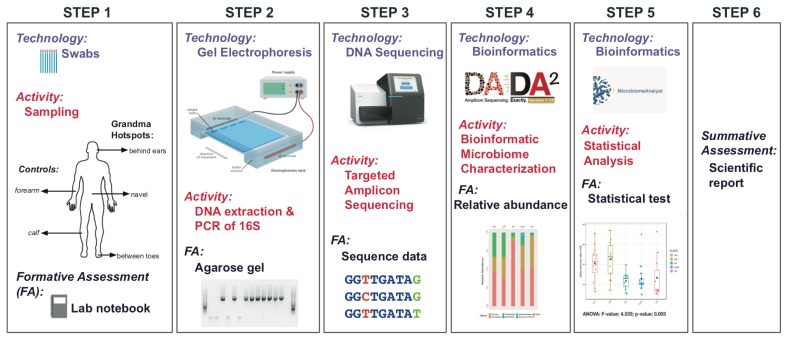
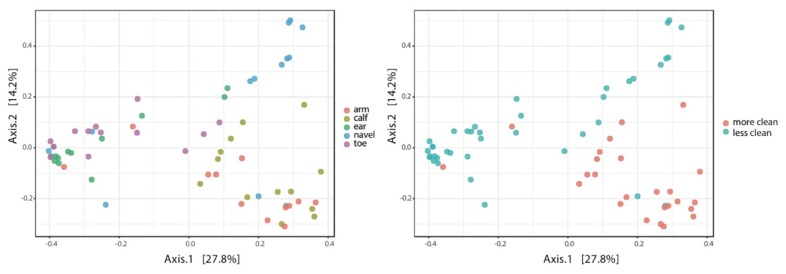
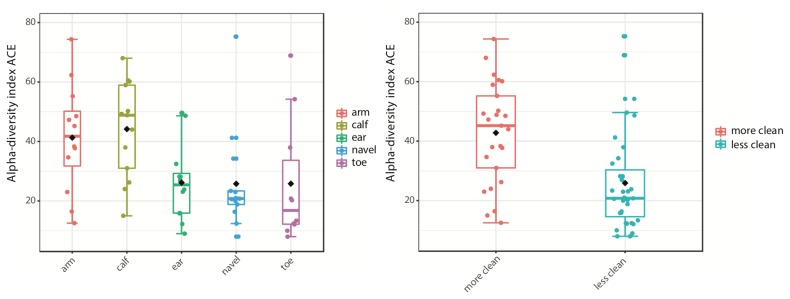
The constantly evolving nature of genomics provides new challenges for students in Public Health as they try to understand how genomic information relates to health and disease. As Public Health curricula attempt to keep pace with the most recent advances in genomics, students should gain experience with analyzing genomic data and applying genomic tools to the study of health-related issues. To advance undergraduate and graduate student education and provide a more comprehensive view of genomics, we developed an educational project including both pedagogic and research components to characterize skin microbial communities (microbiomes) using targeted amplicon sequencing of their genomes (metataxonomy). All students completed the lab procedures, analyzed 16S rRNA genomic data (formative assessments), and wrote a five-page scientific report summarizing and discussing their results (summative assessment). Student grades for the summative assessment ranged from 31.5 to 40 (out of 40) points. They also successfully completed two practicums (problem sets) focused on microbiome sequence data and responded to 12 minute-papers related to genomic topics covered in class. In all these exercises the 2019 students outperformed 2018 students, who did not participate in this educational lab project. By fulfilling all the requirements of this project-based learning experience, students better understood the complexity of genomics and acquired a valuable set of marketable experience and skills in molecular technologies, bioinformatics and statistics (quantitative skills). Additionally, students were able to generate new valuable microbial 16S rRNA genomic data and test hypotheses about the composition and diversity of the microbes living on our skin (microbiota).
基因组学不断发展的特性给公共卫生专业的学生带来了新的挑战,因为他们试图理解基因组信息与健康和疾病之间的关系。随着公共卫生课程努力跟上基因组学的最新进展,学生应该获得分析基因组数据以及将基因组工具应用于健康相关问题研究的经验。为了推进本科生和研究生教育,并提供更全面的基因组学视角,我们开展了一个教育项目,该项目包括教学和研究两个部分,通过对皮肤微生物群落(微生物组)的基因组进行靶向扩增子测序(宏分类学)来对其进行表征。所有学生都完成了实验步骤,分析了16S rRNA基因组数据(形成性评估),并撰写了一份五页的科学报告,总结和讨论他们的结果(总结性评估)。总结性评估中学生的成绩在31.5到40分(满分40分)之间。他们还成功完成了两个专注于微生物组序列数据的实习(问题集),并回答了与课堂上涵盖的基因组学主题相关的12份即时论文。在所有这些练习中,2019年的学生表现优于未参与这个教育实验室项目的2018年学生。通过完成这个基于项目的学习体验的所有要求,学生们更好地理解了基因组学的复杂性,并在分子技术、生物信息学和统计学(定量技能)方面获得了一套宝贵的、有市场价值的经验和技能。此外,学生们能够生成新的、有价值的微生物16S rRNA基因组数据,并检验关于生活在我们皮肤上的微生物(微生物群)的组成和多样性的假设。