Rosa-Alcázar Ángel, García-Hernández María Dolores, Parada-Navas José Luis, Olivares-Olivares Pablo J, Martínez-Murillo Sergio, Rosa-Alcázar Ana I
Department of Psychology, Catholic University of Murcia, Spain.
Department of Personality, Assessment & Psychological Treatment, University of Murcia, Spain.
Int J Clin Health Psychol. 2021 May-Aug;21(2):100223. doi: 10.1016/j.ijchp.2021.100223. Epub 2021 Jan 16.
The main aim of this study was to compare coping strategies in obsessive-compulsive disorder (OCD) patients and a healthy control group during COVID-19 lockdown and to analyze the relationship with some variables which may influence results (depression, anxiety, comorbidity, subtype of obsession-compulsion).
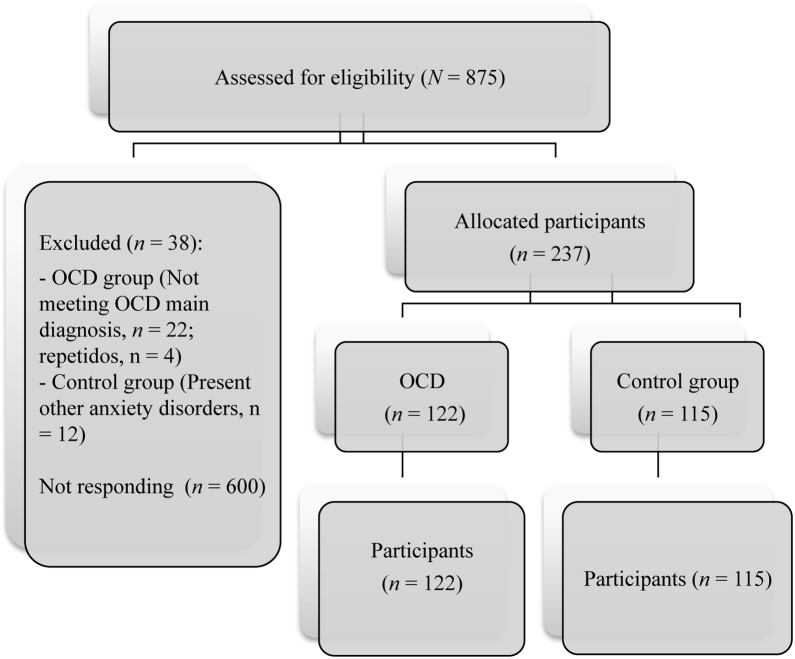
There were 237 participants, 122 OCD and 115 healthy controls, aged 17-61 years old ( = 33.48, = 11.13).
Groups showed differences in the use of some adaptive strategies (positive reinterpretation, acceptance, humor) and maladaptive (denial, self-blame). Within obsessive-compulsive group, comorbidity affected the greater use of inappropriate strategies (denial, substance abuse and self-blame) while type of obsession-compulsion did not influence use. Anxiety and depression levels were related to the use of less adaptive strategies.
These findings strengthen the need for training in the use of effective and adaptive coping strategies, making it necessary to improve clinical follow-up of these patients. It is relevant to be in contact with healthcare professionals, review medication and observe the anxiety and depression levels.
本研究的主要目的是比较强迫症(OCD)患者和健康对照组在新冠疫情封锁期间的应对策略,并分析与可能影响结果的一些变量(抑郁、焦虑、共病、强迫观念-强迫行为亚型)之间的关系。
共有237名参与者,122名强迫症患者和115名健康对照者,年龄在17 - 61岁之间(平均年龄 = 33.48,标准差 = 11.13)。
两组在一些适应性策略(积极重新诠释、接受、幽默)和适应不良策略(否认、自责)的使用上存在差异。在强迫症组中,共病影响了更多不适当策略(否认、药物滥用和自责)的使用,而强迫观念-强迫行为的类型并未影响使用情况。焦虑和抑郁水平与较少适应性策略的使用有关。
这些发现强化了对有效和适应性应对策略使用进行培训的必要性,使得有必要改善对这些患者的临床随访。与医疗保健专业人员保持联系、复查药物并观察焦虑和抑郁水平是很重要的。