Rosyidi Rohadi Muhammad, Wisnu Wardhana Dewa Putu, Apriawan Tedy, Al Fauzi Asra, Priyanto Bambang, Gunawan Kevin, Nugroho Setyo Widi, Prihastomo Krisna Tsaniadi, Nasution Muhammad Deni, Ihwan Andi
Department of Neurosurgery, Medical Faculty of Mataram University, West Nusa Tenggara General Hospital, Mataram, Indonesia.
Department of Neurosurgery,Udayana University Hospital, Medical Faculty of Udayana University, Bali, Indonesia.
Ann Med Surg (Lond). 2021 Jan 16;62:98-103. doi: 10.1016/j.amsu.2021.01.008. eCollection 2021 Feb.
COVID-19, a global pandemic, affects neurosurgical care in Indonesia. This study has objective to propose guideline and algorithm recommendation for the management of TBI patients during this pandemic, which can be used flexibly at neurosurgery centers, both in Indonesia and throughout the world.
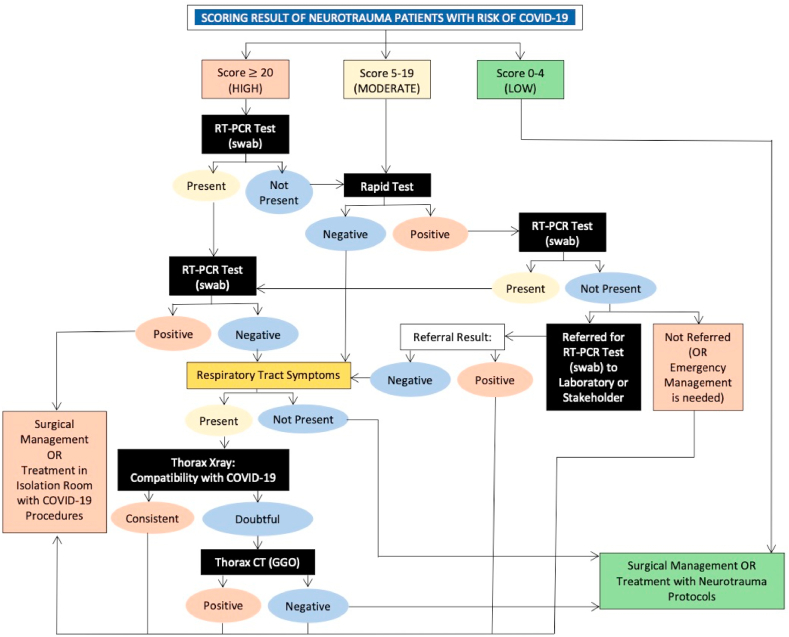
We performed retrospective Cohort analysis from TBI database at tertiary public general hospitals. All neurotrauma cases from mid-February until mid-August 2020 was included in this study. The chronology of COVID-19 pandemics impact in Indonesia was defined by early period from mid-February until end of May 2020, and late period are latter. All subjects undergone the screening and perioperative measures that based on our proposes scoring system and algorithm as follows.
There are many guidelines that explain screening methods in neurosurgery patients in general, as well as neurotrauma in particular. But here, we proposed our own scoring and screening algorithm that has been developed based on conditions in Indonesia. In total of 757 neurotrauma cases data were collected from the pandemic starts in Indonesia.
Screening is a crucial initial step in this pandemic period, not only for COVID patients, but also all patients who enter the emergency room. The use of PPE is a necessity in several neurosurgery centers, especially with high COVID-19 case rates.
The management of neurotrauma patients with suspected and confirmed COVID-19 requires special attention, starting from admission of the patient in ER. Rapid scoring and screening are important and the highest level of PPE is mandatory during patient care.
新型冠状病毒肺炎(COVID-19)作为一场全球大流行疾病,对印度尼西亚的神经外科护理产生了影响。本研究旨在针对大流行期间创伤性脑损伤(TBI)患者的管理提出指南和算法建议,这些建议可在印度尼西亚及全球的神经外科中心灵活使用。
我们对一家三级公立综合医院的TBI数据库进行了回顾性队列分析。纳入了2020年2月中旬至8月中旬所有的神经创伤病例。印度尼西亚COVID-19大流行影响的时间顺序分为早期(2020年2月中旬至5月底)和后期(之后的时期)。所有受试者均接受了基于我们提出的评分系统和算法的筛查及围手术期措施,具体如下。
有许多指南解释了一般神经外科患者的筛查方法,特别是神经创伤患者的筛查方法。但在此,我们提出了基于印度尼西亚情况开发的自己的评分和筛查算法。从印度尼西亚大流行开始共收集了757例神经创伤病例的数据。
筛查是这一大流行时期至关重要的初始步骤,不仅对于COVID患者,对于所有进入急诊室的患者也是如此。在一些神经外科中心,使用个人防护装备是必要的,尤其是在COVID-19病例率高的情况下。
对疑似和确诊COVID-19的神经创伤患者的管理需要特别关注,从患者在急诊科入院时就开始。快速评分和筛查很重要,在患者护理期间必须使用最高级别的个人防护装备。