Department of Neurosurgery, All India Institute of Medical Sciences, New Delhi, India.
Department of Neurosurgery, All India Institute of Medical Sciences, New Delhi, India.
World Neurosurg. 2022 Sep;165:e59-e73. doi: 10.1016/j.wneu.2022.05.076. Epub 2022 May 25.
The primary objective of this study was to evaluate the outcome of patients with traumatic brain injury (TBI) during the coronavirus disease 2019 (COVID-19) pandemic and to compare their outcome with case-matched controls from the prepandemic phase.
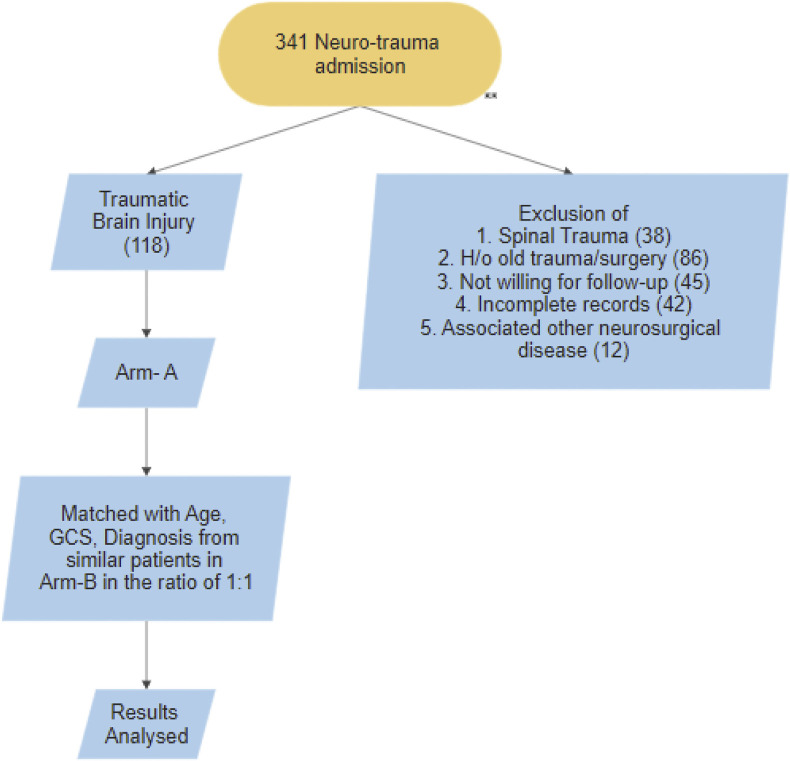
This is a retrospective case-control study in which all patients with TBI admitted during COVID-19 pandemic phase (Arm A) from March 24, 2020 to November 30, 2020 were matched with age and Glasgow Coma Scale score-matched controls from the patients admitted before March 2020 (Arm B).
The total number of patients matched in each arm was 118. The length of hospital stay (8 days vs. 5 days; P < 0.001), transit time from emergency room to operation room (150 minutes vs. 97 minutes; P = 0.271), anesthesia induction time (75 minutes vs. 45 minutes; P = 0.002), and operative duration (275 minutes vs. 180 minutes; P = 0.002) were longer in arm A. Although the incidence of fever and pneumonia was significantly higher in arm A than in arm B (50% vs. 26.3%, P < 0.001 and 27.1% vs. 1.7%, P < 0.001, respectively), outcome (Glasgow Outcome Scale-Extended) and mortality (18.6% vs. 14.4% respectively; P = 0.42) were similar in both the groups.
The outcome of the patients managed for TBI during the COVID-19 pandemic was similar to matched patients with TBI managed at our center before the onset of the COVID-19 pandemic. This finding suggests that the guidelines followed during the COVID-19 pandemic were effective in dealing with patients with TBI. This model can serve as a guide for any future pandemic waves for effective management of patients with TBI without compromising their outcome.
本研究的主要目的是评估在 2019 年冠状病毒病(COVID-19)大流行期间创伤性脑损伤(TBI)患者的结局,并将其与大流行前阶段的病例匹配对照进行比较。
这是一项回顾性病例对照研究,其中所有在 2020 年 3 月 24 日至 2020 年 11 月 30 日 COVID-19 大流行期间入院的 TBI 患者(A 组)均与 2020 年 3 月前入院的年龄和格拉斯哥昏迷量表评分匹配的对照组患者(B 组)进行匹配。
每组匹配的患者总数为 118 例。A 组的住院时间(8 天比 5 天;P<0.001)、从急诊室到手术室的转运时间(150 分钟比 97 分钟;P=0.271)、麻醉诱导时间(75 分钟比 45 分钟;P=0.002)和手术时间(275 分钟比 180 分钟;P=0.002)均较长。尽管 A 组发热和肺炎的发生率明显高于 B 组(50%比 26.3%,P<0.001 和 27.1%比 1.7%,P<0.001),但两组的结局(格拉斯哥结局量表扩展)和死亡率(分别为 18.6%比 14.4%;P=0.42)相似。
在 COVID-19 大流行期间接受 TBI 治疗的患者的结局与大流行前在我们中心接受 TBI 治疗的匹配患者相似。这一发现表明,在 COVID-19 大流行期间遵循的指南在处理 TBI 患者方面是有效的。这种模式可以为任何未来的大流行波次提供指导,以便在不影响患者结局的情况下,有效地管理 TBI 患者。