Tang Lingling, Gu Silan, Gong Yiwen, Li Bo, Lu Haifeng, Li Qiang, Zhang Ruhong, Gao Xiang, Wu Zhengjie, Zhang Jiaying, Zhang Yuanyuan, Li Lanjuan
Department of Infectious Diseases, Shulan (Hangzhou) Hospital Affiliated to Zhejiang Shuren University Shulan International Medical College, Hangzhou 310003, China.
State Key Laboratory for Diagnosis and Treatment of Infectious Diseases, National Clinical Research Center for Infectious Diseases, Collaborative Innovation Center for Diagnosis and Treatment of Infectious Diseases, The First Affiliated Hospital, College of Medicine, Zhejiang University, Hangzhou 310003, China.
Engineering (Beijing). 2020 Oct;6(10):1178-1184. doi: 10.1016/j.eng.2020.05.013. Epub 2020 Jun 8.
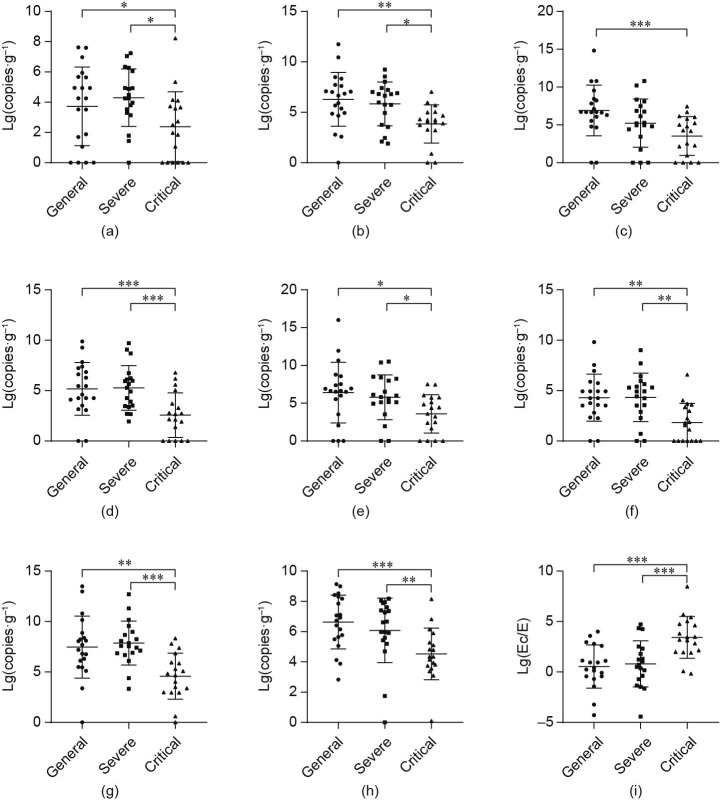
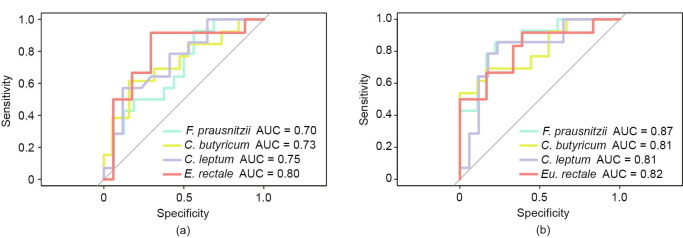
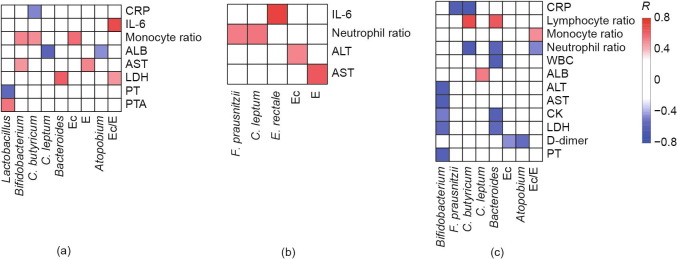
Coronavirus disease 2019 (COVID-19) is a highly contagious infectious disease. Similar to H7N9 infection, pneumonia and cytokine storm are typical clinical manifestations of COVID-19. Our previous studies found that H7N9 patients had intestinal dysbiosis. However, the relationship between the gut microbiome and COVID-19 has not been determined. This study recruited a cohort of 57 patients with either general ( = 20), severe ( = 19), or critical ( = 18) disease. The objective of this study was to investigate changes in the abundance of ten predominant intestinal bacterial groups in COVID-19 patients using quantitative polymerase chain reaction (q-PCR), and to establish a correlation between these bacterial groups and clinical indicators of pneumonia in these patients. The results indicated that dysbiosis occurred in COVID-19 patients and changes in the gut microbial community were associated with disease severity and hematological parameters. The abundance of butyrate-producing bacteria, such as , , , and , decreased significantly, and this shift in bacterial community may help discriminate critical patients from general and severe patients. Moreover, the number of common opportunistic pathogens (Ec) and Enterobacteriaceae (E) increased, especially in critically ill patients with poor prognosis. The results suggest that these bacterial groups can serve as diagnostic biomarkers for COVID-19, and that the Ec/E ratio can be used to predict death in critically ill patients.
2019冠状病毒病(COVID-19)是一种高度传染性的传染病。与H7N9感染相似,肺炎和细胞因子风暴是COVID-19的典型临床表现。我们之前的研究发现H7N9患者存在肠道菌群失调。然而,肠道微生物群与COVID-19之间的关系尚未确定。本研究招募了57例患有普通型(n = 20)、重型(n = 19)或危重型(n = 18)疾病的患者。本研究的目的是使用定量聚合酶链反应(q-PCR)研究COVID-19患者中十种主要肠道细菌群丰度的变化,并建立这些细菌群与这些患者肺炎临床指标之间的相关性。结果表明,COVID-19患者出现了菌群失调,肠道微生物群落的变化与疾病严重程度和血液学参数相关。产丁酸细菌,如[此处原文缺失具体细菌名称]、[此处原文缺失具体细菌名称]、[此处原文缺失具体细菌名称]和[此处原文缺失具体细菌名称]的丰度显著降低,这种细菌群落的变化可能有助于区分危重型患者与普通型和重型患者。此外,常见机会性病原体(Ec)和肠杆菌科(E)的数量增加,尤其是在预后较差的危重症患者中。结果表明,这些细菌群可作为COVID-19的诊断生物标志物,Ec/E比值可用于预测危重症患者的死亡。