Riaz Ramsha, Ahmed Madiha, Baloch Mariam, Rizvi Syed Asad Hasan, Shahid Naureen, Siddiqui Fatima Qadir, Haq Muhammad S, Saleem Sania
Internal Medicine, Dr Ruth KM Pfau Civil Hospital Karachi, Dow University of Health Sciences, Karachi, PAK.
Medicine, Dr Ruth KM Pfau Civil Hospital Karachi, Dow University of Health Sciences, Karachi, PAK.
Cureus. 2020 Dec 27;12(12):e12324. doi: 10.7759/cureus.12324.
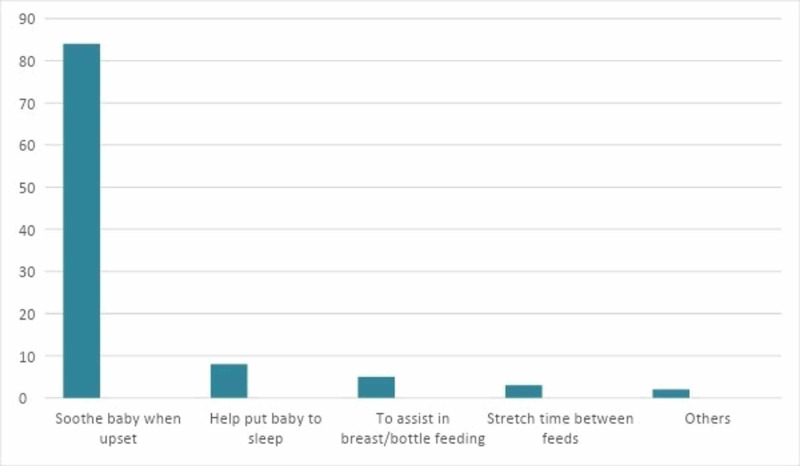
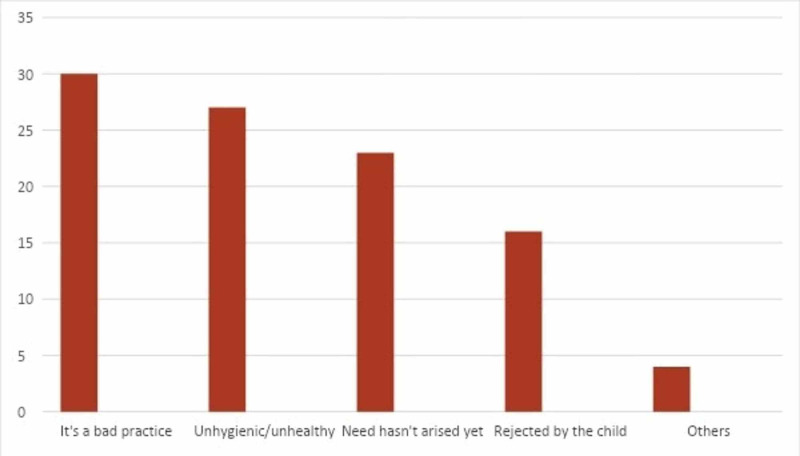
Background Pacifier use has been popular for ages. They are prevalent all over the world because of their various perceived benefits. On the other hand, there is a common belief that they do carry health risks as well. Due to these contradicting belief systems, the frequency of their use, and the factors that determine them, need to be thoroughly evaluated. Since Pakistan is a developing country with a low literacy rate, it can be implied that a vast majority of the country's population may lack awareness regarding the advantages and disadvantages of pacifier use, making them incapable of weighing associated risks versus benefits. The data evaluating these factors in this region are however scarce in the published literature. We, therefore, aimed to highlight the frequency and predictors of pacifier use in the low socioeconomic group of Karachi, Pakistan. Materials and methods A descriptive, cross-sectional study was conducted on a sample of 300 mothers visiting a tertiary care hospital in Karachi, Pakistan. We included mothers who had at least one child under the age of two years, and whose child did not have any oro-nasal anomaly that could prevent them from sucking a pacifier. Data were collected using pre-tested questionnaires and analyzed using the Statistical Package for Social Sciences (SPSS version 23.0, IBM Corp., Armonk, NY, US). Frequencies were calculated and presented in the form of tables. The chi-square test was used to determine the significance of all categorical variables. A P-value of <0.05 was considered to be statistically significant. Results Almost half of our respondents (49%) gave pacifiers to their children. A significant number (59%) of these mothers were uneducated. Almost all (97%) of the users had annual household income less than 15,000 Pakistani rupees (PKR); 34% were primiparous and more than two-thirds (71%) had a normal vaginal delivery. Out of all the factors, maternal age less than 20, annual household income less than 15,000 PKR, and primiparity were significantly associated with pacifier use in mothers (P<0.05). Only a half of the users (51%) cleaned the pacifiers by boiling; one-fourth (25%) washed it with water only; while 18% washed it with soap and water. The majority (84%) of the mothers used the pacifier to soothe the baby when upset. Among mothers who did not use a pacifier, about a third (30%) did not do so as they believed it's a bad practice. About one-fourth (27%) believed it was unhygienic. Conclusions Our study highlights the gap in the awareness of mothers regarding pacifier use. Using this data, we can target to disseminate specific information to this population to integrate safe and healthy child care habits in society.
安抚奶嘴的使用由来已久。由于其被认为具有多种益处,在世界各地都很普遍。另一方面,人们普遍认为使用安抚奶嘴也存在健康风险。由于存在这些相互矛盾的观念体系,安抚奶嘴的使用频率及其决定因素需要进行全面评估。巴基斯坦是一个识字率较低的发展中国家,这意味着该国绝大多数人口可能缺乏对使用安抚奶嘴利弊的认识,无法权衡相关风险与益处。然而,已发表的文献中缺乏评估该地区这些因素的数据。因此,我们旨在强调巴基斯坦卡拉奇社会经济地位较低群体中安抚奶嘴的使用频率及其预测因素。
对在巴基斯坦卡拉奇一家三级护理医院就诊的300名母亲进行了一项描述性横断面研究。我们纳入了至少有一个两岁以下孩子且孩子没有任何可能妨碍其吸吮安抚奶嘴的口鼻异常的母亲。使用预先测试的问卷收集数据,并使用社会科学统计软件包(SPSS 23.0版,IBM公司,美国纽约州阿蒙克)进行分析。计算频率并以表格形式呈现。使用卡方检验确定所有分类变量的显著性。P值<0.05被认为具有统计学意义。
几乎一半(49%)的受访者会给孩子使用安抚奶嘴。这些母亲中很大一部分(59%)未受过教育。几乎所有(97%)的使用者家庭年收入低于15000巴基斯坦卢比(PKR);34%为初产妇,超过三分之二(71%)为正常阴道分娩。在所有因素中,母亲年龄小于20岁、家庭年收入低于15000 PKR以及初产与母亲使用安抚奶嘴显著相关(P<0.05)。只有一半(51%)的使用者通过煮沸来清洁安抚奶嘴;四分之一(25%)仅用水清洗;而18%用肥皂和水清洗。大多数(84%)母亲在孩子烦躁不安时使用安抚奶嘴来安抚。在不使用安抚奶嘴的母亲中,约三分之一(30%)不这样做是因为她们认为这是一种不好的做法。约四分之一(27%)认为这不卫生。
我们的研究凸显了母亲在使用安抚奶嘴方面的认知差距。利用这些数据,我们可以针对性地向这一人群传播特定信息,以在社会中融入安全健康的儿童护理习惯。