Belizário José E, Faintuch Joel, Malpartida Miguel Garay
Department of Pharmacology, Institute of Biomedical Sciences, University of São Paulo, São Paulo, Brazil.
Department of Gastroenterology of Medical School, University of Sao Paulo, São Paulo, Brazil.
Front Cell Infect Microbiol. 2021 Jan 7;10:564194. doi: 10.3389/fcimb.2020.564194. eCollection 2020.
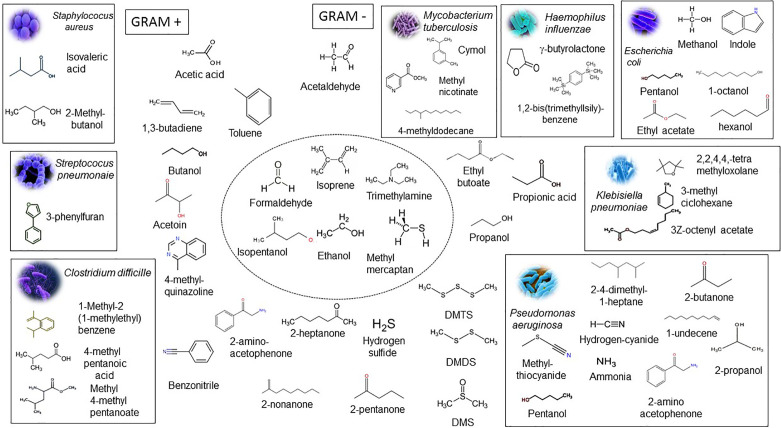
Exhaled breath contains thousand metabolites and volatile organic compounds (VOCs) that originated from both respiratory tract and internal organ systems and their microbiomes. Commensal and pathogenic bacteria and virus of microbiomes are capable of producing VOCs of different chemical classes, and some of them may serve as biomarkers for installation and progression of various common human diseases. Here we describe qualitative and quantitative methods for measuring VOC fingerprints generated by cellular and microbial metabolic and pathologic pathways. We describe different chemical classes of VOCs and their role in the host cell-microbial interactions and their impact on infection disease pathology. We also update on recent progress on VOC signatures emitted by isolated bacterial species and microbiomes, and VOCs identified in exhaled breath of patients with respiratory tract and gastrointestinal diseases, and inflammatory syndromes, including the acute respiratory distress syndrome and sepsis. The VOC curated databases and instrumentations have been developed through statistically robust breathomic research in large patient populations. Scientists have now the opportunity to find potential biomarkers for both triage and diagnosis of particular human disease.
呼出的气体含有数千种代谢物和挥发性有机化合物(VOCs),它们源自呼吸道和内部器官系统及其微生物群落。微生物群落中的共生菌、致病菌和病毒能够产生不同化学类别的VOCs,其中一些可能作为各种常见人类疾病发生和发展的生物标志物。在这里,我们描述了用于测量由细胞和微生物代谢及病理途径产生的VOC指纹图谱的定性和定量方法。我们描述了不同化学类别的VOCs及其在宿主细胞-微生物相互作用中的作用,以及它们对感染性疾病病理学的影响。我们还介绍了分离出的细菌物种和微生物群落发出的VOC特征,以及在患有呼吸道和胃肠道疾病以及炎症综合征(包括急性呼吸窘迫综合征和脓毒症)的患者呼出气体中鉴定出的VOCs的最新进展。通过对大量患者群体进行统计稳健的呼吸组学研究,已经开发出了VOC管理数据库和仪器。科学家们现在有机会找到用于特定人类疾病分诊和诊断的潜在生物标志物。