School of Public Health and Community Medicine, University of Gothenburg, Gothenburg, Sweden.
Network Aging Research (NAR), Heidelberg University, Heidelberg, Germany.
BMC Geriatr. 2021 Feb 1;21(1):93. doi: 10.1186/s12877-020-01991-0.
The Lifestyle-integrated Functional Exercise (LiFE) program is an effective but resource-intensive fall prevention program delivered one-to-one in participants' homes. A recently developed group-based LiFE (gLiFE) could enhance large-scale implementability and decrease resource intensity. The aim of this qualitative focus group study is to compare participants' experiences regarding acceptability of gLiFE vs LiFE.
Programs were delivered in seven group sessions (gLiFE) or seven individual home visits (LiFE) within a multi-center, randomized non-inferiority trial. Four structured focus group discussions (90-100 min duration; one per format and study site) on content, structure, and subjective effects of gLiFE and LiFE were conducted. Qualitative content analysis using the method of inductive category formation by Mayring was applied for data analysis. Coding was managed using NVivo.
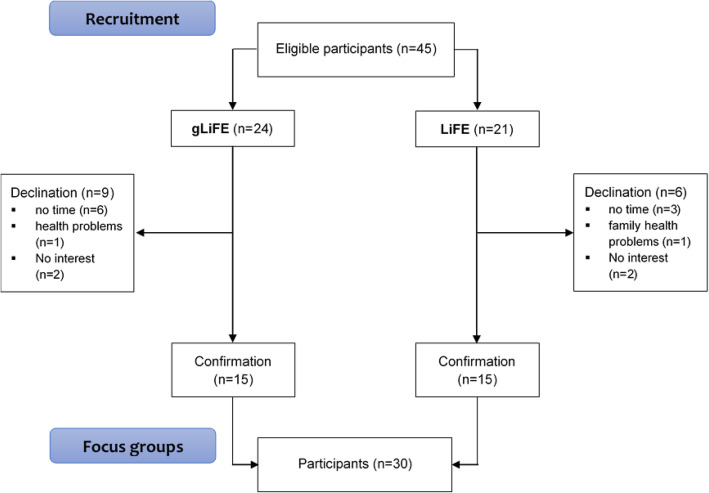
In both formats, participants (N = 30, 22 women, n = 15, n = 15, mean age 78.8 ± 6.6 years) were positive about content, structure, and support received by trainers. Participants reflected on advantages of both formats: the social aspects of learning the program in a peer group (gLiFE), and benefits of learning the program at home (LiFE). In gLiFE, some difficulties with the implementation of activities were reported. In both formats, the majority of participants reported positive outcomes and successful implementation of new movement habits.
This is the first study to examine participants' views on and experiences with gLiFE and LiFE, revealing strengths and limitations of both formats that can be used for program refinement. Both formats were highly acceptable to participants, suggesting that gLiFE may have similar potential to be adopted by adults aged 70 years and older compared to LiFE.
ClinicalTrials.gov , NCT03462654 . Registered on March 12, 2018.
生活方式综合功能锻炼(LiFE)计划是一种有效的但资源密集型的预防跌倒计划,在参与者的家中进行一对一的服务。最近开发的基于小组的 LiFE(gLiFE)可以提高大规模实施的可行性并降低资源强度。本定性焦点小组研究的目的是比较参与者对基于小组的 LiFE(gLiFE)和 LiFE 的可接受性的体验。
在一项多中心、随机非劣效性试验中,该计划通过七次小组会议(gLiFE)或七次单独家访(LiFE)来进行。在每个格式和研究地点,进行了四次关于 gLiFE 和 LiFE 的内容、结构和主观效果的结构化焦点小组讨论(90-100 分钟的持续时间;每种格式一次)。使用迈林的归纳类别形成方法进行定性内容分析,用于数据分析。使用 NVivo 管理编码。
在两种格式中,参与者(N=30,22 名女性,n=15,n=15,平均年龄 78.8±6.6 岁)对培训师提供的内容、结构和支持表示肯定。参与者反思了两种格式的优势:在同伴小组中学习计划的社交方面(gLiFE),以及在家中学习计划的好处(LiFE)。在 gLiFE 中,一些活动的实施困难被报道。在两种格式中,大多数参与者报告了积极的结果和新运动习惯的成功实施。
这是第一项研究参与者对基于小组的 LiFE 和 LiFE 的看法和经验,揭示了两种格式的优势和局限性,可用于计划的改进。两种格式都受到参与者的高度认可,这表明 gLiFE 可能与 LiFE 一样具有被 70 岁及以上成年人采用的潜力。
ClinicalTrials.gov,NCT03462654。于 2018 年 3 月 12 日注册。