Rachael Hinton Editing, Geneva, Switzerland.
Independent consultant, London, UK.
Global Health. 2021 Feb 1;17(1):18. doi: 10.1186/s12992-021-00664-w.
The success of the Sustainable Development Goals (SDGs) is predicated on multisectoral collaboration (MSC), and the COVID-19 pandemic makes it more urgent to learn how this can be done better. Complex challenges facing countries, such as COVID-19, cut across health, education, environment, financial and other sectors. Addressing these challenges requires the range of responsible sectors and intersecting services - across health, education, social and financial protection, economic development, law enforcement, among others - transform the way they work together towards shared goals. While the necessity of MSC is recognized, research is needed to understand how sectors collaborate, inform how to do so more efficiently, effectively and equitably, and ascertain similarities and differences across contexts. To answer these questions and inform practice, research to strengthen the evidence-base on MSC is critical.
This paper draws on a 12-country study series on MSC for health and sustainable development, in the context of the health and rights of women, children and adolescents. It is written by core members of the research coordination and country teams. Issues were analyzed during the study period through 'real-time' discussions and structured reporting, as well as through literature reviews and retrospective feedback and analysis at the end of the study.
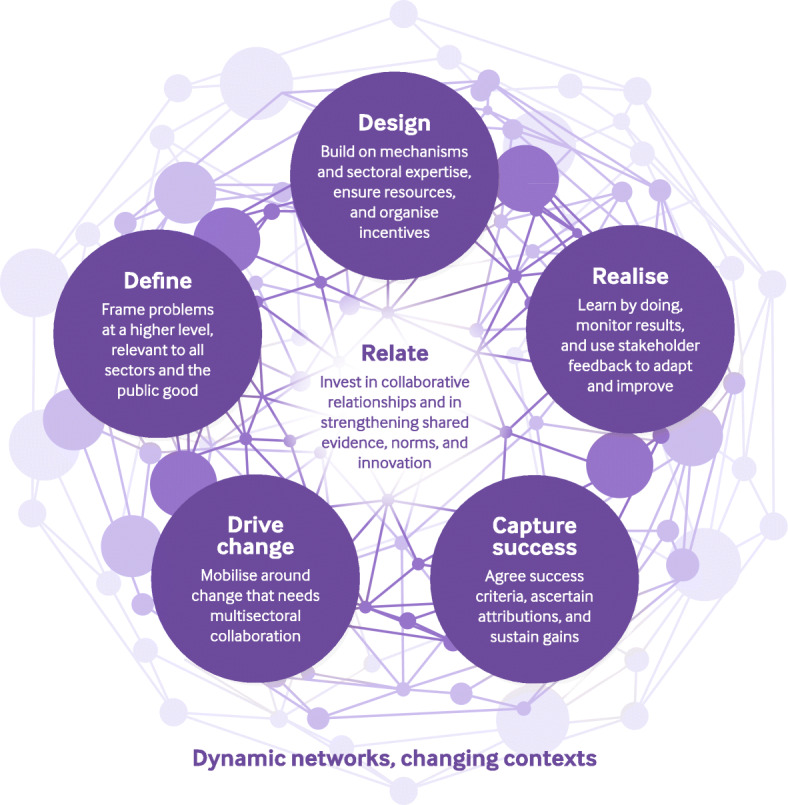
We identify four considerations that are unique to MSC research which will be of interest to other researchers, in the context of COVID-19 and beyond: 1) use theoretical frameworks to frame research questions as relevant to all sectors and to facilitate theoretical generalizability and evolution; 2) specifically incorporate sectoral analysis into MSC research methods; 3) develop a core set of research questions, using mixed methods and contextual adaptations as needed, with agreement on criteria for research rigor; and 4) identify shared indicators of success and failure across sectors to assess MSCs.
In responding to COVID-19 it is evident that effective MSC is an urgent priority. It enables partners from diverse sectors to effectively convene to do more together than alone. Our findings have practical relevance for achieving this objective and contribute to the growing literature on partnerships and collaboration. We must seize the opportunity here to identify remaining knowledge gaps on how diverse sectors can work together efficiently and effectively in different settings to accelerate progress towards achieving shared goals.
可持续发展目标(SDGs)的成功取决于多部门合作(MSC),而 COVID-19 大流行使得更好地了解如何实现这一目标变得更加紧迫。各国面临的复杂挑战,如 COVID-19,跨越了卫生、教育、环境、金融等部门。应对这些挑战需要负责的部门和交叉服务——跨越卫生、教育、社会和金融保护、经济发展、执法等部门——改变他们共同实现共同目标的合作方式。虽然认识到 MSC 的必要性,但需要研究如何进行部门合作,为更高效、更有效和更公平地合作提供信息,并确定不同背景下的相似性和差异。为了回答这些问题并为实践提供信息,加强 MSC 证据基础的研究至关重要。
本文借鉴了一项针对卫生和可持续发展多部门合作的 12 国研究系列,其背景是妇女、儿童和青少年的健康和权利。它由研究协调和国家团队的核心成员撰写。在研究期间,通过“实时”讨论和结构化报告,以及文献综述和研究结束时的回顾性反馈和分析,对问题进行了分析。
我们确定了在 COVID-19 背景下和其他情况下,对其他研究人员可能感兴趣的 MSC 研究的四个独特考虑因素:1)使用理论框架来框定与所有部门相关的研究问题,并促进理论的可推广性和发展;2)具体将部门分析纳入 MSC 研究方法;3)根据需要使用混合方法和情境适应,制定一套核心研究问题,并就研究严谨性标准达成一致;4)确定跨部门合作的共同成功和失败指标,以评估 MSCs。
在应对 COVID-19 时,显然有效的 MSC 是当务之急。它使来自不同部门的合作伙伴能够有效地聚集在一起,共同做更多的事情。我们的研究结果对实现这一目标具有实际意义,并为伙伴关系和合作的不断增长的文献做出了贡献。我们必须抓住这一机会,确定在不同环境下,不同部门如何能够高效、有效地合作,以加速实现共同目标方面的剩余知识差距。