University of Minnesota Division of Biostatistics, Minneapolis, MN, USA.
University of Minnesota School of Nursing, Minneapolis, MN, USA.
J Alzheimers Dis. 2021;80(1):233-244. doi: 10.3233/JAD-201100.
Aerobic exercise has shown inconsistent cognitive effects in older adults with Alzheimer's disease (AD) dementia.
To examine the immediate and longitudinal effects of 6-month cycling on cognition in older adults with AD dementia.
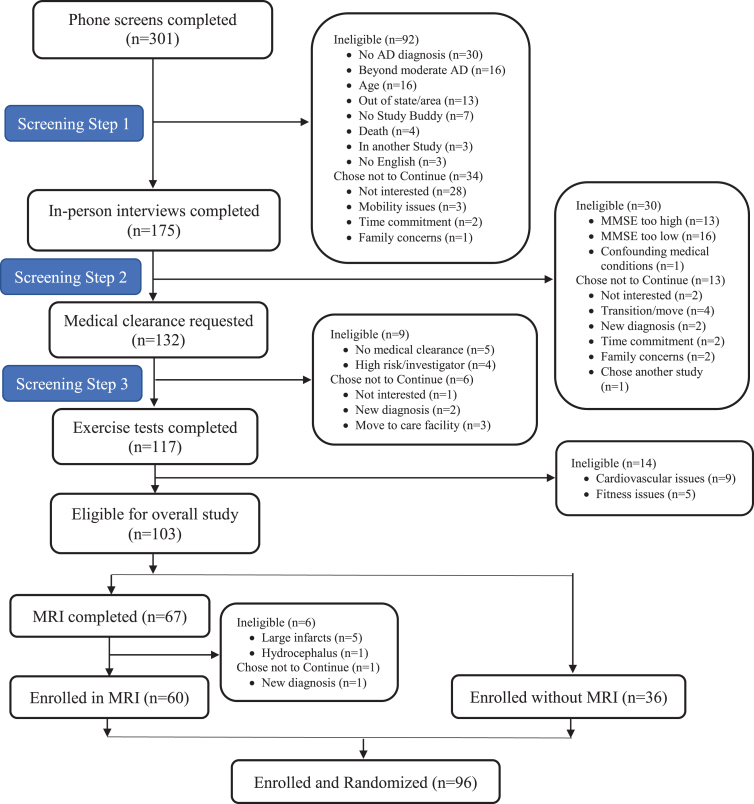
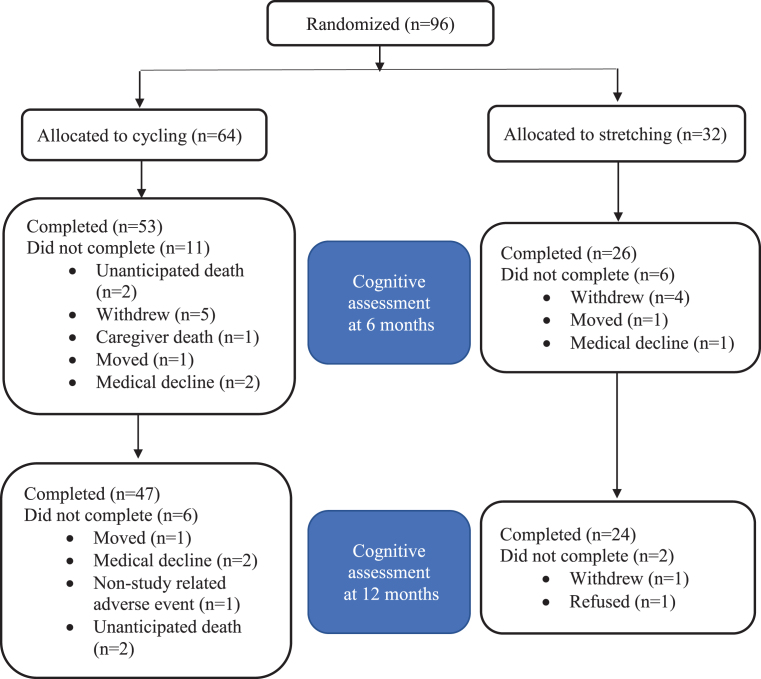
This randomized controlled trial randomized 96 participants (64 to cycling and 32 to stretching for six months) and followed them for another six months. The intervention was supervised, moderate-intensity cycling for 20-50 minutes, 3 times a week for six months. The control was light-intensity stretching. Cognition was assessed at baseline, 3, 6, 9, and 12 months using the AD Assessment Scale-Cognition (ADAS-Cog). Discrete cognitive domains were measured using the AD Uniform Data Set battery.
The participants were 77.4±6.8 years old with 15.6±2.9 years of education, and 55% were male. The 6-month change in ADAS-Cog was 1.0±4.6 (cycling) and 0.1±4.1 (stretching), which were both significantly less than the natural 3.2±6.3-point increase observed naturally with disease progression. The 12-month change was 2.4±5.2 (cycling) and 2.2±5.7 (control). ADAS-Cog did not differ between groups at 6 (p = 0.386) and 12 months (p = 0.856). There were no differences in the 12-month rate of change in ADAS-Cog (0.192 versus 0.197, p = 0.967), memory (-0.012 versus -0.019, p = 0.373), executive function (-0.020 versus -0.012, p = 0.383), attention (-0.035 versus -0.033, p = 0.908), or language (-0.028 versus -0.026, p = 0.756).
Exercise may reduce decline in global cognition in older adults with mild-to-moderate AD dementia. Aerobic exercise did not show superior cognitive effects to stretching in our pilot trial, possibly due to the lack of power.
有氧运动对患有阿尔茨海默病(AD)痴呆的老年人的认知影响不一致。
研究 6 个月自行车运动对 AD 痴呆老年人认知的即时和纵向影响。
这项随机对照试验将 96 名参与者(64 名进行自行车运动,32 名进行拉伸运动,持续 6 个月)随机分组,并在另外 6 个月内进行随访。干预措施是监督、中等强度的自行车运动,每周 3 次,每次 20-50 分钟,持续 6 个月。对照组为低强度拉伸。使用 AD 评估量表认知(ADAS-Cog)在基线、3、6、9 和 12 个月评估认知。使用 AD 统一数据集中的电池测量离散的认知域。
参与者的年龄为 77.4±6.8 岁,受教育年限为 15.6±2.9 年,55%为男性。ADAS-Cog 的 6 个月变化为 1.0±4.6(自行车运动)和 0.1±4.1(拉伸),均明显低于疾病进展自然观察到的 3.2±6.3 点的自然增加。12 个月的变化为 2.4±5.2(自行车运动)和 2.2±5.7(对照)。6 个月(p = 0.386)和 12 个月(p = 0.856)时,两组之间的 ADAS-Cog 无差异。12 个月时 ADAS-Cog 的变化率也没有差异(0.192 与 0.197,p = 0.967),记忆(-0.012 与-0.019,p = 0.373)、执行功能(-0.020 与-0.012,p = 0.383)、注意力(-0.035 与-0.033,p = 0.908)或语言(-0.028 与-0.026,p = 0.756)。
运动可能会减缓轻度至中度 AD 痴呆老年人的整体认知能力下降。在我们的初步试验中,有氧运动并没有显示出比拉伸运动更好的认知效果,这可能是由于缺乏力量。