Center for Gene Therapy, The Research Institute at Nationwide Children's Hospital, Columbus, OH, USA.
Department of Pediatrics and Neurology, The Ohio State University, Columbus, OH, USA.
J Neuromuscul Dis. 2021;8(4):469-479. doi: 10.3233/JND-200548.
Duchenne muscular dystrophy (DMD) is a rare, X-linked, fatal, degenerative neuromuscular disease caused by DMD gene mutations. A relationship between exon skipping and dystrophin production in exon 51-amenable patients treated with eteplirsen (EXONDYS 51®) is established. Once-weekly eteplirsen significantly increased dystrophin, with slower decline in ambulatory function compared to baseline. Long-term treatment with eteplirsen leads to accumulation of dystrophin over time and observed functional benefits in patients with DMD.
Compare long-term ambulatory function in eteplirsen-treated patients versus controls.
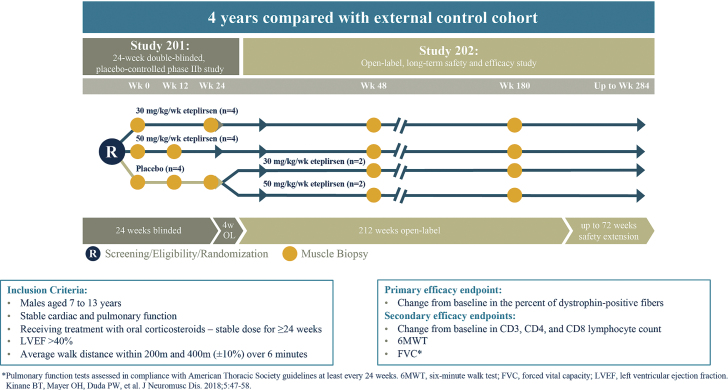
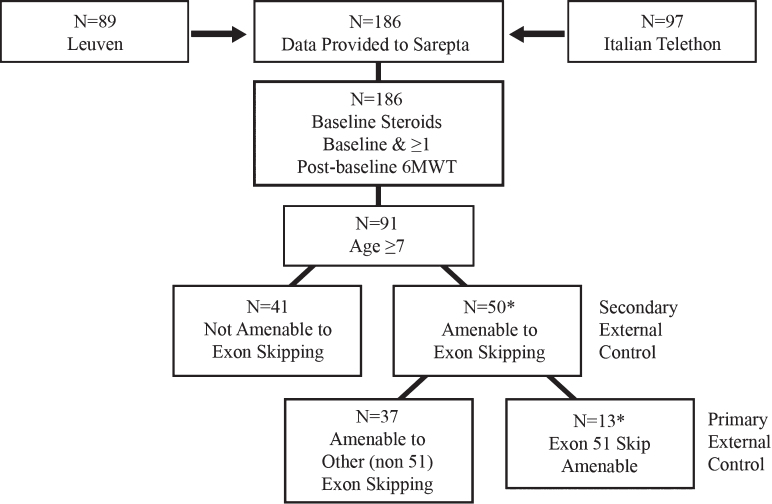
Study 201/202 included 12 eteplirsen-treated patients assessed twice/year for ambulatory function over 4 years. Ambulatory evaluations (6-minute walk test [6MWT], loss of ambulation, and North Star Ambulatory Assessment [NSAA]) were compared with matched controls from Italian Telethon and Leuven registries.
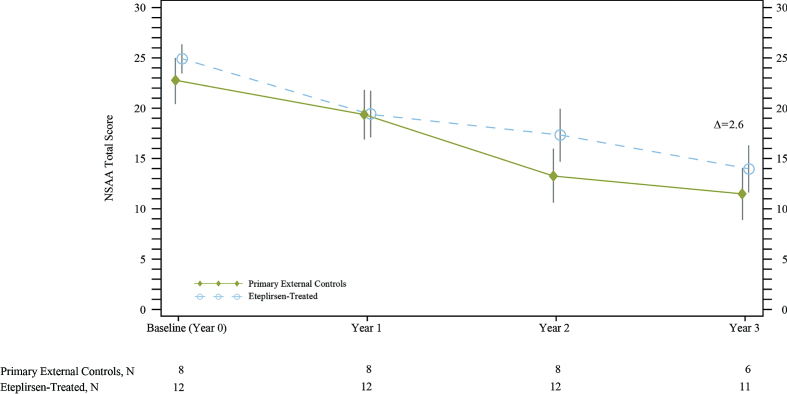
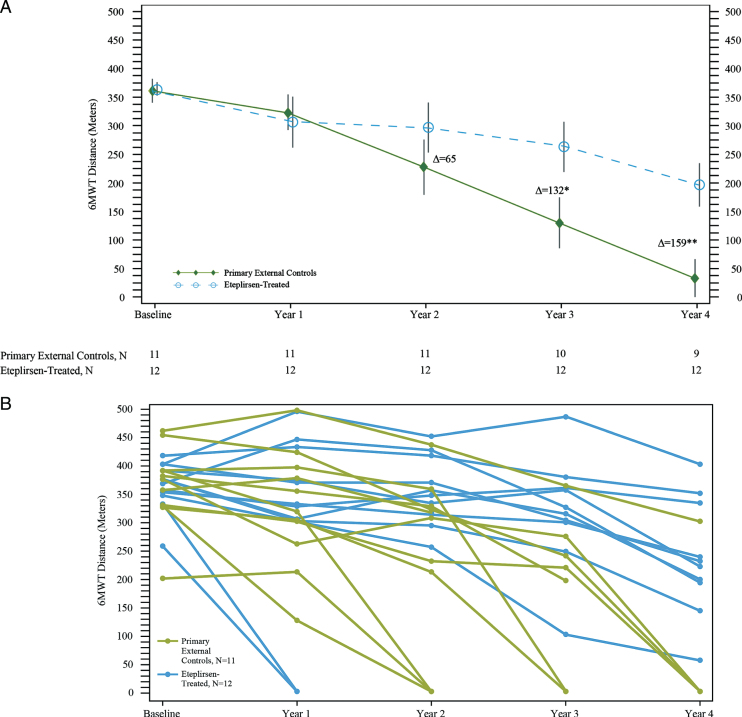
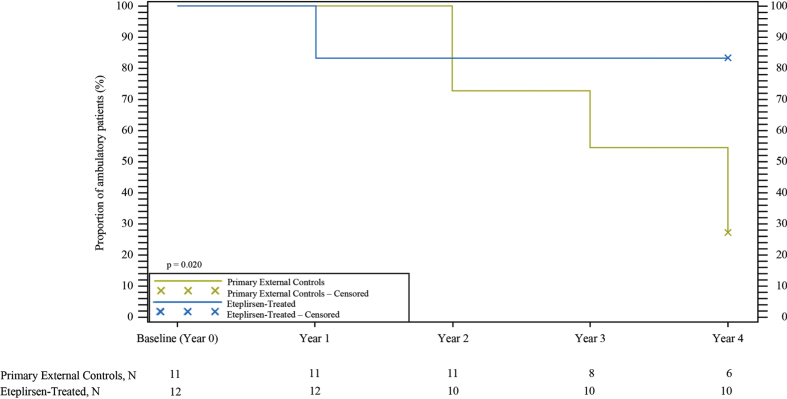
At Years 3 and 4, eteplirsen-treated patients demonstrated markedly greater mean 6MWT than controls (difference in change from baseline of 132 m [95%CI (29, 235), p = 0.015] at Year 3 and 159 m [95%CI (66, 253), p = 0.002] at Year 4). At Year 4, a significantly greater proportion of eteplirsen-treated patients were still ambulant versus controls (10/12 vs 3/11; p = 0.020). At Year 3, eteplirsen-treated patients demonstrated milder NSAA decline versus controls (difference in change from baseline of 2.6, 95%CI [-6, 11]), however, the difference was not statistically significant; Year 4 control NSAA data were not available.
In this retrospective matched control study, eteplirsen treatment resulted in attenuation of ambulatory decline over a 4-year observation period, supporting long-term benefit in patients with DMD.
杜氏肌营养不良症(DMD)是一种罕见的 X 连锁、致命的神经肌肉退行性疾病,由 DMD 基因突变引起。在接受eteplirsen(EXONDYS 51®)治疗的外显子 51 跳跃型患者中,建立了外显子跳跃与抗肌萎缩蛋白产生之间的关系。每周一次的eteplirsen 显著增加了抗肌萎缩蛋白,与基线相比,其运动功能下降速度较慢。长期接受 eteplirsen 治疗会导致抗肌萎缩蛋白随时间积累,并观察到 DMD 患者的功能获益。
比较eteplirsen 治疗患者与对照组的长期步行功能。
研究 201/202 纳入了 12 名接受eteplirsen 治疗的患者,在 4 年内每两年评估两次步行功能。将步行评估(6 分钟步行试验[6MWT]、丧失步行能力和北方之星步行评估[NSAA])与来自意大利 Telethon 和 Leuven 登记处的匹配对照组进行比较。
在第 3 年和第 4 年,eteplirsen 治疗组患者的平均 6MWT 明显大于对照组(与基线相比,第 3 年的变化差值为 132 米[95%CI(29,235)],p=0.015;第 4 年为 159 米[95%CI(66,253)],p=0.002)。在第 4 年,eteplirsen 治疗组中有更大比例的患者仍能行走,而对照组为 10/12 比 3/11(p=0.020)。在第 3 年,eteplirsen 治疗组患者的 NSAA 下降幅度小于对照组(与基线相比,差值为 2.6,95%CI[-6,11]),但差异无统计学意义;第 4 年对照组的 NSAA 数据不可用。
在这项回顾性匹配对照组研究中,eteplirsen 治疗可减缓 4 年观察期间的步行能力下降,支持 DMD 患者的长期获益。