Departments of Physical Medicine & Rehabilitation and Pediatrics, University of California Davis Health System and School of Medicine, Sacramento, CA, USA.
Department of Neurology, University of California, Los Angeles, Los Angeles, CA, USA.
J Neuromuscul Dis. 2021;8(6):989-1001. doi: 10.3233/JND-210643.
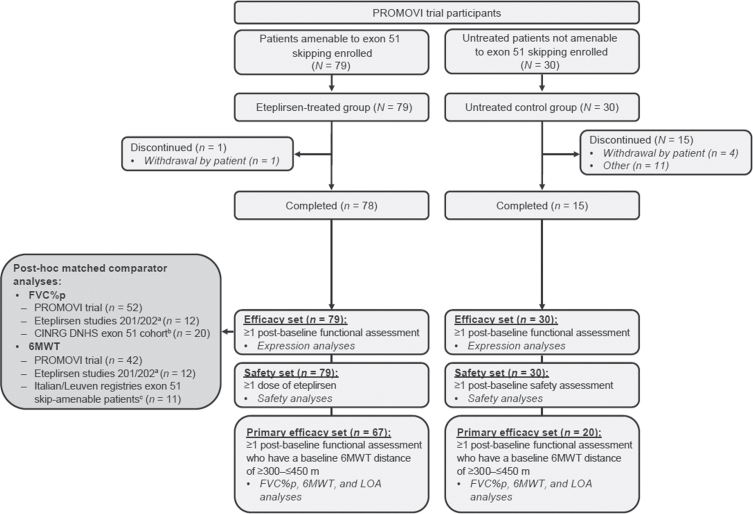
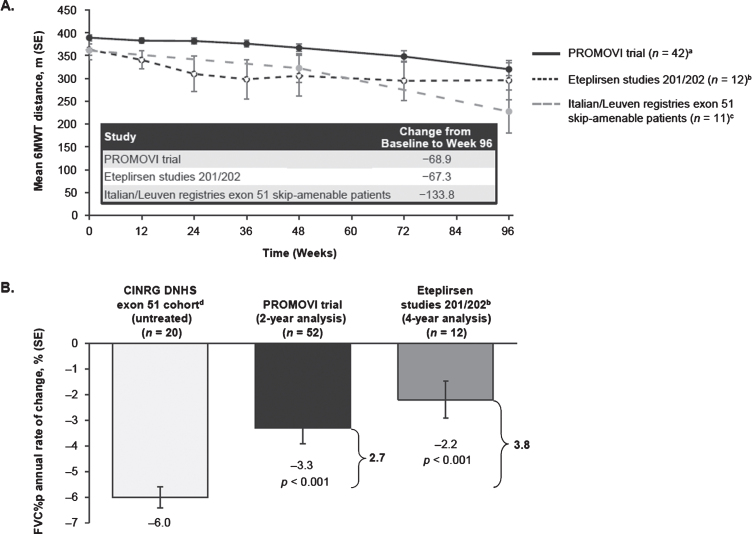
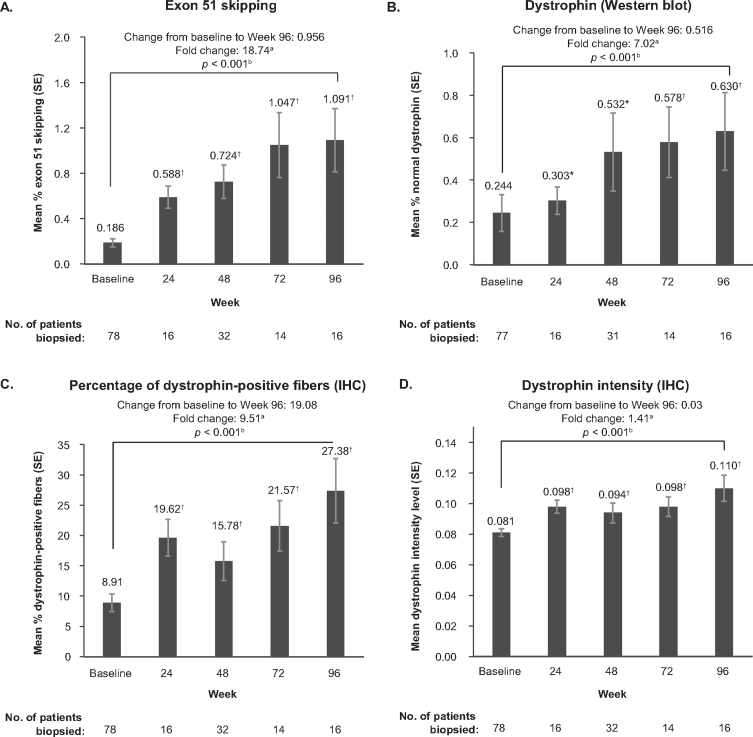
BackgroundEteplirsen received accelerated FDA approval for treatment of Duchenne muscular dystrophy (DMD) with mutations amenable to exon 51 skipping, based on demonstrated dystrophin production.ObjectiveTo report results from PROMOVI, a phase 3, multicenter, open-label study evaluating efficacy and safety of eteplirsen in a larger cohort.MethodsAmbulatory patients aged 7-16 years, with confirmed mutations amenable to exon 51 skipping, received eteplirsen 30 mg/kg/week intravenously for 96 weeks. An untreated cohort with DMD not amenable to exon 51 skipping was also enrolled.Results78/79 eteplirsen-treated patients completed 96 weeks of treatment. 15/30 untreated patients completed the study; this cohort was considered an inappropriate control group because of genotype-driven differences in clinical trajectory. At Week 96, eteplirsen-treated patients showed increased exon skipping (18.7-fold) and dystrophin protein (7-fold) versus baseline. Post-hoc comparisons with patients from eteplirsen phase 2 studies (4658-201/202) and mutation-matched external natural history controls confirmed previous results, suggesting clinically notable attenuation of decline on the 6-minute walk test over 96 weeks (PROMOVI: -68.9 m; phase 2 studies: -67.3 m; external controls: -133.8 m) and significant attenuation of percent predicted forced vital capacity annual decline (PROMOVI: -3.3%, phase 2 studies: -2.2%, external controls: -6.0%; p < 0.001). Adverse events were generally mild to moderate and unrelated to eteplirsen. Most frequent treatment-related adverse events were headache and vomiting; none led to treatment discontinuation.ConclusionsThis large, multicenter study contributes to the growing body of evidence for eteplirsen, confirming a positive treatment effect, favorable safety profile, and slowing of disease progression versus natural history.
依替膦酸酶已获得美国食品药品监督管理局(FDA)批准,用于治疗可通过外显子 51 跳跃实现exon skipping 的杜氏肌营养不良症(DMD),其依据为药物治疗可使肌营养不良蛋白产生。
报告 PROMOVI 研究结果,该研究为一项多中心、开放性、3 期临床研究,评估eteplirsen 在更大队列中的疗效和安全性。
7-16 岁、经证实有exon 51 跳跃治疗适应证的可活动患者,每周静脉输注 30mg/kg eteplirsen 96 周。同时也纳入了未经治疗且不适合exon 51 跳跃的 DMD 患者。
78/79 例接受eteplirsen 治疗的患者完成了 96 周的治疗。30 例未经治疗的患者中有 15 例完成了研究;由于该队列存在基因型驱动的临床轨迹差异,因此被认为是不适当的对照组。在第 96 周时,eteplirsen 治疗组的外显子跳跃(18.7 倍)和肌营养不良蛋白(7 倍)均较基线增加。与eteplirsen 2 期研究(4658-201/202)和基因突变匹配的外部自然病史对照组的事后比较证实了先前的结果,提示在 96 周内 6 分钟步行测试的临床显著下降(PROMOVI:-68.9m;2 期研究:-67.3m;外部对照组:-133.8m)和预测用力肺活量年下降百分比的显著减少(PROMOVI:-3.3%,2 期研究:-2.2%,外部对照组:-6.0%;p<0.001)。不良事件通常为轻至中度,与 eteplirsen 无关。最常见的与治疗相关的不良事件为头痛和呕吐;均未导致治疗中断。
这项大型多中心研究为 eteplirsen 的不断增加的证据提供了补充,证实了其具有积极的治疗效果、良好的安全性和减缓疾病进展的作用,优于自然病史。