Mueller Franziska, Friese Alexandra, Pathe Claudio, da Silva Richard Cardoso, Rodriguez Kenny Bravo, Musacchio Andrea, Bange Tanja
Department of Mechanistic Cell Biology, Max Planck Institute of Molecular Physiology, Otto-Hahn-Str. 11, 44227 Dortmund, Germany.
Centre for Medical Biotechnology, Faculty of Biology, University Duisburg-Essen, Universitaetsstrasse, 45141 Essen, Germany.
Sci Adv. 2021 Jan 15;7(3). doi: 10.1126/sciadv.abc8590. Print 2021 Jan.
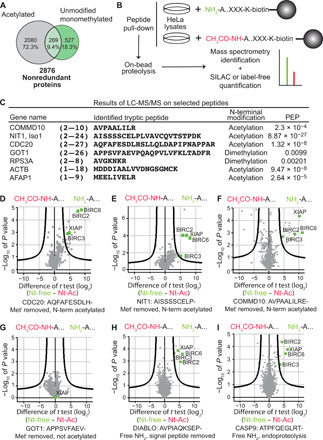
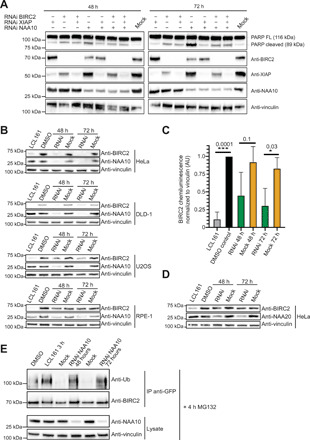
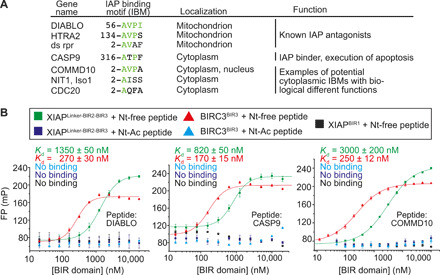
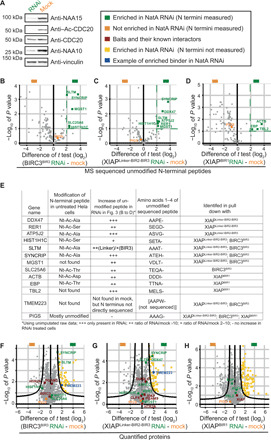
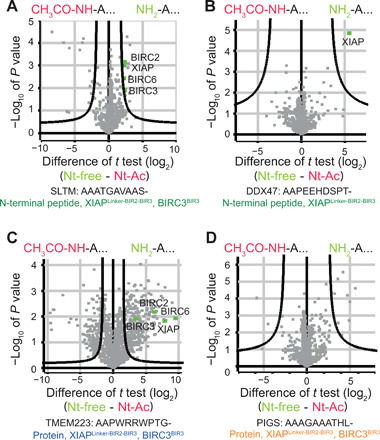
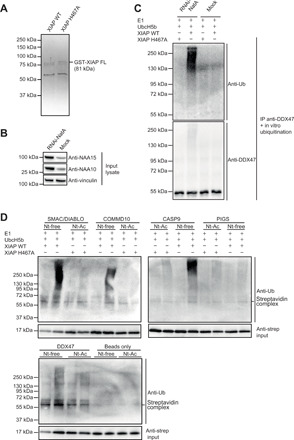
SMAC/DIABLO and HTRA2 are mitochondrial proteins whose amino-terminal sequences, known as inhibitor of apoptosis binding motifs (IBMs), bind and activate ubiquitin ligases known as inhibitor of apoptosis proteins (IAPs), unleashing a cell's apoptotic potential. IBMs comprise a four-residue, loose consensus sequence, and binding to IAPs requires an unmodified amino terminus. Closely related, IBM-like N termini are present in approximately 5% of human proteins. We show that suppression of the N-alpha-acetyltransferase NatA turns these cryptic IBM-like sequences into very efficient IAP binders in cell lysates and in vitro and ultimately triggers cellular apoptosis. Thus, amino-terminal acetylation of IBM-like motifs in NatA substrates shields them from IAPs. This previously unrecognized relationship suggests that amino-terminal acetylation is generally protective against protein degradation in human cells. It also identifies IAPs as agents of a general quality control mechanism targeting unacetylated rogues in metazoans.
SMAC/DIABLO和HTRA2是线粒体蛋白,其氨基末端序列被称为凋亡抑制蛋白结合基序(IBM),可结合并激活被称为凋亡抑制蛋白(IAP)的泛素连接酶,释放细胞的凋亡潜能。IBM由一个四残基的松散共有序列组成,与IAP的结合需要未修饰的氨基末端。与之密切相关的是,约5%的人类蛋白质中存在类似IBM的N末端。我们发现,N-α-乙酰转移酶NatA的抑制会使这些隐蔽的类似IBM的序列在细胞裂解物和体外成为非常有效的IAP结合剂,并最终触发细胞凋亡。因此,NatA底物中类似IBM基序的氨基末端乙酰化可使其免受IAP的影响。这种先前未被认识到的关系表明,氨基末端乙酰化通常可保护人类细胞中的蛋白质不被降解。它还将IAP鉴定为后生动物中针对未乙酰化异常蛋白的一种通用质量控制机制的作用因子。