Institute for Biological Physics, University of Cologne, Köln, Germany.
PLoS Pathog. 2021 Feb 1;17(2):e1009251. doi: 10.1371/journal.ppat.1009251. eCollection 2021 Feb.
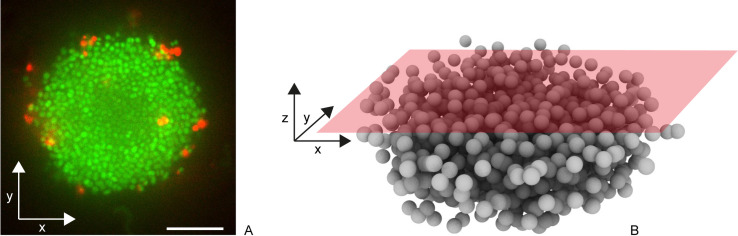
Biofilm formation protects bacteria from antibiotics. Very little is known about the response of biofilm-dwelling bacteria to antibiotics at the single cell level. Here, we developed a cell-tracking approach to investigate how antibiotics affect structure and dynamics of colonies formed by the human pathogen Neisseria gonorrhoeae. Antibiotics targeting different cellular functions enlarge the cell volumes and modulate within-colony motility. Focusing on azithromycin and ceftriaxone, we identify changes in type 4 pilus (T4P) mediated cell-to-cell attraction as the molecular mechanism for different effects on motility. By using strongly attractive mutant strains, we reveal that the survivability under ceftriaxone treatment depends on motility. Combining our results, we find that sequential treatment with azithromycin and ceftriaxone is synergistic. Taken together, we demonstrate that antibiotics modulate T4P-mediated attractions and hence cell motility and colony fluidity.
生物膜的形成能使细菌免受抗生素的影响。人们对于生物膜内细菌在单细胞水平上对抗生素的反应知之甚少。在这里,我们开发了一种细胞跟踪方法来研究抗生素如何影响人类病原体淋病奈瑟菌形成的菌落的结构和动态。针对不同细胞功能的抗生素会增大细胞体积并调节菌落内的运动性。我们专注于阿奇霉素和头孢曲松,确定了 4 型菌毛(T4P)介导的细胞间吸引的变化是对运动性产生不同影响的分子机制。通过使用具有强烈吸引力的突变株,我们揭示了在头孢曲松治疗下的生存能力取决于运动性。综合我们的结果,我们发现阿奇霉素和头孢曲松的序贯治疗具有协同作用。总之,我们证明抗生素可以调节 T4P 介导的吸引力,从而调节细胞运动性和菌落流变性。