Izmir Biomedicine and Genome Center, Turkey.
Genetics and Bioengineering Department, Izmir University of Economics, Turkey.
Mol Oncol. 2021 Aug;15(8):2185-2202. doi: 10.1002/1878-0261.12916. Epub 2021 Mar 8.
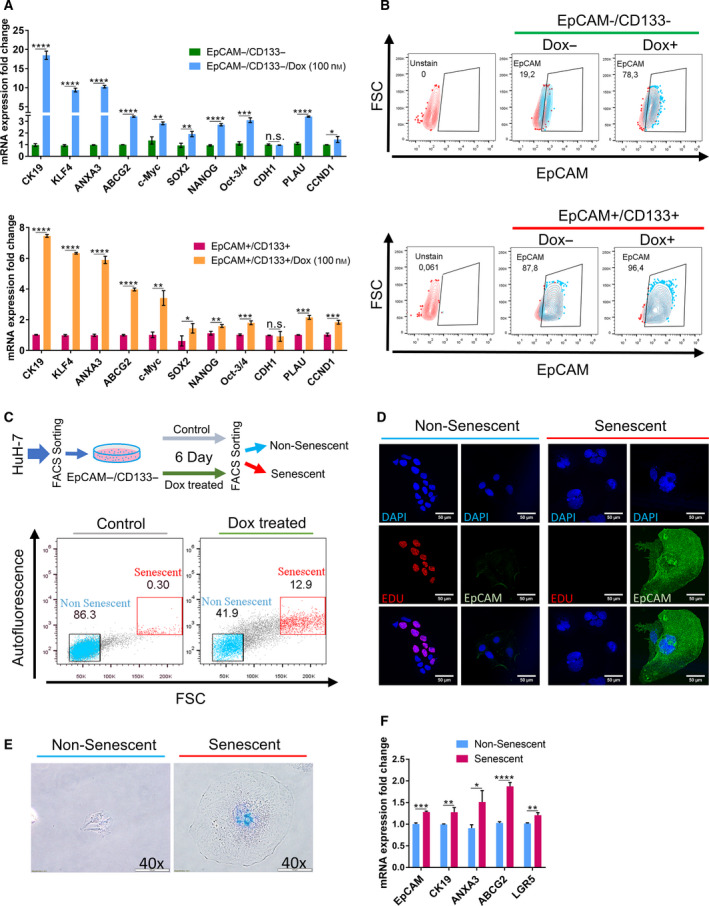
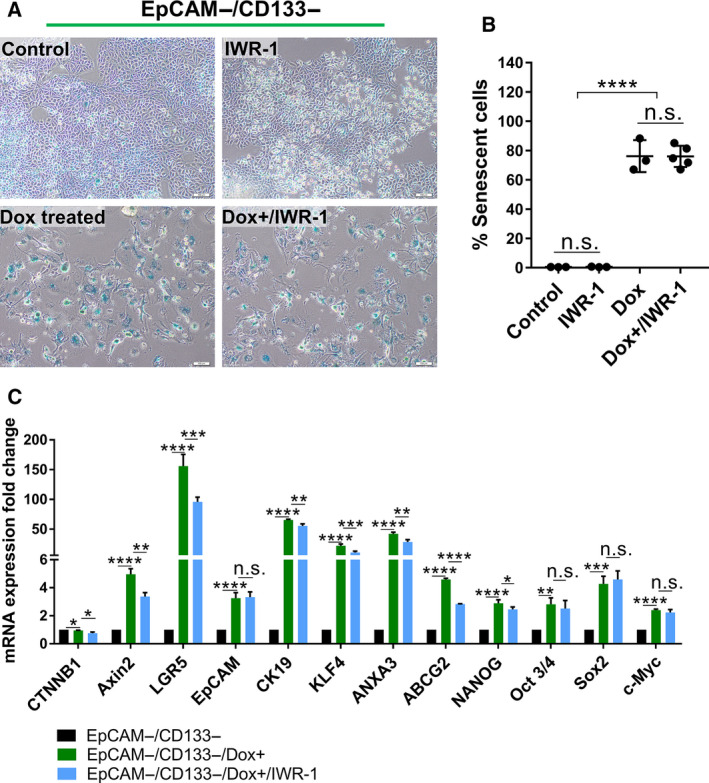
The therapeutic induction of senescence is a potential means to treat cancer, primarily acting through the induction of a persistent growth-arrested state in tumors. However, recent studies have indicated that therapy-induced senescence (TIS) in tumor cells allows for the prolonged survival of a subgroup of cells in a dormant state, with the potential to re-enter the cell cycle along with an increased stemness gene expression. Residual cells after TIS with increased cancer stem cell phenotype may have profound implications for tumor aggressiveness and disease recurrence. Herein, we investigated senescence-associated stemness in EpCAM+/CD133+ liver cancer stem cell and EpCAM-/CD133- nonstem cell populations in HuH7 cell line. We demonstrated that treatment with doxorubicin induces senescence in both cell populations, accompanied by a significant increase in the expression of reprogramming genes SOX2, KLF4, and c-MYC as well as liver stemness-related genes EpCAM, CK19, and ANXA3 and the multidrug resistance-related gene ABCG2. Moreover, doxorubicin treatment significantly increased EpCAM + population in nonstem cells indicating senescence-associated reprogramming of nonstem cell population. Also, Wnt/β-catenin target genes were increased in these cells, while inhibition of this signaling pathway decreased stem cell gene expression. Importantly, Dox-treated EpCAM-/CD133- nonstem cells had increased in vivo tumor-forming ability. In addition, when SASP-CM from Dox-treated cells were applied onto hİPSC-derived hepatocytes, senescence was induced in hepatocytes along with an increased expression of TGF-β, KLF4, and AXIN2. Importantly, SASP-CM was not able to induce senescence in Hep3B-TR cells, a derivative line rendered resistant to TGF-β signaling. Furthermore, ELISA experiments revealed that the SASP-CM of Dox-treated cells contain inflammatory cytokines IL8 and IP10. In summary, our findings further emphasize the importance of carefully dissecting the beneficial and detrimental aspects of prosenescence therapy in HCC and support the potential use of senolytic drugs in HCC treatment in order to eliminate adverse effects of TIS.
衰老的治疗诱导是治疗癌症的一种潜在手段,主要通过在肿瘤中诱导持续的生长停滞状态来实现。然而,最近的研究表明,肿瘤细胞中的治疗诱导衰老(TIS)允许处于休眠状态的亚群细胞延长存活时间,并有重新进入细胞周期的潜力,并伴随着干性基因表达的增加。TIS 后具有增加的癌症干细胞表型的残留细胞可能对肿瘤侵袭性和疾病复发有深远的影响。在此,我们研究了 HuH7 细胞系中 EpCAM+/CD133+肝癌干细胞和 EpCAM-/CD133-非干细胞群体中的衰老相关干性。我们证明,多柔比星治疗诱导两种细胞群体衰老,同时显著增加重编程基因 SOX2、KLF4 和 c-MYC 以及肝干细胞相关基因 EpCAM、CK19 和 ANXA3 和多药耐药相关基因 ABCG2 的表达。此外,多柔比星处理显著增加了非干细胞中的 EpCAM+群体,表明非干细胞群体的衰老相关重编程。此外,这些细胞中的 Wnt/β-catenin 靶基因增加,而抑制该信号通路可降低干细胞基因表达。重要的是,用多柔比星处理的 EpCAM-/CD133-非干细胞在体内形成肿瘤的能力增加。此外,当将来自用多柔比星处理的细胞的 SASP-CM 应用于 hİPSC 衍生的肝细胞时,肝细胞中诱导衰老,同时 TGF-β、KLF4 和 AXIN2 的表达增加。重要的是,SASP-CM 不能诱导 Hep3B-TR 细胞衰老,该衍生系对 TGF-β信号具有抗性。此外,ELISA 实验表明,用多柔比星处理的细胞的 SASP-CM 含有炎症细胞因子 IL8 和 IP10。总之,我们的发现进一步强调了仔细剖析 HCC 中促衰老治疗的有益和有害方面的重要性,并支持在 HCC 治疗中使用衰老溶解药物以消除 TIS 的不利影响的潜力。