Department of Mathematics, College of Science, Nanjing Agricultural University, Nanjing 210095, China.
College of Agriculture, Nanjing Agricultural University, Nanjing 210095, China.
Genes (Basel). 2021 Jan 28;12(2):191. doi: 10.3390/genes12020191.
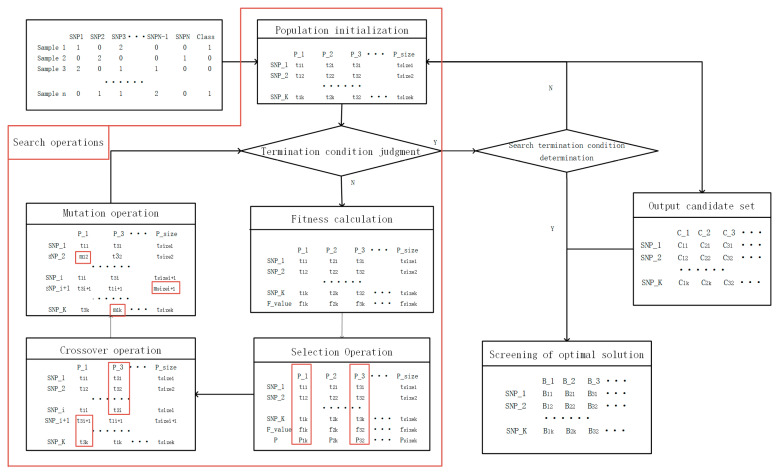
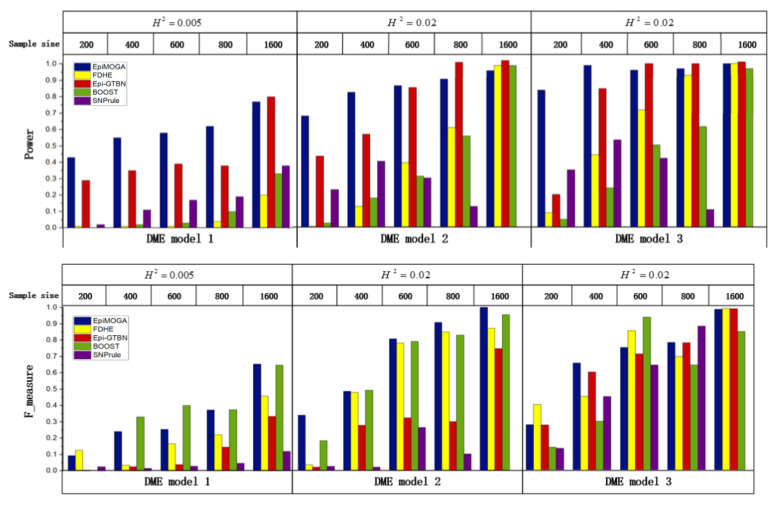
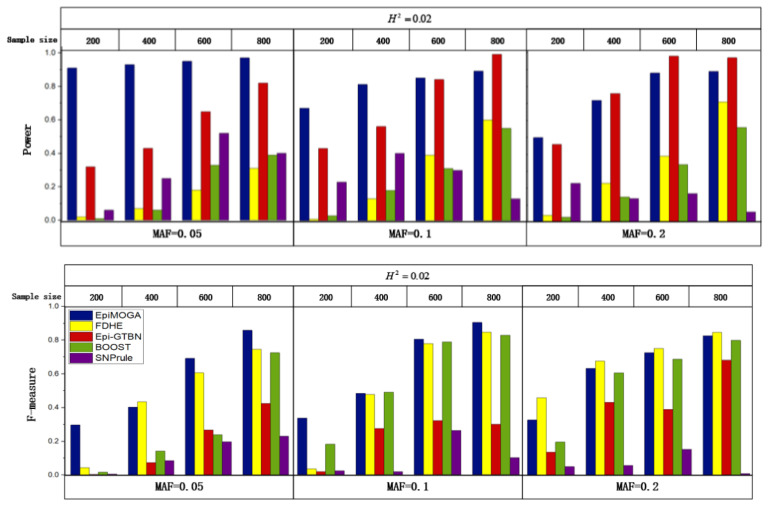
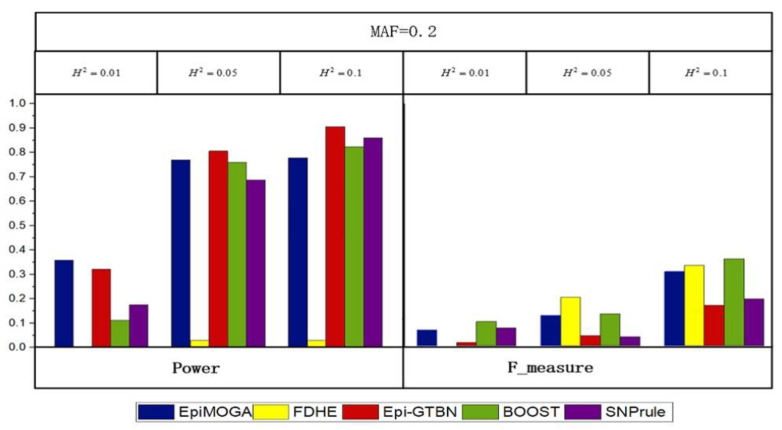
In genome-wide association studies, detecting high-order epistasis is important for analyzing the occurrence of complex human diseases and explaining missing heritability. However, there are various challenges in the actual high-order epistasis detection process due to the large amount of data, "small sample size problem", diversity of disease models, etc. This paper proposes a multi-objective genetic algorithm (EpiMOGA) for single nucleotide polymorphism (SNP) epistasis detection. The K2 score based on the Bayesian network criterion and the Gini index of the diversity of the binary classification problem were used to guide the search process of the genetic algorithm. Experiments were performed on 26 simulated datasets of different models and a real Alzheimer's disease dataset. The results indicated that EpiMOGA was obviously superior to other related and competitive methods in both detection efficiency and accuracy, especially for small-sample-size datasets, and the performance of EpiMOGA remained stable across datasets of different disease models. At the same time, a number of SNP loci and 2-order epistasis associated with Alzheimer's disease were identified by the EpiMOGA method, indicating that this method is capable of identifying high-order epistasis from genome-wide data and can be applied in the study of complex diseases.
在全基因组关联研究中,检测高阶上位性对于分析复杂人类疾病的发生和解释遗传缺失性很重要。然而,由于数据量大、“小样本量问题”、疾病模型多样性等各种挑战,实际的高阶上位性检测过程存在各种困难。本文提出了一种用于单核苷酸多态性(SNP)上位性检测的多目标遗传算法(EpiMOGA)。基于贝叶斯网络准则的 K2 评分和二分类问题多样性的基尼指数被用于指导遗传算法的搜索过程。在 26 个不同模型的模拟数据集和一个真实的阿尔茨海默病数据集上进行了实验。结果表明,EpiMOGA 在检测效率和准确性方面明显优于其他相关和竞争方法,特别是对于小样本量数据集,并且 EpiMOGA 的性能在不同疾病模型的数据集之间保持稳定。同时,EpiMOGA 方法鉴定出了与阿尔茨海默病相关的一些 SNP 位点和 2 阶上位性,表明该方法能够从全基因组数据中识别高阶上位性,可应用于复杂疾病的研究。