Population Health Department, QIMR Berghofer Medical Research Institute, Brisbane, Queensland, Australia
School of Nursing, Queensland University of Technology (QUT), Brisbane, Queensland, Australia.
BMJ Open. 2021 Feb 1;11(2):e041968. doi: 10.1136/bmjopen-2020-041968.
To predict the cost and health effects of routine use of whole-genome sequencing (WGS) of bacterial pathogens compared with those of standard of care.
Budget impact analysis was performed over the following 5 years. Data were primarily from sequencing results on clusters of multidrug-resistant organisms across 27 hospitals. Model inputs were derived from hospitalisation and sequencing data, and epidemiological and costing reports, and included multidrug resistance rates and their trends.
Queensland, Australia.
Hospitalised patients.
WGS surveillance of six common multidrug-resistant organisms (, , , , sp and ) compared with standard of care or routine microbiology testing.
Expected hospital costs, counts of patient infections and colonisations, and deaths from bloodstream infections.
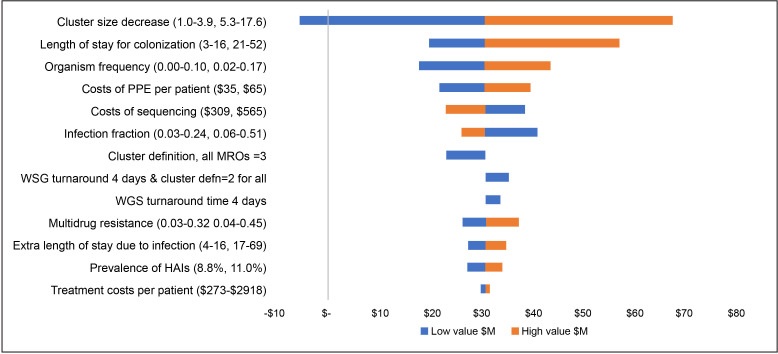
In 2021, 97 539 patients in Queensland are expected to be infected or colonised with one of six multidrug-resistant organisms with standard of care testing. WGS surveillance strategy and earlier infection control measures could avoid 36 726 infected or colonised patients and avoid 650 deaths. The total cost under standard of care was $A170.8 million in 2021. WGS surveillance costs an additional $A26.8 million but was offset by fewer costs for cleaning, nursing, personal protective equipment, shorter hospital stays and antimicrobials to produce an overall cost savings of $30.9 million in 2021. Sensitivity analyses showed cost savings remained when input values were varied at 95% confidence limits.
Compared with standard of care, WGS surveillance at a state-wide level could prevent a substantial number of hospital patients infected with multidrug-resistant organisms and related deaths and save healthcare costs. Primary prevention through routine use of WGS is an investment priority for the control of serious hospital-associated infections.
预测与标准护理相比,常规使用全基因组测序(WGS)检测细菌病原体的成本和健康效果。
在接下来的 5 年内进行预算影响分析。数据主要来自 27 家医院的多药耐药菌群的测序结果。模型输入来自住院和测序数据,以及流行病学和成本报告,包括多药耐药率及其趋势。
澳大利亚昆士兰州。
住院患者。
与标准护理或常规微生物检测相比,对六种常见多药耐药菌(、、、、sp 和 )进行 WGS 监测。
预计医院成本、患者感染和定植病例数,以及血流感染导致的死亡。
预计在 2021 年,昆士兰州的 97539 名患者将感染或定植六种多药耐药菌中的一种,采用标准护理检测。WGS 监测策略和更早的感染控制措施可以避免 36726 名感染或定植患者,并避免 650 人死亡。2021 年,在标准护理下的总成本为 1.708 亿澳元。WGS 监测额外增加了 2680 万澳元的成本,但由于清洁、护理、个人防护设备、住院时间缩短和抗生素使用减少,总成本节省了 3090 万澳元。敏感性分析表明,在输入值在 95%置信限内变化时,仍能节省成本。
与标准护理相比,在全州范围内进行 WGS 监测可以预防大量感染多药耐药菌的住院患者和相关死亡,并节省医疗保健成本。通过常规使用 WGS 进行一级预防是控制严重医院相关感染的投资重点。