Neupane Netra Prasad, Karn Abhishek Kumar, Mukeri Imdad Husen, Pathak Prateek, Kumar Praveen, Singh Samayaditya, Qureshi Insaf Ahmed, Jha Tarun, Verma Amita
Bioorganic and Medicinal Chemistry Research Laboratory, Department of Pharmaceutical Sciences, Sam Higginbottom University of Agriculture, Technology and Sciences, Allahabad, 211007, India.
Laboratory of Computational Modeling of Drugs, Higher Medical and Biological School, South Ural State University, Chelyabinsk, Russia.
Biocatal Agric Biotechnol. 2021 Mar;32:101924. doi: 10.1016/j.bcab.2021.101924. Epub 2021 Jan 27.
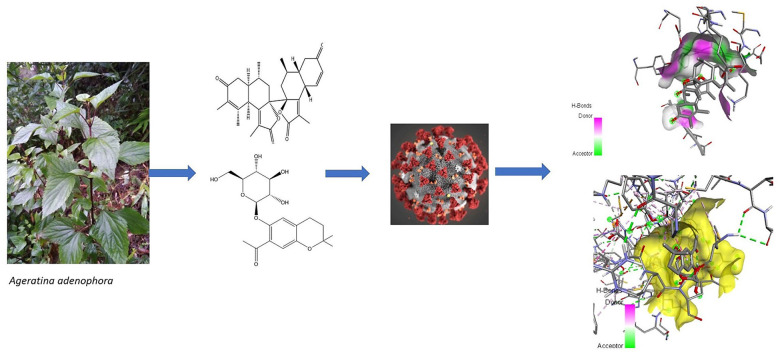
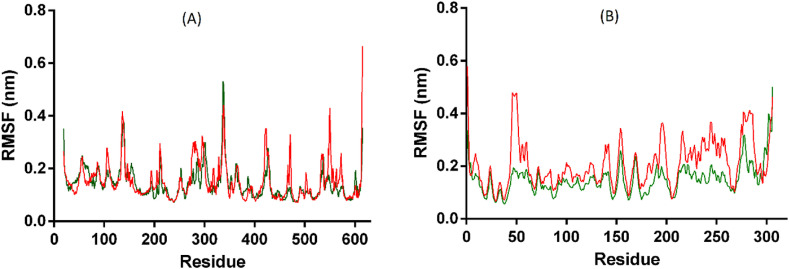
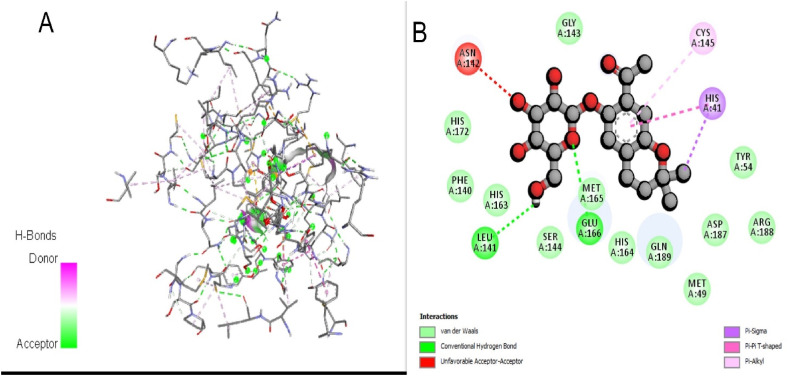
The outbreak of COVID-19 created unprecedented strain in the healthcare system. Various research revealed that COVID-19 main protease (M) and human angiotensin-converting enzyme 2 (ACE2) are responsible for viral replication and entry into the human body, respectively. Blocking the activity of these enzymes gives a potential therapeutic target for the COVID-19. The objective of the study was to explore phytochemicals from against SARS-CoV-2 through studies. In this study, 34 phytochemicals of were docked with M and ACE2 through AutoDock Tools-1.5.6 and their binding affinity was studied. Phytochemicals with higher affinity have been chosen for further molecular dynamics simulations to determine the stability with target protein. Molecular dynamics simulations were studied on GROMACS 5.1.4 version. Furthermore, 5-β-glucosyl-7-demethoxy-encecalin (5GDE) and 2-oxocadinan-3,6(11)-dien-12,7-olide (BODO) were found to be potential blockers with excellent binding affinity with Mpro and ACE2 than their native inhibitors remdesivir and hydroxychloroquine respectively. The drug likeness study and pharmacokinetics of the phytoconstituents present in A. adenophora provide an excellent support for the lead drug discovery against COVID-19.
新型冠状病毒肺炎(COVID-19)疫情给医疗系统带来了前所未有的压力。多项研究表明,COVID-19主要蛋白酶(M)和人血管紧张素转换酶2(ACE2)分别负责病毒复制和进入人体。阻断这些酶的活性为COVID-19提供了一个潜在的治疗靶点。本研究的目的是通过对接研究探索紫茎泽兰中的植物化学物质对严重急性呼吸综合征冠状病毒2(SARS-CoV-2)的作用。在本研究中,通过AutoDock Tools-1.5.6将紫茎泽兰的34种植物化学物质与M和ACE2进行对接,并研究它们的结合亲和力。选择具有较高亲和力的植物化学物质进行进一步的分子动力学模拟,以确定与靶蛋白的稳定性。在GROMACS 5.1.4版本上进行分子动力学模拟。此外,发现5-β-葡萄糖基-7-去甲氧基恩卡林(5GDE)和2-氧代卡迪南-3,6(11)-二烯-12,7-内酯(BODO)是潜在的阻滞剂,它们与M蛋白酶和ACE2的结合亲和力分别优于其天然抑制剂瑞德西韦和羟氯喹。对紫茎泽兰中植物成分的类药性研究和药代动力学为发现抗COVID-19的先导药物提供了有力支持。