National Institute of Occupational Safety and Health, 6-21-1, Nagao, Tama-ku, Kawasaki, 214-8585, Japan.
Ohara Memorial Institute for Science of Labour, Tokyo, Japan.
Int Arch Occup Environ Health. 2021 Jul;94(5):991-1001. doi: 10.1007/s00420-021-01655-5. Epub 2021 Feb 1.
We aimed to cross-sectionally investigate how work and sleep conditions could be associated with excessive fatigue symptoms as an early sign of Karoshi (overwork-related cerebrovascular and cardiovascular diseases; CCVDs).
We distributed a questionnaire regarding work, sleep, and excessive fatigue symptoms to 5410 truck drivers, as the riskiest occupation for overwork-related CCVDs, and collected 1992 total samples (response rate: 36.8%). The research team collected 1564 investigation reports required for compensation for Karoshi. Of them, 190 reports listed the prodromes of Karoshi, which were used to develop the new excessive fatigue symptoms inventory.
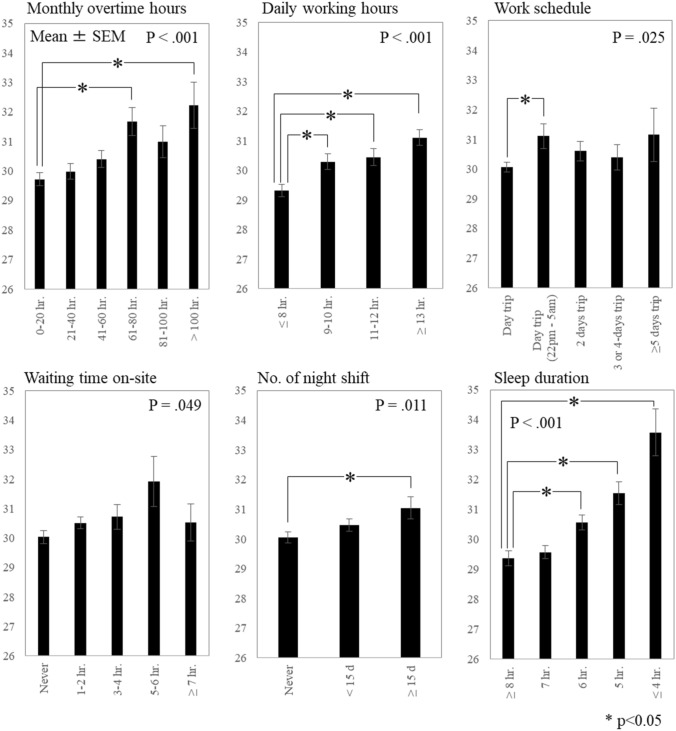
One-way analyses of variance showed that the excessive fatigue symptoms differed significantly by monthly overtime hours (p < 0.001), daily working time (p < 0.001), work schedule (p = 0.025), waiting time on-site (p = 0.049), number of night shifts (p = 0.011), and sleep duration on workdays (p < 0.001). Multivariate mixed-model regression analyses revealed shorter sleep duration as the most effective parameter for predicting excessive fatigue symptoms. Multiple logistic regression analysis confirmed that the occurrences of CCVDs were significantly higher in the middle [adjusted ORs = 3.56 (1.28-9.94)] and high-score groups [3.55 (1.24-10.21)] than in the low-score group.
The findings suggested that shorter sleep duration was associated more closely with a marked increase in fatigue, as compared with the other work and sleep factors. Hence, ensuring sleep opportunities could be targeted for reducing the potential risks of Karoshi among truck drivers.
本研究旨在调查工作和睡眠条件如何与过度疲劳症状相关,过度疲劳症状是过劳相关脑血管和心血管疾病(CCVDs)的早期迹象。
我们向 5410 名卡车司机发放了一份关于工作、睡眠和过度疲劳症状的问卷,因为卡车司机是与过劳相关 CCVD 风险最高的职业,并收集了 1992 份总样本(应答率:36.8%)。研究小组收集了 1564 份与过劳相关 CCVD 补偿相关的调查报告。其中,190 份报告列出了过劳相关 CCVD 的前驱症状,这些报告被用来开发新的过度疲劳症状清单。
单因素方差分析显示,过度疲劳症状在月加班时间(p<0.001)、每日工作时间(p<0.001)、工作时间表(p=0.025)、现场等待时间(p=0.049)、夜班次数(p=0.011)和工作日睡眠时间(p<0.001)方面存在显著差异。多变量混合模型回归分析显示,睡眠时间较短是预测过度疲劳症状的最有效参数。多变量逻辑回归分析证实,CCVD 的发生在中值[调整后的 ORs=3.56(1.28-9.94)]和高分[3.55(1.24-10.21)]组中明显高于低分组。
研究结果表明,与其他工作和睡眠因素相比,较短的睡眠时间与疲劳明显增加更密切相关。因此,确保睡眠机会可能是减少卡车司机过劳相关潜在风险的目标。