Department of Surgery and Cancer, Imperial College London, London, United Kingdom.
Department of Biotechnology and Applied Clinical Sciences, University of L'Aquila, L'Aquila, Italy.
Thorac Cancer. 2021 Mar;12(6):880-889. doi: 10.1111/1759-7714.13852. Epub 2021 Feb 1.
Improved outcome in tobacco smoking patients with non-small cell lung cancer (NSCLC) following immunotherapy has previously been reported. However, little is known regarding this association during first-line immunotherapy in patients with high PD-L1 expression. In this study we compared clinical outcomes according to the smoking status of two large multicenter cohorts.
We compared clinical outcomes according to the smoking status (never smokers vs. current/former smokers) of two retrospective multicenter cohorts of metastatic NSCLC patients, treated with first-line pembrolizumab and platinum-based chemotherapy.
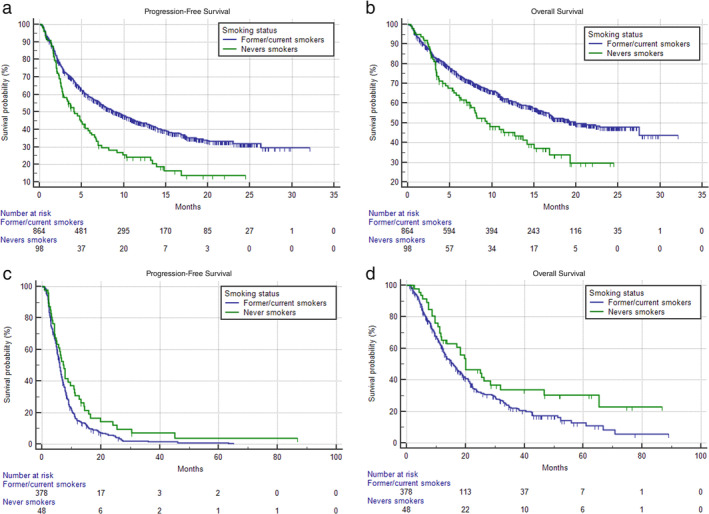
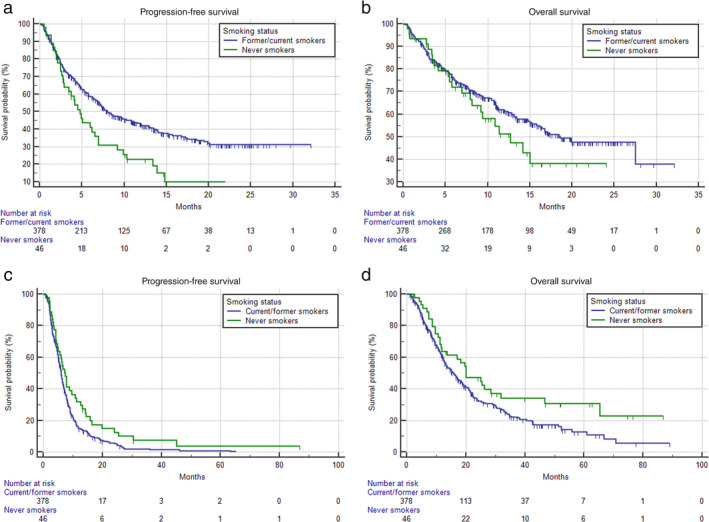
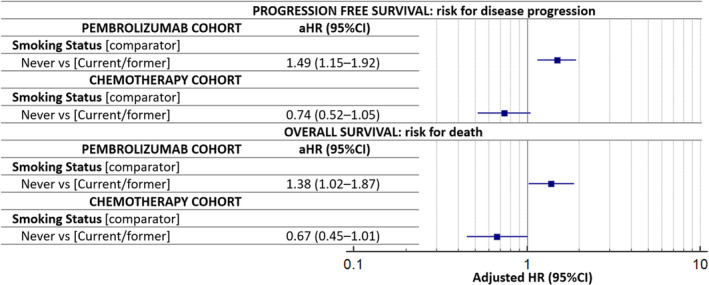
A total of 962 NSCLC patients with PD-L1 expression ≥50% who received first-line pembrolizumab and 462 NSCLC patients who received first-line platinum-based chemotherapy were included in the study. Never smokers were confirmed to have a significantly higher risk of disease progression (hazard ratio [HR] = 1.49 [95% CI: 1.15-1.92], p = 0.0022) and death (HR = 1.38 [95% CI: 1.02-1.87], p = 0.0348) within the pembrolizumab cohort. On the contrary, a nonsignificant trend towards a reduced risk of disease progression (HR = 0.74 [95% CI: 0.52-1.05], p = 0.1003) and death (HR = 0.67 [95% CI: 0.45-1.01], p = 0.0593) were reported for never smokers within the chemotherapy cohort. After a random case-control matching, 424 patients from both cohorts were paired. Within the matched pembrolizumab cohort, never smokers had a significantly shorter progression-free survival (PFS) (HR = 1.68 [95% CI: 1.17-2.40], p = 0.0045) and a nonsignificant trend towards a shortened overall survival (OS) (HR = 1.32 [95% CI: 0.84-2.07], p = 0.2205). On the contrary, never smokers had a significantly longer PFS (HR = 0.68 [95% CI: 0.49-0.95], p = 0.0255) and OS (HR = 0.66 [95% CI: 0.45-0.97], p = 0,0356) compared to current/former smoker patients within the matched chemotherapy cohort. On pooled multivariable analysis, the interaction term between smoking status and treatment modality was concordantly statistically significant with respect to ORR (p = 0.0074), PFS (p = 0.0001) and OS (p = 0.0020), confirming the significantly different impact of smoking status across the two cohorts.
Among metastatic NSCLC patients with PD-L1 expression ≥50% receiving first-line pembrolizumab, current/former smokers experienced improved PFS and OS. On the contrary, worse outcomes were reported among current/former smokers receiving first-line chemotherapy.
先前已有报道称,免疫疗法可改善非小细胞肺癌(NSCLC)患者的吸烟状况。然而,对于 PD-L1 高表达患者的一线免疫治疗中这种关联,我们知之甚少。在本研究中,我们比较了两个大型多中心队列中患者的吸烟状况。
我们比较了两个转移性 NSCLC 患者的多中心回顾性队列的吸烟状况(从不吸烟者与当前/前吸烟者),这些患者接受了一线 pembrolizumab 和铂类化疗治疗。
共有 962 名 PD-L1 表达≥50%的 NSCLC 患者接受了一线 pembrolizumab 治疗,462 名 NSCLC 患者接受了一线铂类化疗。从不吸烟者被证实疾病进展的风险显著增加(危险比 [HR] = 1.49 [95%CI:1.15-1.92],p = 0.0022),死亡风险也显著增加(HR = 1.38 [95%CI:1.02-1.87],p = 0.0348)。相反,在化疗组中,从不吸烟者疾病进展的风险(HR = 0.74 [95%CI:0.52-1.05],p = 0.1003)和死亡风险(HR = 0.67 [95%CI:0.45-1.01],p = 0.0593)呈降低趋势,但无统计学意义。经随机病例对照匹配后,两个队列各有 424 例患者配对。在匹配的 pembrolizumab 队列中,从不吸烟者的无进展生存期(PFS)明显缩短(HR = 1.68 [95%CI:1.17-2.40],p = 0.0045),总生存期(OS)也呈缩短趋势(HR = 1.32 [95%CI:0.84-2.07],p = 0.2205)。相反,从不吸烟者的 PFS(HR = 0.68 [95%CI:0.49-0.95],p = 0.0255)和 OS(HR = 0.66 [95%CI:0.45-0.97],p = 0.0356)明显长于当前/前吸烟者。在多变量分析中,吸烟状况和治疗方式之间的交互项在 ORR(p = 0.0074)、PFS(p = 0.0001)和 OS(p = 0.0020)方面均具有统计学意义,证实了两组之间吸烟状况的显著不同影响。
在 PD-L1 表达≥50%的接受一线 pembrolizumab 治疗的转移性 NSCLC 患者中,当前/前吸烟者的 PFS 和 OS 得到改善。相反,当前/前吸烟者接受一线化疗的预后较差。