Department of Epidemiology, School of Public Health and Tropical Medicine, Tulane University, 1440 Canal Street, Suite 1724, New Orleans, LA 70112, USA.
Department of Epidemiology and Biostatistics, School of Public Health, Peking University, 38 Xueyuan Road, Haidian District, Beijing 100191, China.
Eur Heart J. 2021 Apr 21;42(16):1582-1591. doi: 10.1093/eurheartj/ehaa1031.
Little is known about the relation between the long-term joint exposure to various ambient air pollutants and the incidence of heart failure (HF). We aimed to assess the joint association of various air pollutants with HF risk and examine the modification effect of the genetic susceptibility.
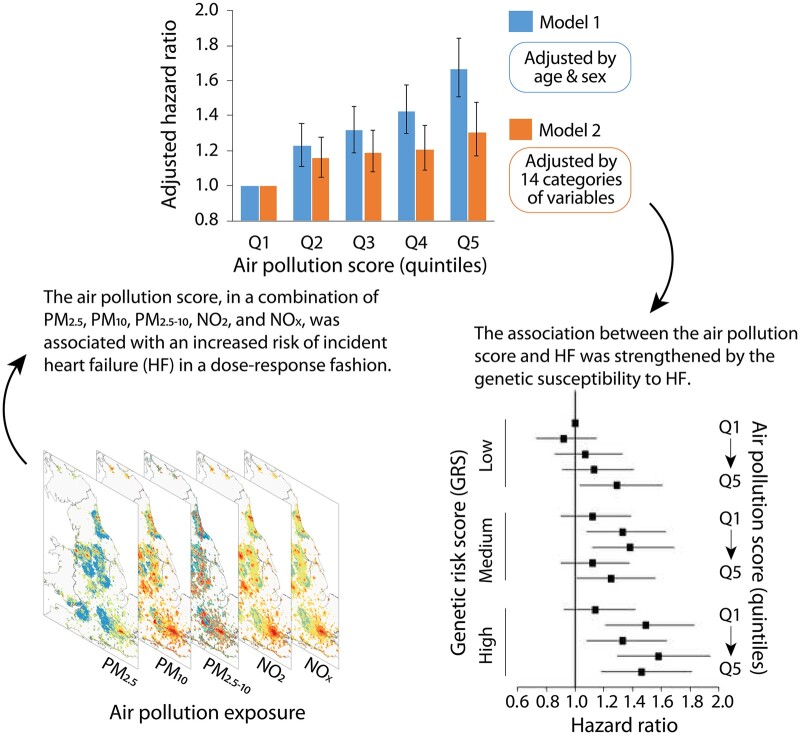
This study included 432 530 participants free of HF, atrial fibrillation, or coronary heart disease in the UK Biobank study. All participants were enrolled from 2006 to 2010 and followed up to 2018. The information on particulate matter (PM) with diameters ≤2.5 µm (PM2.5), ≤10 µm (PM10), and between 2.5 and 10 µm (PM2.5-10) as well as nitrogen oxides (NO2 and NOx) was collected. We newly proposed an air pollution score to assess the joint exposure to the five air pollutants through summing each pollutant concentration weighted by the regression coefficients with HF from single-pollutant models. We also calculated the weighted genetic risk score of HF. During a median of 10.1 years (4 346 642 person-years) of follow-up, we documented 4201 incident HF. The hazard ratios (HRs) [95% confidence interval (CI)] of HF for a 10 µg/m3 increase in PM2.5, PM10, PM2.5-10, NO2, and NOx were 1.85 (1.34-2.55), 1.61 (1.30-2.00), 1.13 (0.80-1.59), 1.10 (1.04-1.15), and 1.04 (1.02-1.06), respectively. We found that the air pollution score was associated with an increased risk of incident HF in a dose-response fashion. The HRs (95% CI) of HF were 1.16 (1.05-1.28), 1.19 (1.08-1.32), 1.21 (1.09-1.35), and 1.31 (1.17-1.48) in higher quintile groups compared with the lowest quintile of the air pollution score (P trend <0.001). In addition, we observed that the elevated risk of HF associated with a higher air pollution score was strengthened by the genetic susceptibility to HF.
Our results indicate that the long-term joint exposure to various air pollutants including PM2.5, PM10, PM2.5-10, NO2, and NOx is associated with an elevated risk of incident HF in an additive manner. Our findings highlight the importance to comprehensively assess various air pollutants in relation to the HF risk.
人们对长期接触各种环境空气污染物与心力衰竭(HF)发病率之间的关系知之甚少。我们旨在评估各种空气污染物与 HF 风险的联合关联,并研究遗传易感性的修饰作用。
本研究纳入了英国生物库研究中 432530 名无 HF、心房颤动或冠心病的参与者。所有参与者均于 2006 年至 2010 年入组,并随访至 2018 年。收集了直径≤2.5μm(PM2.5)、≤10μm(PM10)以及 2.5-10μm 之间的颗粒物(PM2.5-10)以及氮氧化物(NO2 和 NOx)的信息。我们通过将单污染物模型中与 HF 相关的每个污染物浓度乘以回归系数,提出了一种新的空气污染评分来评估五种空气污染物的联合暴露情况。我们还计算了 HF 的加权遗传风险评分。在中位 10.1 年(4346642 人年)的随访期间,我们记录了 4201 例 HF 事件。PM2.5、PM10、PM2.5-10、NO2 和 NOx 每增加 10μg/m3,HF 的危险比(HR)[95%置信区间(CI)]分别为 1.85(1.34-2.55)、1.61(1.30-2.00)、1.13(0.80-1.59)、1.10(1.04-1.15)和 1.04(1.02-1.06)。我们发现,空气污染评分与 HF 发病风险呈剂量反应关系。与空气污染评分最低五分位组相比,HF 的 HR(95%CI)分别为 1.16(1.05-1.28)、1.19(1.08-1.32)、1.21(1.09-1.35)和 1.31(1.17-1.48)(P 趋势<0.001)。此外,我们还观察到,与 HF 遗传易感性相关的较高空气污染评分与 HF 相关的较高发病风险呈增强趋势。
我们的研究结果表明,长期接触包括 PM2.5、PM10、PM2.5-10、NO2 和 NOx 在内的各种空气污染物与 HF 事件风险呈相加方式相关。我们的研究结果强调了全面评估各种空气污染物与 HF 风险之间关系的重要性。