China Academy of Chinese Medical Sciences, Beijing, China.
Wuhan Jinyintan Hospital, Wuhan, China.
J Ethnopharmacol. 2021 Sep 15;277:113888. doi: 10.1016/j.jep.2021.113888. Epub 2021 Jan 30.
The coronavirus disease 2019 (COVID-19) has formed a global pandemic since late 2019. Benefitting from the application experience of Chinese Medicine (CM) for influenza and SARS, CM has been used to save patients at the early stage of COVID-19 outbreak in China.
In order to evaluate the efficacy and safety of CM, and compare with Western Medicine (WM) for COVID-19, we conducted a retrospective case series study based on the patients in Wuhan Jinyintan Hospital, Wuhan, China.
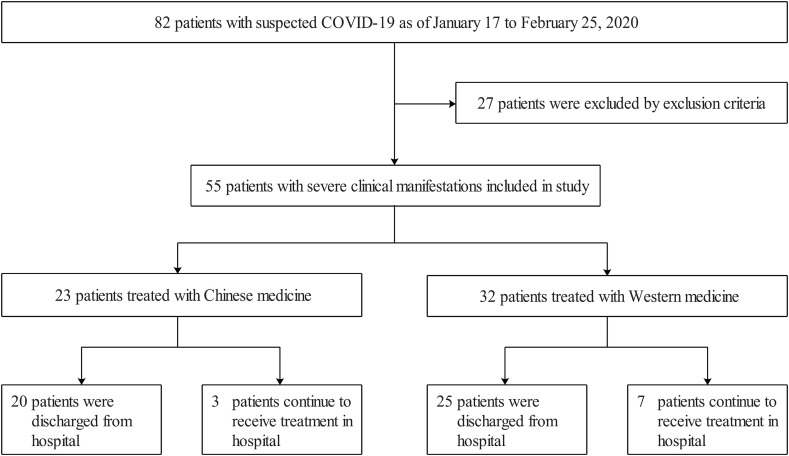
The inclusion and exclusion criteria of data extraction were set for this retrospective study. All patients who were admitted by the Wuhan Jinyintan Hospital between January 17th and February 25th 2020 were considered. In addition, patients enrolled met the severe defined by the guidelines released by the National Health Commission of the People's Republic of China. In these cases included in the study, CM or WM treatment was selected according to the wishes of the patients at the beginning of hospitalization. The patients in CM group were treated with Huashi Baidu granule (137 g po, bid) combined with the injections of Xiyanping (100 mg iv, bid), Xuebijing (100 ml iv, bid) and Shenmai (60 ml iv, qd) according to the syndrome of epidemic toxin blocking the lung in the theory of Traditional Chinese Medicine. The WM group received antiviral therapy (including abidor capsule 0.2 g po, tid; Lopinavir-Ritonavir tablets, 500 mg po, bid), antibiotics (such as cefoperazone 2 g iv, bid; moxifloxacin hydrochloride tablets, 0.4 g po, qd) or corticosteroid therapy (such as methylprednisolone succinate sodium 40 mg iv, qd; prednisone, 30 mg po, qd). In addition, patients in both groups received routine supportive treatment, including oxygen inhalation, symptomatic therapy, and/or human intravenous immunoglobulin, and/or serum albumin, and treatment for underlying diseases. The clinical outcomes were evaluated based on changes related with clinical manifestations, computer tomography (CT) scan images, and laboratory examinations before and after the treatment.
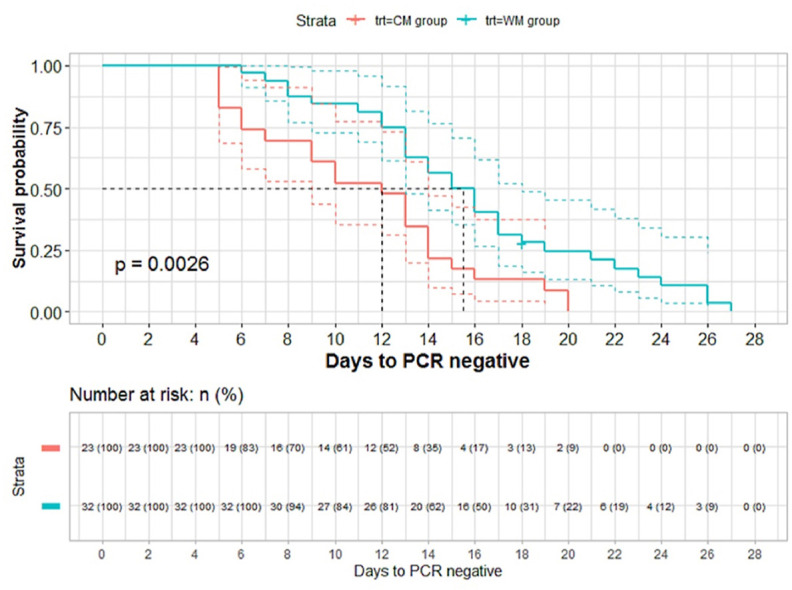
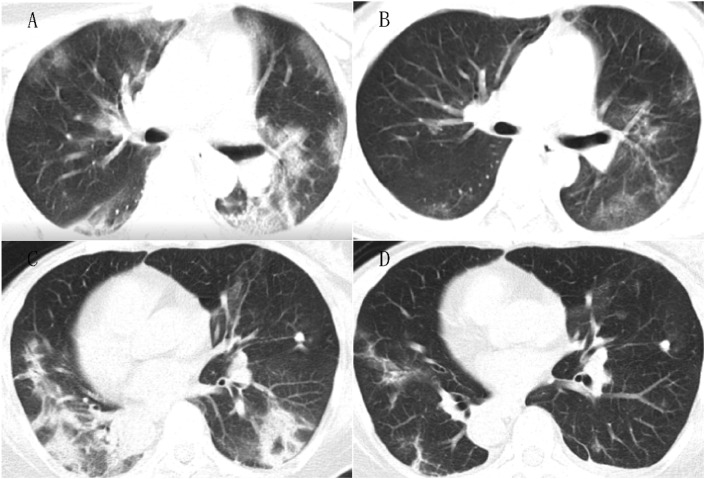
55 severe COVID-19 patients, with 23 in CM group and 32 in WM group, were included for analyzed. There was no case of death, being transferred to ICU, or receiving invasive mechanical ventilation in two groups during hospitalization. The median time of SARS-CoV-2 RNA clearance in CM and WM group were 12 days and 15.5 days respectively, the ratio of nucleic acid negative conversion of CM group at different follow-up time points was significantly higher than that of WM group (HR: 2.281, P = 0.018). Further, the chest CT imaging showed more widely lung lesion opacity absorbed in the CM group. The high sensitivity C-reactive protein and serum ferritin decreased significantly in the CM group (P<0.05). There was no significant difference in adverse events in terms of liver function and renal function between the two groups.
Based on this retrospective analysis from Wuhan Jinyintan Hospital, CM has better effects in SARS-CoV-2 RNA clearance, promoting lung lesion opacity absorbed and reducing inflammation in severe COVID-19 patients, which is effective and safe therapy for treating severe COVID-19 and reducing mortality.
自 2019 年底以来,新型冠状病毒病(COVID-19)已在全球范围内流行。得益于中医药治疗流感和 SARS 的应用经验,中医药在中国 COVID-19 疫情早期就被用于救治患者。
为了评估中医药(CM)在 COVID-19 患者中的疗效和安全性,并与西药(WM)进行比较,我们对中国武汉金银潭医院的患者进行了回顾性病例系列研究。
本回顾性研究设定了数据提取的纳入和排除标准。所有在 2020 年 1 月 17 日至 2 月 25 日期间入住武汉金银潭医院的患者均被认为符合条件。此外,纳入的患者符合中国国家卫生健康委员会发布的指南中规定的严重标准。在这项研究中包括的病例中,根据患者入院时的意愿选择 CM 或 WM 治疗。CM 组患者根据中医疫病毒闭肺证型接受化湿败毒颗粒(137g 口服,每日 2 次)联合喜炎平(100mg 静脉滴注,每日 2 次)、血必净(100ml 静脉滴注,每日 2 次)和参麦(60ml 静脉滴注,每日 1 次)治疗。WM 组接受抗病毒治疗(包括阿比多尔胶囊 0.2g 口服,每日 3 次;洛匹那韦/利托那韦片,500mg 口服,每日 2 次)、抗生素(如头孢哌酮 2g 静脉滴注,每日 2 次;莫西沙星片,0.4g 口服,每日 1 次)或皮质类固醇治疗(如甲泼尼龙琥珀酸钠 40mg 静脉滴注,每日 1 次;泼尼松,30mg 口服,每日 1 次)。此外,两组患者均接受常规支持治疗,包括吸氧、对症治疗和/或静脉用人免疫球蛋白、血清白蛋白和治疗基础疾病。根据治疗前后临床表现、计算机断层扫描(CT)图像和实验室检查的变化评估临床结果。
55 例重症 COVID-19 患者,CM 组 23 例,WM 组 32 例,纳入分析。两组患者在住院期间均无死亡、转 ICU 或接受有创机械通气。CM 组和 WM 组 SARS-CoV-2 RNA 清除中位数时间分别为 12 天和 15.5 天,CM 组不同随访时间点核酸转阴率明显高于 WM 组(HR:2.281,P=0.018)。进一步的胸部 CT 影像学显示 CM 组更广泛的肺部病变透明度吸收。CM 组高敏 C 反应蛋白和血清铁蛋白显著降低(P<0.05)。两组患者在肝功能和肾功能方面的不良反应无显著差异。
基于武汉金银潭医院的回顾性分析,CM 可更有效地清除 SARS-CoV-2 RNA,促进重症 COVID-19 患者肺部病变透明度吸收和减轻炎症,是治疗重症 COVID-19 并降低死亡率的有效安全治疗方法。